Background:
Kaposi sarcoma (KS), an HIV-associated malignancy, is caused by Kaposi sarcoma herpesvirus (KSHV). KS commonly affects the skin but can also lead to symptomatic visceral manifestations in the pulmonary and gastrointestinal (GI) tracts; it requires invasive procedures such as bronchoscopy or endoscopy for diagnosis. We assessed the outcomes of patients (pts) with visceral KS and evaluated the saliva KSHV viral load (VL) as a diagnostic marker.
Methods:
We conducted a retrospective study of pts with a history of KS from the HIV and AIDS Malignancy Branch who underwent bronchoscopy and/or endoscopy/colonoscopy for symptoms concerning pulmonary and GI KS between 2005-2023. Diagnosis of pulmonary KS was based on imaging and visualization of large airway lesions consistent with KS on bronchoscopy. GI KS was confirmed with a biopsy following diagnostic procedures. KSHV VL DNA was quantified in saliva and peripheral blood using primers for the KSHV K6 gene, while cell number was calculated using human endogenous retrovirus 3 primers. Receiver operator curves were created to observe sensitivity and specificity of KSHV saliva VL to diagnose visceral KS among pts with visceral KS symptoms. Overall Survival (OS) was estimated using Kaplan-Meier analysis from date of KS diagnosis to death or last follow-up.
Results:
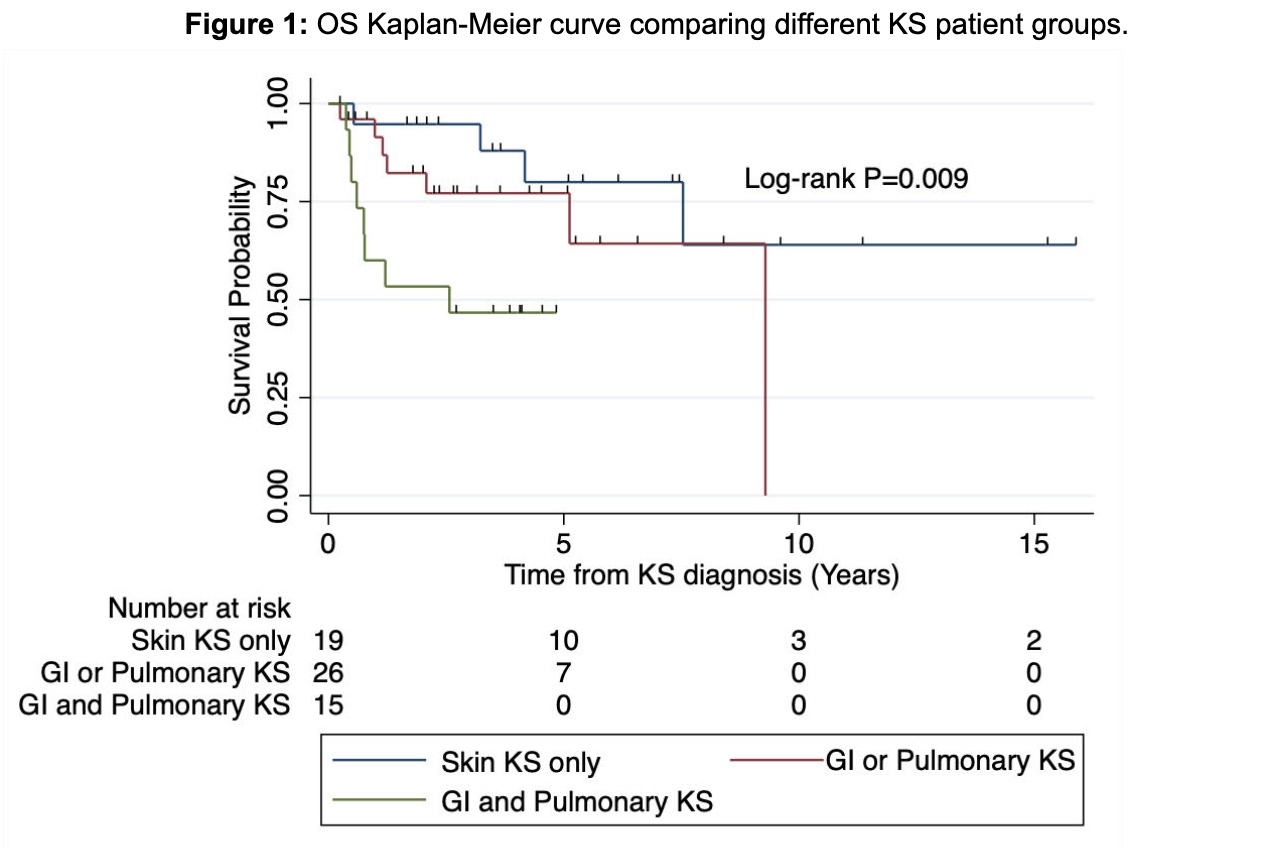
Sixty pts (57 with HIV diagnosis, 77% on antiretroviral therapy, median (med) HIV VL of 87 copies/mL and CD4 T cell count of 125 cells/µL) underwent procedures to identify visceral KS. Twenty-six had either pulmonary or GI KS (pulmonary= 8, GI= 18), 15 had both GI and pulmonary KS, and 19 had skin KS without visceral KS. Of those with any visceral KS, 51.2% had other concurrent KSHV-associated disorders. The med KSHV VL in the saliva among those with visceral KS was 1 (IQR: 1, 67566) copy/10^6 cells and was 767 (IQR: 629, 8455) copies/10^6 cells in the peripheral blood. A saliva KSHV VL level of > 190 copies/10^6 cells had a sensitivity of 46%, specificity of 76%, and a positive likelihood ratio of 2 for predicting the presence of visceral disease among symptomatic pts. Median OS in pts with skin KS only was not reached, was 9.2 years in pts with GI or pulmonary KS, and 2.6 years in pts with both GI and pulmonary KS (P=0.009, Figure 1).
Conclusions:
Despite well controlled HIV among pts with KS, the presence of visceral KS impacts overall survival. Saliva KSHV VL may be a useful tool to aid in diagnosis of visceral KS in limited-resource settings.