Background:
Emergency departments (EDs) serve as important clinical settings for hepatitis C (HCV) screening and care, yet optimal methods of linkage-to-care for HCV-diagnosed individuals remain unknown. The goal of this study was to test the effectiveness of linkage navigation (LN) and clinician referral (CR) among ED patients identified with untreated HCV with a primary hypothesis that LN plus CR is superior to CR alone.
Methods:
We performed a prospective two-arm parallel-group comparative effectiveness randomized trial at Denver Health Medical Center among ED patients with untreated HCV. Participants were randomized in a concealed fashion to CR alone or CR plus LN. All participants provided informed consent. Individuals in the CR arm were educated about HCV by their primary ED clinician and given information on how to access HCV care verbally and in discharge instructions. Individuals in the LN arm met with a linkage navigator in the ED or by phone after the visit. The LN reiterated basic HCV education and helped schedule and facilitate HCV treatment appointments. Pre-specified outcomes, collected in a blinded manner, were initiation of HCV treatment (primary), appointment with an HCV clinician, completion of treatment, and sustained virologic response 12 weeks after treatment (secondary) at 6 months post-enrollment. Analyses were performed using intention-to-treat with differences, precision estimates, and bivariate hypothesis testing.
Results:
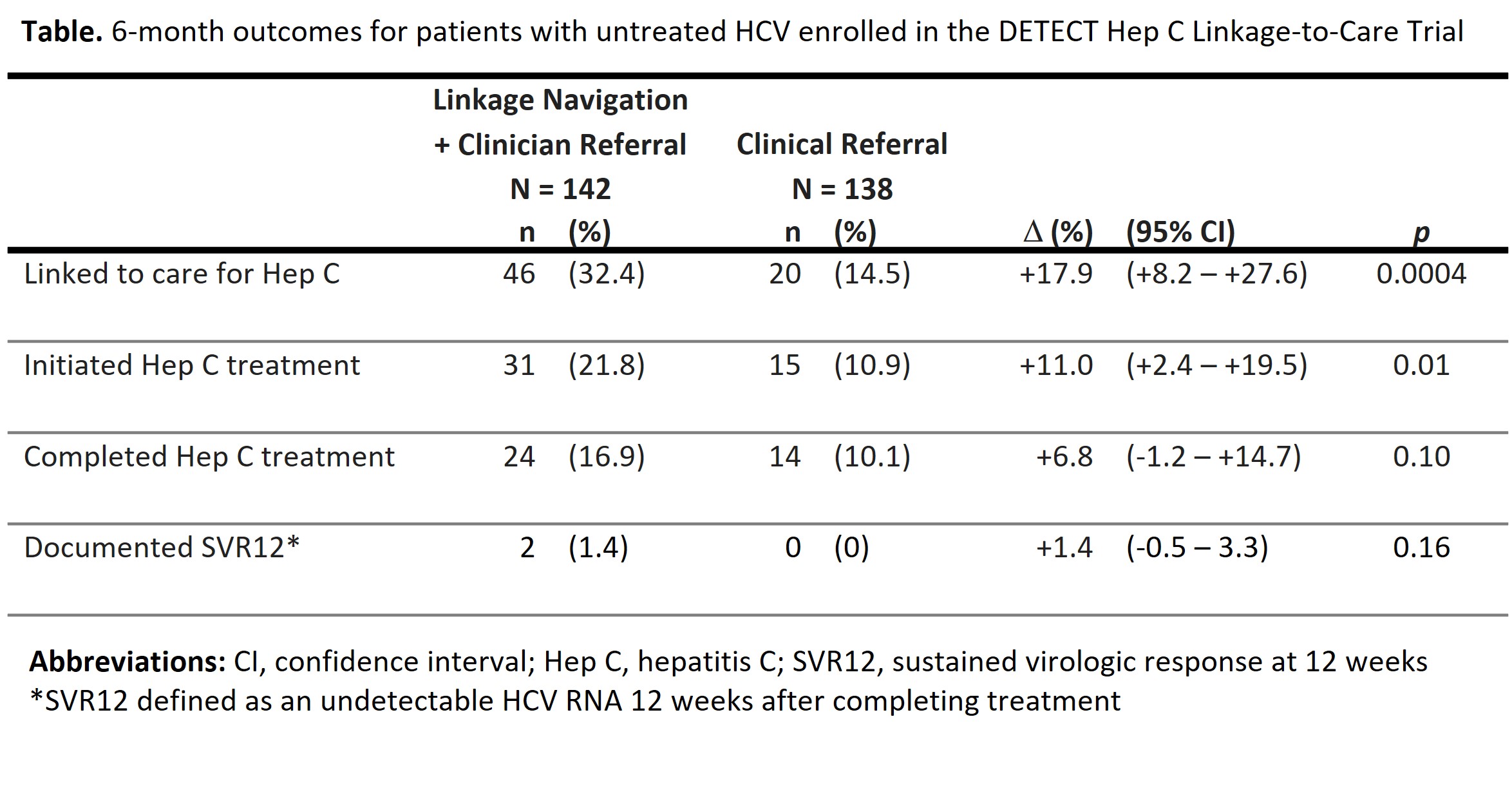
From November 2019 through January 2023, 280 individuals were randomized with excellent balance in baseline characteristics, including individuals <40 years of age or with recent injection drug use (IDU). Individuals in the LN arm were significantly more likely to link to care (Δ = 18%, p=0.0004) and initiate treatment (Δ = 11%, p=0.01). More individuals in the LN arm completed treatment though this was not statistically significant (Δ = 7%, p=0.09) (Table). Among participants <40 years or with recent IDU, treatment initiation did not differ between arms (p=0.75).
Conclusions:
Among ED patients with untreated HCV, early follow-up suggests that LN in addition to CR is superior to CR-alone for initiating HCV treatment, but additional follow-up is needed to better understand the effect of a linkage navigator on the downstream elements of the HCV continuum, including treatment completion and cure, and cost effectiveness of employing a navigator. Even with a navigator, linkage rates were low suggesting new approaches to HCV treatment initiation are needed.