Background:
Characterizing the burden and understanding the vulnerabilities and risks for active hepatitis C virus (HCV) infection in the direct-acting antiviral (DAA) era among PWH will provide key information on current progress and guide efforts toward HCV micro-elimination. We evaluated the prevalence of HCV viremia among PWH in clinical care in the US during the DAA era and examined risk factors for HCV viremia from 2018-22.
Methods:
Using a serial cross-sectional design, we examined all adult PWH in clinical care at 9 sites in the CFAR Network of Integrated Clinical Systems (CNICS) cohort with ≥1 encounter in 2011-13 (pre-interferon free DAA era, number of participants=22445), 2014-17 (early DAA era, N=25161), or 2018-22 (current DAA era, N=25314). We defined HCV viremia as a positive HCV RNA or genotype. Prevalence of HCV viremia was determined for each time period, using the most recent available lab results, and by demographic group (age, gender, race/ethnicity). We administered validated survey instruments to measure current substance use (AUDIT-C, alcohol; ASSIST, other drugs) and depressive symptom severity (PHQ-9). FIB-4 score was calculated using the age and closest lab values on or before a participant’s HCV lab test. We used adjusted relative risk regression (Poisson) to evaluate risk factors for HCV viremia in 2018-22.
Results:
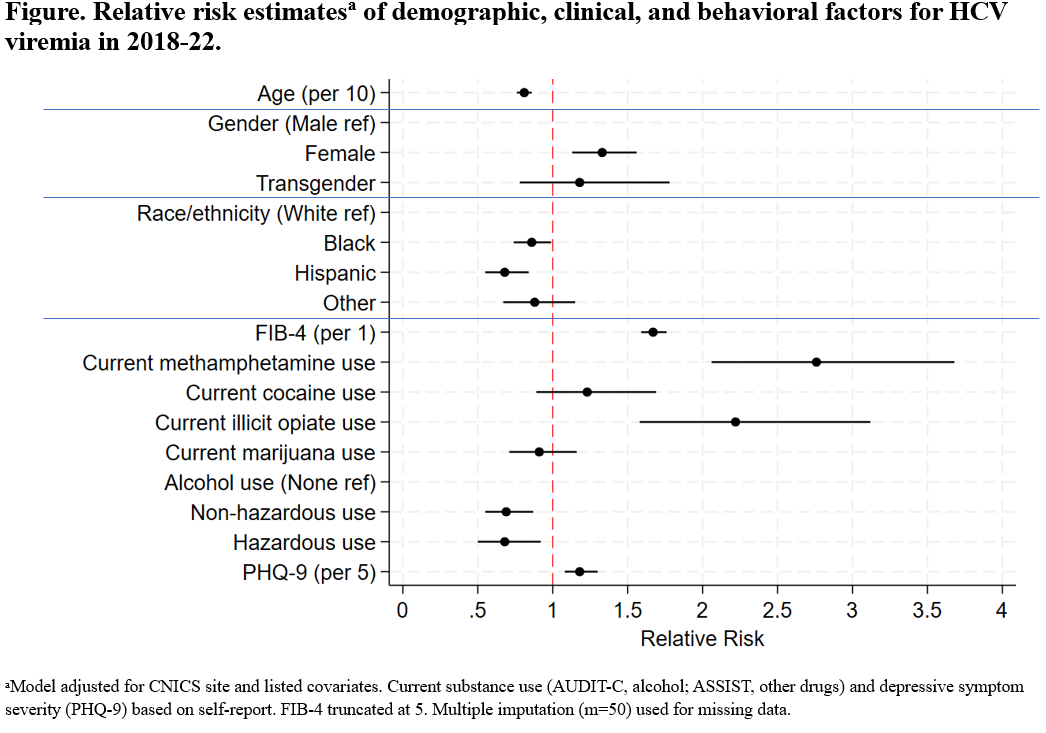
Among PWH in care, the overall prevalence of HCV viremia was 8.7% in 2011-13, 10.5% in 2014-17, and 4.8% in 2018-22. Disparities in the prevalence of HCV viremia across groups defined by age, gender, and race/ethnicity were smaller in 2018-22 than earlier time periods (overall range across all 3 demographic groups by time period: 3.0-13.0% [2011-13]; 3.5-14.4% [2014-17]; 3.2-5.6% [2018-22]). In adjusted relative risk regression, identifying as female (RR 1.33, 95% CI 1.13-1.56), FIB-4 (RR 1.67 per unit, 95% CI 1.59-1.76), depressive symptom severity (RR 1.18 per 5 units on PHQ-9, 95% CI 1.08-1.30), and current use of methamphetamine (RR 2.76, 95% CI 2.06-3.68) or illicit opioids (RR 2.22, 95% CI 1.58-3.12) (P<0.001 for each factor) were associated with higher likelihood of HCV viremia in 2018-22.
Conclusions:
The prevalence of HCV viremia during the DAA era in this US-based national cohort of PWH improved over time and across demographic subgroups but remains elevated. Our findings underscore the importance of prioritizing substance use and mental health treatment in PWH to achieve HCV elimination goals.