Background:
Reverse transcription and integration are key steps of the Human Immunodeficiency Virus type 1 (HIV-1) replication, performed respectively by the viral enzyme’s reverse transcriptase (RT) and integrase (IN). Interactions between these two enzymes are critical: IN improves both reverse transcription early steps and processivity, while the RT enhances the integrase strand transfer activity. The use of integrase strand transfer inhibitors (INSTIs) has led to emergence of resistant viral mutants, occurring mostly in the integrase gene. Most of them exhibit an impaired integration compared to wild-type (WT) viruses. However, their impacts on reverse transcription efficiency remain unclear. Our objective was to determine the impact of three of the main INSTI-associated resistance mutation profiles, R263K, N155H and G140S/Q148H on reverse transcription and kinetics of integration.
Methods:
We performed in-vitro infections with wild-type and INSTI resistant viruses: R263K, N155H and G140S/Q148H, produced by site-directed mutagenesis. Early and late reverse transcription products were measured by quantitative digital-droplet PCR. Kinetics of integration were analyzed using quantitative PCR on integrated forms of HIV DNA at 24- and 72-hours post infection.
Results:
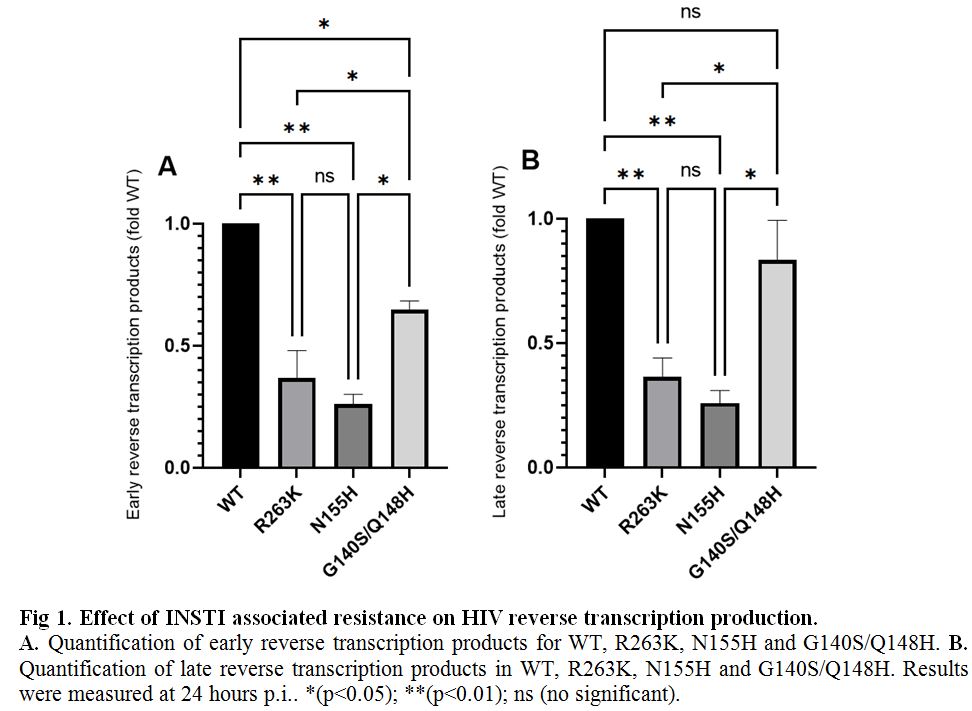
R263K mutation had a major effect on reverse transcription (Figure 1A and B) and a weaker impact on integration. N155H mutation strongly affected reverse transcription (Figure 1A and B) and integration. The G140S/Q148H double mutant profile was associated with a weak impact on reverse transcription (Figure 1A and B) and a more important impact on integration compared to WT.
Conclusions:
INSTI resistance mutations alter integration efficiency but also the reverse transcription step. This phenomenon is in accordance with the close interaction between these two enzymes during HIV-1 replication. These observations might contribute to explain the loss of fitness observed in INSTI resistant mutants during virological failure.