Background:
South Africa introduced tenofovir/lamivudine/dolutegravir (TLD) as the preferred first-line antiretroviral therapy (ART) regimen in 2019. Few data are available from individuals who transitioned from efavirenz (EFV)-based ART to TLD in rural public sector clinics in South Africa. Our objective was to evaluate viral suppression and regimen tolerability for individuals who were transitioned to TLD in this setting.
Methods:
We conducted a prospective cohort study in rural KwaZulu-Natal. We enrolled adults ages >18 years who were transitioned from EFV-based ART to TLD by the clinic. Participants were enrolled on the date of TLD transition with follow-up visits 24 and 48 weeks later. We obtained blood specimens at each visit for retrospective viral load (VL) testing. Our primary outcome was viral suppression <50 copies/mL with retention in care at 48-weeks post-TLD transition. We fitted a multivariable logistic regression model to assess predictors of the composite outcome of viral suppression with retention in care.
Results:
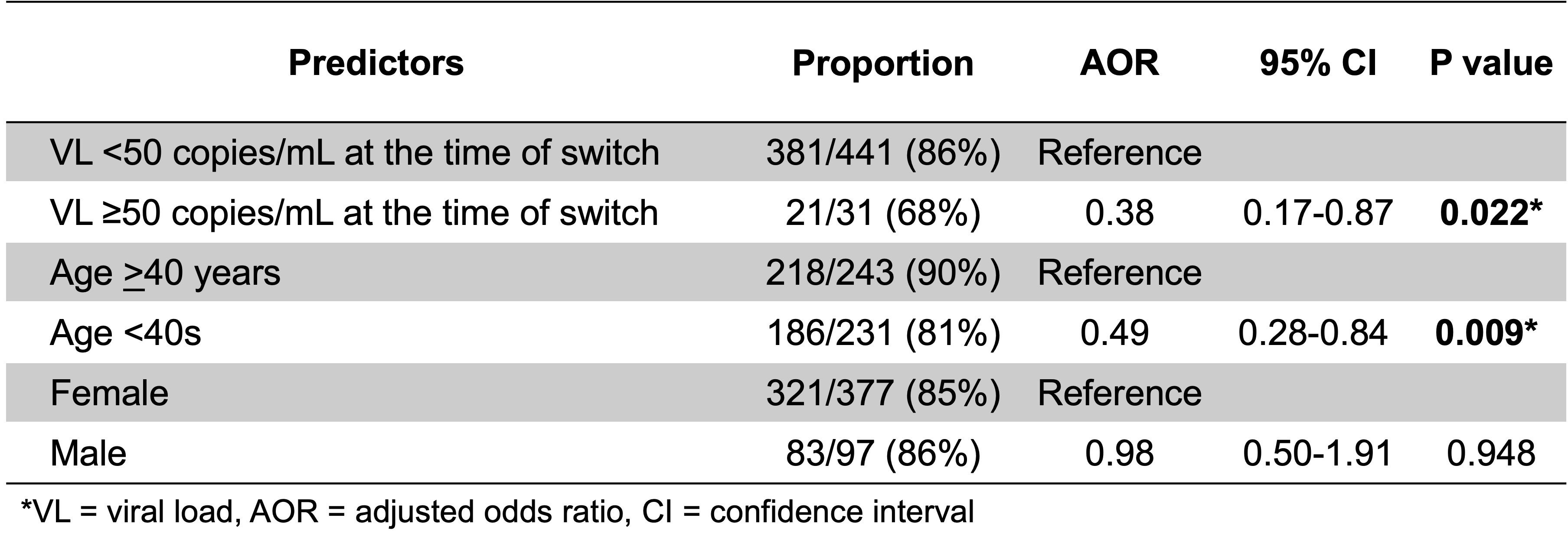
We enrolled 499 participants with a median age of 39 years (IQR 32–50 years), and 80% were female. The median duration of ART prior to TLD transition was 6 years (IQR 4-9 years). At the time of TLD transition, 93% had VL <50 copies/mL, 3% had VL between 50 and 1,000 copies/mL, and 3% had VL >1,000 copies/mL. By 48 weeks, 81% were suppressed and in care, 5% were unsuppressed and in care, 9% were lost from care, 0.5% were deceased, 2% were retained in care with missing VL data, and 3% had disenrolled. Only 3 participants discontinued TLD. In a multivariable logistic regression model, those with age <40 years and detectable viremia at the time of TLD transition were less likely to be virally suppressed and in care at 48 weeks (Table). Furthermore, only two-thirds of those with detectable viremia at the time of transition to TLD were virally suppressed after 48 weeks.
Conclusions:
In the South African public sector, TLD was well tolerated with a <1% discontinuation rate. However, using an observational cohort approach with intensive outcome monitoring, only 81% of participants were virally suppressed and in care at 48 weeks. Over half of those who did not achieve the primary endpoint were lost from care or deceased. While high rates of viral suppression among those in care support widespread programmatic transition to TLD, further efforts are needed to optimize adherence and retention in care to attain programmatic goals of >95% viral suppression among those on ART.