Background:
HIV-specific CTL responses remain present even under long term ART, in association with residual HIV expression. Selection of CTL-resistant reservoir-harboring clones may contribute to HIV persistence, with BCL-2 overexpression being a previously reported mechanism. To identify additional mechanisms of resistance, we developed an in vitro model that compares infected cells surviving CTL pressure to non-targeted infected bystander cells in the same environment. Here, we highlight a specific metabolic profile enriched in CTL-resistant infected cells.
Methods:
CD4+ T-cells were infected with HIVJRSCF (WT) or a variant containing an escape mutation in the Gag-TW10 epitope (TW10esc). Killing assays were performed by labeling infected T-cells with CTFR (WT) or CFSE (TW10esc) dyes, then culturing these together with a TW10-specific CTL clone. Surviving WT-infected and bystander TW10esc-infected cells were sorted based on HIV-Env expression and profiled by RNAseq, CITEseq and flow cytometry. Killing assays were also performed with pre-treatment of infected cells with the FDA approved antimalarial Atovaquone (ATQ) and iron chelator Deferoxamine (DFO).
Results:
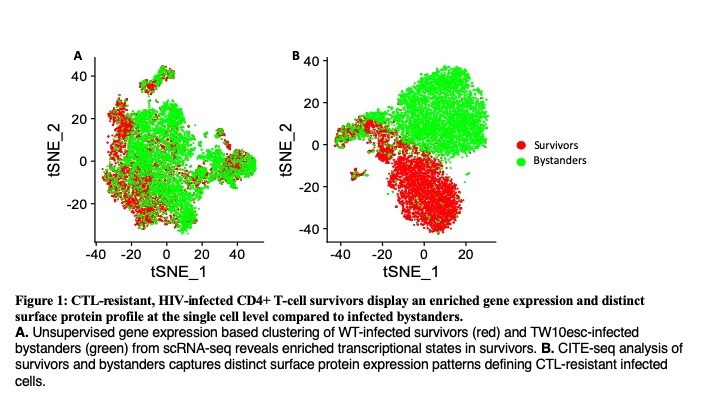
WT-infected survivors exhibited distinctive transcriptional and protein expression profiles, relative to bystanders (Figure 1). GSEA analysis of RNAseq data revealed that among several dysregulated pathways, WT-survivors were negatively enriched for Hallmark Glycolysis (n=4, NES = -1.74, Padj = 2.96e-05) and byproducts of active metabolism such as Hallmark Hypoxia (NES = -1.79, Padj = 1e-05). Flow cytometry on WT-survivors showed enrichment of cells expressing lower levels of cellular reactive oxygen species (ROS) (n=4, mean = -24.41% +/- 13.62, P=0.037). Pre-treatment of infected cells with ATQ, to increase ROS accumulation, and DFO, to induce hypoxia, modestly and robustly enhanced susceptibilities of infected cells to elimination by CTL respectively (ATQ: n=5, P = 0.09 ; DFO: n=4, P = 0.015; ATQ+DFO: n=4, P = 0.051).
Conclusions:
Oxidative disbalance contributes to CTL mediated killing. Our results suggest that lower levels of ROS and hypoxic responses in HIV-infected cells with particular metabolic features renders these cells less susceptible to killing by CTL. Treatment with FDA-approved and well-tolerated ROS inducer ATQ and hypoxia-inducing iron-chelator DFO increased CTL mediated elimination of infected cells in vitro. Targeting metabolic balance may be a strategy to enhance elimination of persistent HIV-infected cells.