Background:
In prior investigations, we uncovered the impact of Mycobacterium tuberculosis (MTB) infection on the innate immune system in people with HIV (PWH). We showed an improved ability to control HIV and less susceptibility to opportunistic infections in untreated PWH. Intriguingly, it also heightened the risk of non-communicable diseases such as diabetes mellitus. Our exploration of the transcriptome in PWH, with and without MTB infection, unveiled gene alterations associated with innate immunity and B cell upregulation. Additionally, another group showed that active TB enhances immune responses. Here we extend these investigations and determine the effects of MTB infection on the anti-HIV-1 antibody (Ab) response.
Methods:
Using data from the Swiss HIV Cohort Study and the Swiss 4.5K neutralization Screen (Rusert, Nat Med, 2016), we assessed immune responses in PWH dependent on MTB status (excluding active TB and preventively treated). We examined two aspects: (i) plasma neutralization against eight HIV strains (activity/breadth score 0 to 24), and (ii) relative plasma Ab (IgG1/2/3) binding (score 0 to 1) to 20 HIV antigens. We determined the impact of MTB status by tobit and linear regression adjusting for ethnicity, age, sex, CD4, HIV viral load, viral diversity, and infection duration. We employed bayesian networks to elucidate interplays between factors, particularly disentangle direct and indirect effects.
Results:
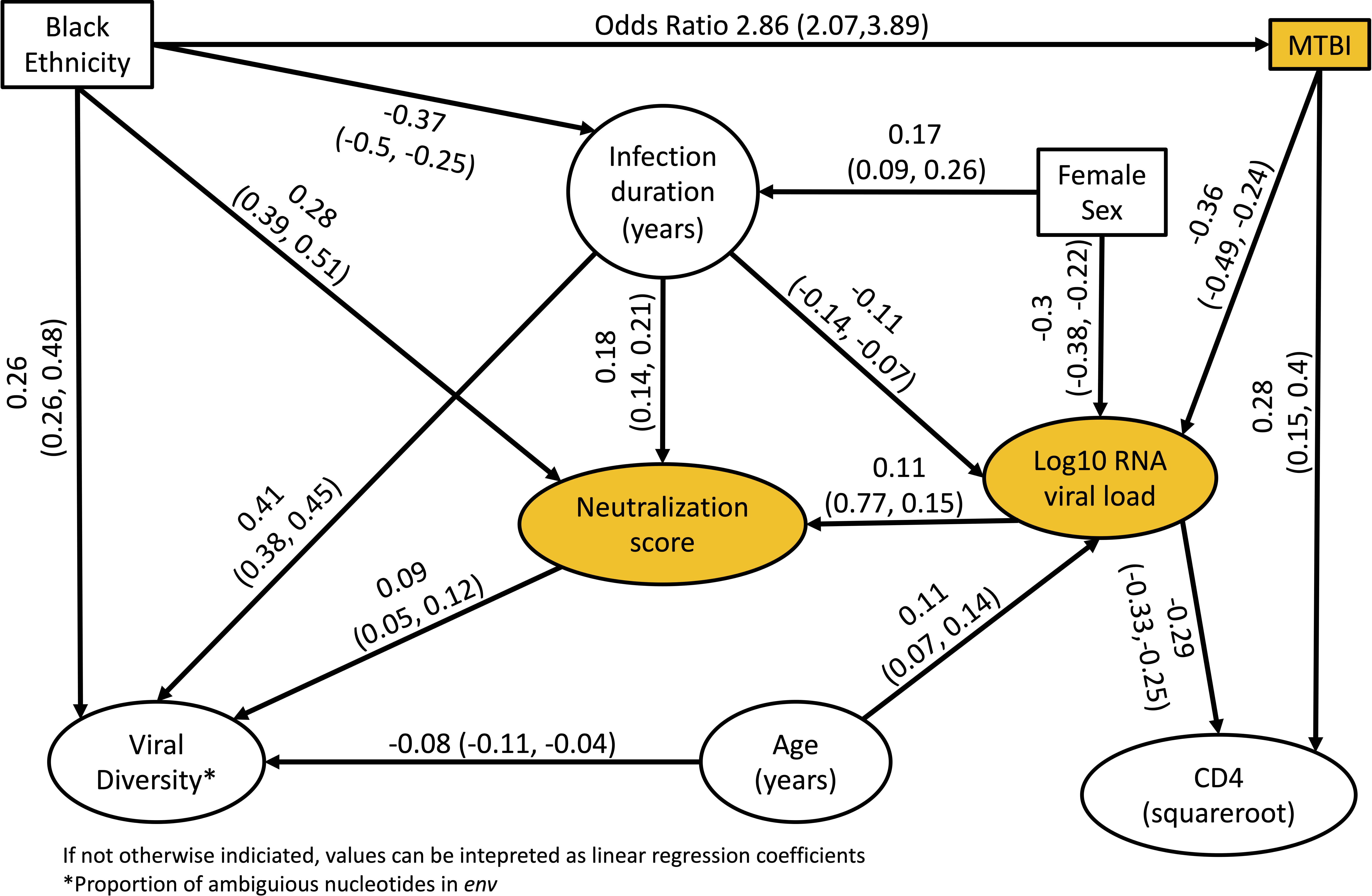
Our analysis included 2,823 PWH (211 MTB infected). MTB infection was associated with a -0.74 (-1.44,-0.05) neutralization reduction in multivariable tobit regression. Moreover, MTB infection was associated with a -0.04 (-0.07,-0.01) binding decrease of epitopes/IgG classes (IgG2 trimer, IgG1 gp140, IgG1 V3), previously shown to be predictive of high neutralization. Bayesian network analysis (Figure) showed MTB infection was associated with a -0.36 (-0.63,-0.08) log10 viral load decrease. In turn, one log10 viral load increase, was associated with a 0.11 (0.03,0.19) neutralization increase.
Conclusions:
Consistent with our previous findings, our results underscore the immediate impact of MTB infection in reducing HIV-1 viral load. The resulting decreased exposure to HIV-1 antigen is likely the cause of the observed attenuated HIV-1 antibody response. While a modest decrease in binding Abs may be of limited consequence, a reduced ability to induce neutralizing Abs in untreated HIV and MTB co-infection may potentially counteract the gains in HIV-1 control induced by MTB.