Background:
HIV-1 envelope (Env)-specific broadly neutralizing antibodies (bNAbs) have several potential clinical benefits including in infants: Infants have limited tolerable antiretroviral treatment (ART) options, given daily for prevention and twice daily for treatment. In contrast, bNAbs with modified Leucine-Serine (LS) Fc receptors permit infrequent subcutaneous dosing. Moreover, unlike ART, bNAbs may facilitate viral reservoir reduction and contribute to functional cure. However, data on HIV-1 Env evolution and bNAb susceptibility in perinatally infected infants are limited.
Methods:
The evolution of Clade C Env in five infants (4 female) born with HIV-1 and with intermittent viraemia despite early ART was investigated over 19.3 (range: 16.9 – 21) months. A single-genome sequencing approach using Oxford Nanopore Technologies (ONT) was developed and validated using Sanger Sequencing as reference. In short, consensus sequences were constructed for each single genome using NECAT, a published bioinformatics pipeline that corrects ONT error. Defective individual genomes containing stop codons were excluded. The susceptibility of the remaining genomes to 33 bNAbs were investigated using the bNAb-Resistance Predictor (bNAb-ReP) machine learning algorithm.
Results:
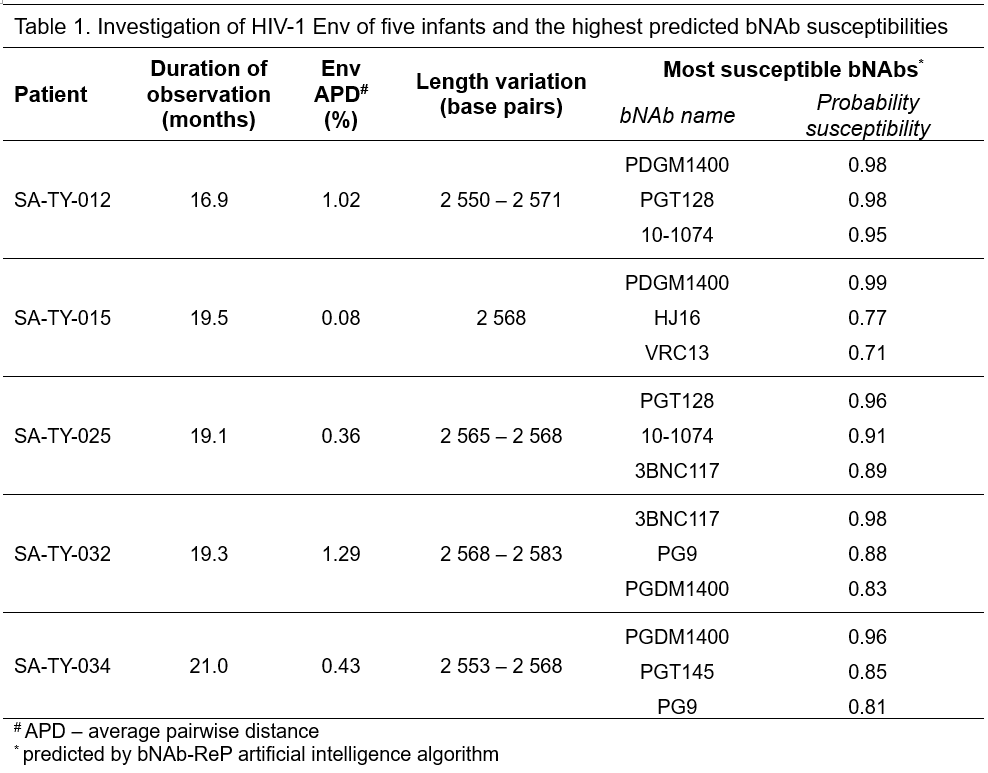
The intra-patient average pairwise distances (APD) ranged from 0.08% – 1.29% (median: 0.43%). Different evolutionary patterns were observed. Env length variation emerged in 4 out of 5 infants. Phylogenetic trees showed temporal structure in four cases with new variants emerging either from majority or minority populations or apparent ancestral or archived variants. All variants were identified as CCR5-tropic by three genotypic prediction models. Predicted bNAb susceptibility showed much higher inter-patient than intra-patient variability with PGDM1400, PGT128 and 3BNC117 (Table 1) predicted to have the highest susceptibilities overall.
Conclusions:
As phenotypic bNAb susceptibility testing is costly and has low reproducibility, we developed an efficient Env genotypic assay, combining single-genome sequencing with ONT to accommodate Env sequence length variation. Applying our workflow, the predicted susceptibility to bNAbs varied across individuals due to high levels of inter-patient Env diversity. Early ART-treated infants often have viraemia due to adherence challenges. However, early intra-patient Env evolution was limited and unlikely to impact bNAb susceptibility. Updated prediction algorithms require validation across HIV-1 subtypes.