Background:
Myeloid-derived suppressor cells (MDSC) are a heterogenous population that suppress T, B, and NK cell function through multiple mechanisms and expand with acute and chronic inflammatory conditions. We evaluated whether frequencies of MDSC are associated with measures of HIV persistence and levels of inflammation in persons with HIV (PWH) on long-term ART.
Methods:
In the ACTG A5321 cohort of PWH with well-documented suppression of HIV-1 viremia on ART, we measured peripheral blood frequencies of classic (c) MDSC [Lineage(-), CD33+, HLADR-] and monocytic (m) MDSC [Lineage(-), CD33+, HLADR-, CD14+, CD11b+] by flow cytometry. To evaluate anti- or pro-inflammatory profile, we calculated the ratio of %mMDSC (anti-) and %intermediate monocytes (iMono; CD14+CD16+; pro-inflammatory). We then determined associations between MDSC frequencies and mMDSC/iMono (higher ratio – more anti-inflammatory) with measures of HIV persistence, including residual viremia, HIV DNA, cell-associated HIV RNA, and intact proviral DNA, and with soluble measures of inflammation.
Results:
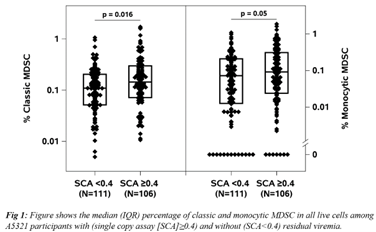
The 225 participants had a median age of 49 yrs, CD4 count of 681 cells/mm3, and ART duration of 7 yrs. The median cMDSC frequency was 0.13% of all live cells while mMDSC was 0.08%. Frequencies of both MDSC populations correlated with each other (r=0.31; p<0.001, Spearman). Lower mMDSC frequencies were associated with longer ART duration (r= -0.20; p<0.001). Participants with residual viremia (HIV RNA≥0.4 cps/mL) had higher %cMDSC than those with HIV RNA <0.4 cps/mL (0.14% vs 0.11%; p=0.016, Wilcoxon; Fig 1). There was also a trend for higher %mMDSC in those with residual viremia (0.09% vs 0.07%; p=0.05). Higher frequencies of mMDSC and cMDSC were associated with lower levels of pro-inflammatory cytokines IP-10 (r= -0.23, p<0.001 & r= -0.18, p=0.008, respectively) and TNF (r= -0.15, p=0.024 & = -0.15, p=0.021, respectively) even after adjusting for pre-ART RNA. The mMDSC/iMono ratio did not correlate with any measure of HIV persistence. Higher ratios were associated with lower IP-10 (r= -0.24, p<0.001) and TNF (r= -0.15, p=0.028) levels even after further adjusting for age, pre-ART CD4 count, and years on ART.
Conclusions:
Our finding that higher MDSC frequencies are associated with residual viremia despite long-term ART suggests that MDSC could inhibit virally suppressive HIV-specific immune responses. Reversing MDSC-mediated suppression would possibly enhance immune control of HIV but could also increase chronic inflammation.