Background:
Immunological non-responders (INRs) are people living with HIV (PLHIV) who fail to adequately restore CD4+ T-cell levels during suppressive ART. In contrast, immunological responders (IRs) do achieve CD4+ T-cell levels comparable to healthy individuals. Morbidity and mortality are increased in INRs. However, the pathogenesis of INRs is multifactorial and not fully elucidated yet. In this exploratory proteomics study, we looked for proteins which might be related to INR. SKAP1 is a lymphocyte protein which is important for T-cell migration, activation and proliferation. Previous work has shown that lymphocyte proliferation and IL-2 production were severely impaired in SKAP1 knock-out mice. The main function of SKAP1 is activating LFA-1, an integrin binding receptor. Knockdown of one of the LFA-1 heterodimers causes impaired CD4+ T-cell migration to the intestine and lymph nodes. SKAP1 has never been described in the context of HIV.
Methods:
The 2000HIV study (clinicaltrials NTC03994835) is a Dutch cross-omics multi-center study enrolling 1895 virally suppressed PLHIV, divided into a discovery and an independent validation cohort. We performed linear regression differential expression analysis on targeted serum proteomics (Olink, 2368 proteins) of INRs compared to IRs. In addition, we analyzed whole blood DNA methylation (NanoDrop spectrophotometer).
Results:
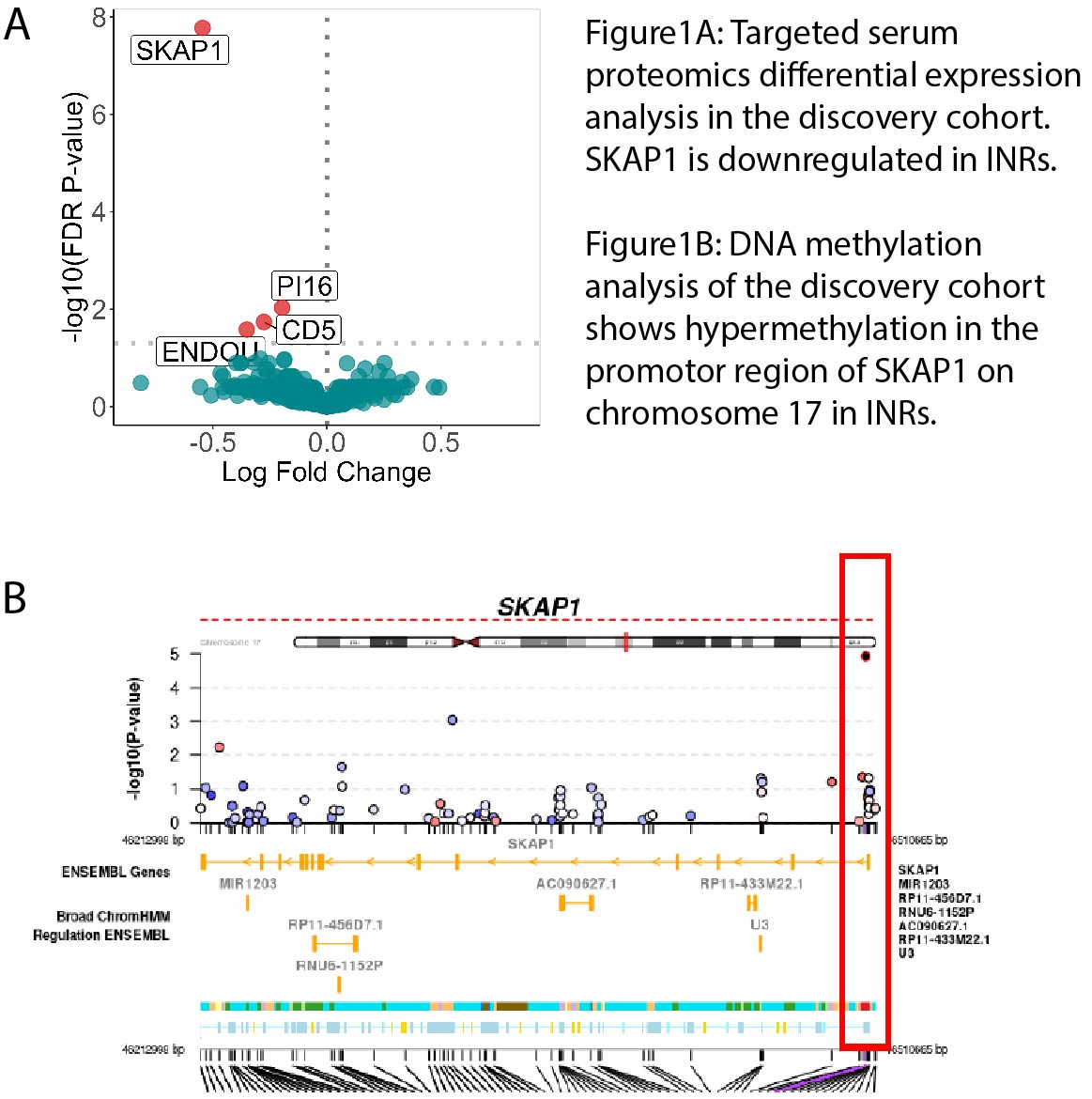
The discovery cohort consists of 62 INRs and 1224 IRs, and the validation cohort of 26 INRs and 243 IRs. INRs were older and had more advanced HIV disease before starting cART. Proteomic analysis showed that SKAP1 was significantly downregulated in INRs in both the discovery (logFC = -0.545, FDR<0.0001) and the validation cohort (logFC = -0.628, pval<0.0001) (Figure 1A). SKAP1 was the most significant protein in both cohorts. In addition, we observed hypermethylation at cg26532208, a CpG site in the promotor area of the SKAP1 gene in the discovery cohort (logFC = -0.096, FDR = 0.042) (Figure 1B), as well as in the validation cohort (logFC = -0.093, pval = 0.00078) which suggests decreased transcription. Finally, a significant correlation between CD4+ T-cell count and SKAP1 levels was found in the overall cohort irrespective of immunological responder status.
Conclusions:
We found evidence for decreased SKAP1 expression levels in INRs in a large cohort study across two separate -omics layers. Previous work on SKAP1 function and these new data emphasizes its potential role in INR pathogenesis and might open new therapeutic avenues.