Background:
Bacterial sexually transmitted infections (STIs) have been shown to facilitate HIV transmission and acquisition. Long-acting cabotegravir (CAB-LA) demonstrated superiority vs daily oral tenofovir disoproxil fumarate/emtricitabine (TDF/FTC) for HIV prevention in two large randomized controlled trials, but an assessment of efficacy in the setting of STIs has not been performed.
Methods:
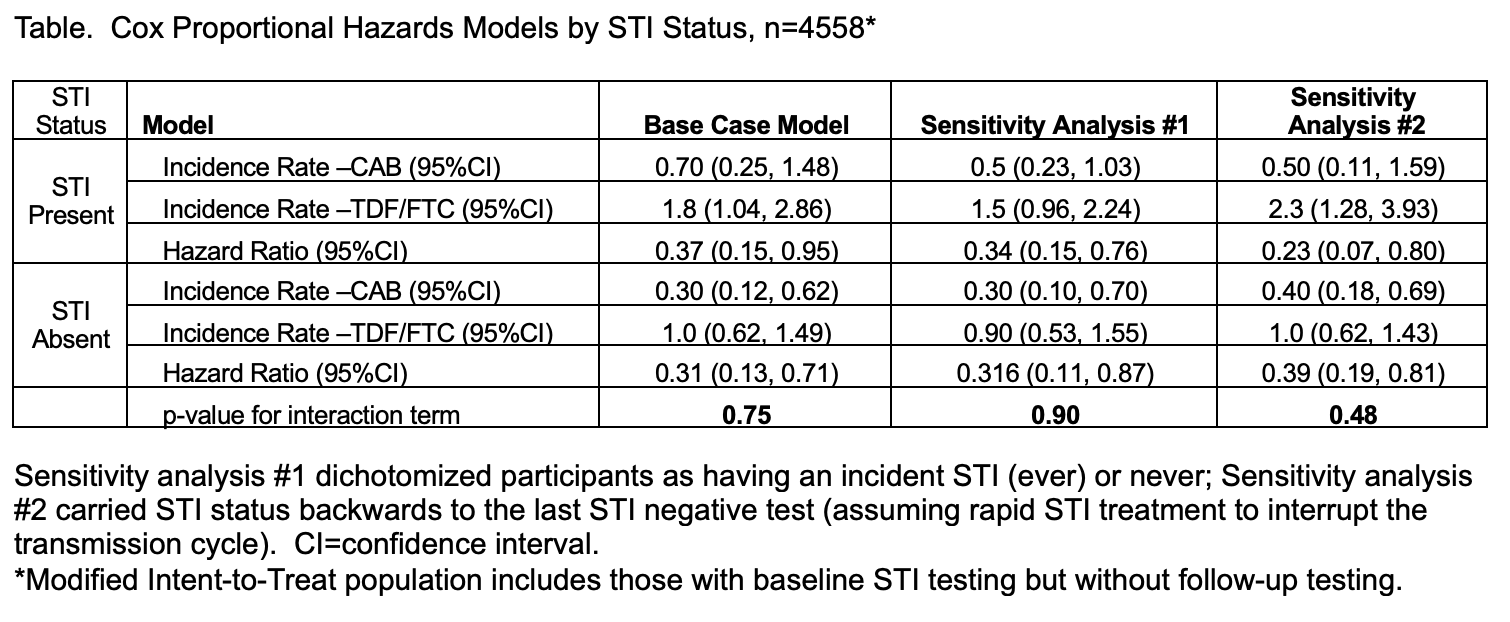
From the blinded period of HPTN 083, we calculated incident STI events per 100 person-years (PY), including repeat events, from enrollment to last STI testing prior to May 15, 2020. We used Cox proportional hazards modeling with STI status as a time-varying covariate to look for potential interactions between STI status and the relative efficacy of CAB-LA vs. TDF/FTC. Serologic testing for syphilis and nucleic acid amplification testing for rectal and urethral gonorrhea and chlamydia were conducted every six months or when participants reported STI symptoms or exposures. Date of first HIV diagnosis was determined by an independent adjudication committee. Since the precise dates of STI infection and completion of STI treatment were unknown, each time interval between STI tests was classified as STI-positive or STI-negative. Intervals before and after each positive STI test were considered STI-positive, and all others were considered STI-negative. Sensitivity analyses were conducted with different methods of STI-status extrapolation. For Cox-Models, we included those without follow-up.
Results:
Among 3859 participants (ppts) included in the analysis, the overall STI incidence rate was 50.7 infections/100PY. STIs were diagnosed in 1562 (40.5%) ppts, with multiple STIs reported for 691 (17.9%), and 79% of STI diagnoses occurring in 25% of ppts. There was no difference in STI incidence by PrEP arm. In a m-ITT analysis (Table), HIV incidence was lower with CAB-LA vs TDF/FTC regardless of presence or absence of STIs (hazard ratios of 0.37 and 0.31, respectively, with no significant interaction between STIs and the HR for HIV incidence (p = 0.75). Sensitivity analyses yielded similar results.
Conclusions:
In a large PrEP trial with high STI incidence among participants, CAB-LA maintained robust protective efficacy relative to TDF/FTC in the setting of bacterial STIs. It is not a foregone conclusion that all HIV pre-exposure prophylaxis agents will maintain protective efficacy in the presence of bacterial STIs, and robustness to STIs should be interrogated for each agent. Future analyses should include HSV-2.