Background:
Vaccines generate humoral immunity by activating antigen-specific helper T cells and B cells, which cooperate in germinal centers (GCs) to generate high-affinity antibodies. To provide antibody-based protection, an HIV vaccine will likely need to induce broadly neutralizing antibodies (bnAb). To date, identified bnAbs exhibit unusual features like extensive and improbable mutations and lengthy CDR3s; their precursor clones are often rare and have low affinity for HIV Env trimers. Emerging strategies to prime these rare precursors involve achieving prolonged antigen exposure, formulating multivalent and particulate immunogens, or employing potent adjuvants; these strategies have been shown to amplify GCs in preclinical studies, but combining these effects in a single shot is challenging.
Methods:
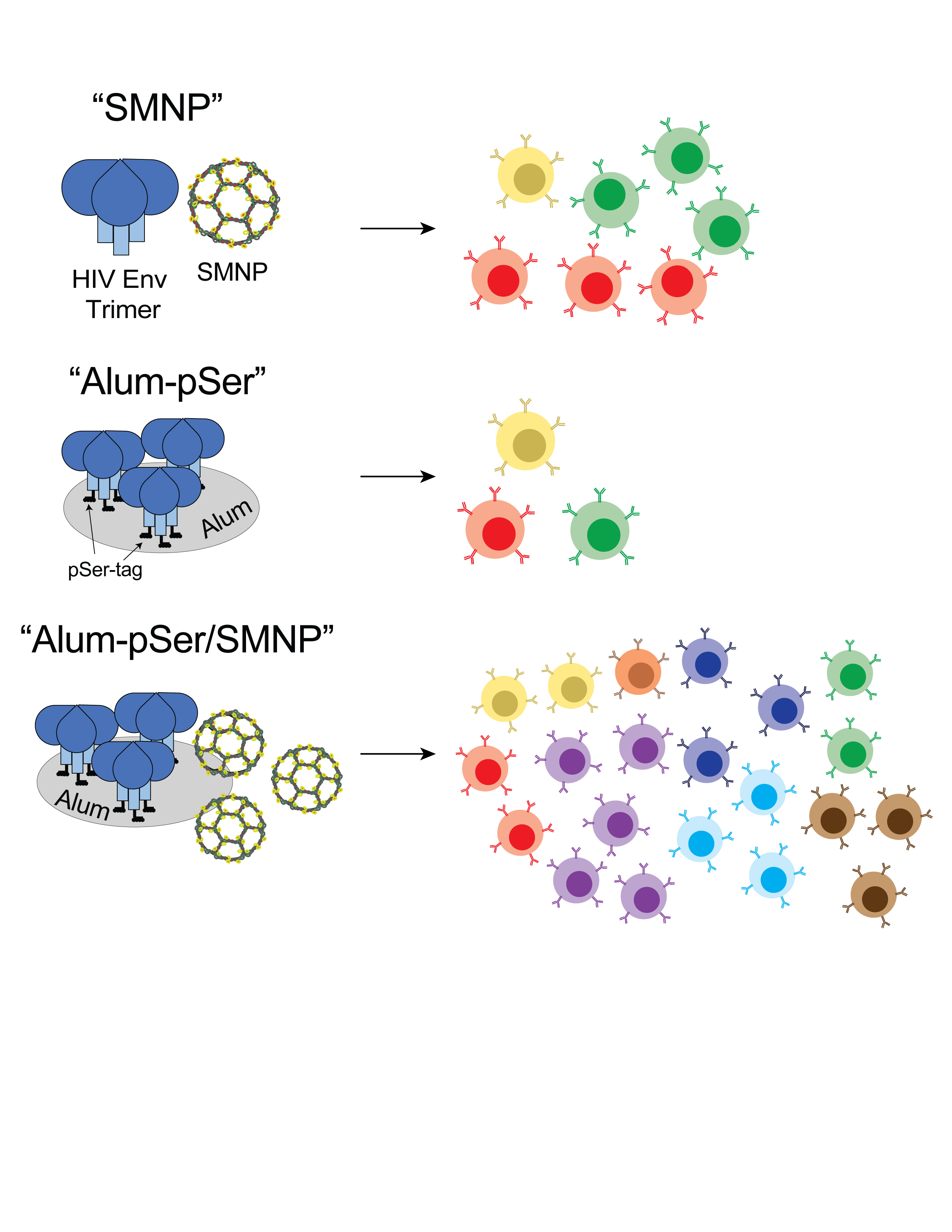
Toward this goal, we engineered aluminum hydroxide (alum), the most common clinical adjuvant, into a slow-delivery vehicle by tagging HIV Env trimer immunogens with short phosphoserine (pSer) linkers to promote alum-binding-individual alum particles are decorated with antigens and mimic virus-like particles. We term this multivalent antigen and alum complex ‘alum-pSer.’ In parallel, we developed a potent saponin-based adjuvant, SMNP, to modulate the inflammation. In this study, we examined the impact of alum-pSer, SMNP, or combining these two adjuvants (Abstract Figure) on humoral response and GC B cells in mice using flow cytometry, ELISA, scRNAseq, and microscopy.
Results:
The alum-pSer approach bolstered immunogen bioavailability. The SMNP adjuvant enhanced lymph drainage and immunogen transport to follicles. Notably, the combination exhibited remarkable synergy in amplifying humoral responses compared to SMNP or alum-pSer alone, eliciting 3.3-fold and 56-fold more antigen-specific GC B cells on day 14 and 1.8-fold and 12-fold greater serum IgG titers on day 28, respectively. The combination adjuvant augmented GC B cell clonal expansion and diversity and revealed an enrichment of S-phase, indicative of stronger positive selection by T cells. Moreover, we found that only the combination approach led to pronounced accumulation of intact HIV Env trimer on follicular dendritic cells.
Conclusions:
These findings indicate this simple combination adjuvant approach achieves both sustained antigen availability and altered antigen localization, productively steering the GC response in a way conducive to priming rare B cell clones against protective HIV epitopes and broadly applicable to other pathogens.