Background:
Integrase inhibitor (INSTI)-containing antiretroviral therapy (ART) is currently the guideline-recommended first-line treatment for HIV. Delayed initiation of INSTIs may amplify racial and ethnic inequities in health outcomes among people with HIV. We therefore estimated racial/ethnic differences in ART initiation and INSTI prescription among adults newly entering HIV care in the United States from 2007-2019.
Methods:
We conducted an observational study among 42,841 adults entering HIV care at over 200 U.S. clinical sites in the North American AIDS Cohort Collaboration on Research and Design (NA-ACCORD). Outcomes were the probability of initiating ART within 1 month of care entry and the proportion of patients prescribed an INSTI. For each outcome, we estimated overall (i.e., unadjusted) differences among non-Hispanic (NH) Black and Hispanic compared with NH White patients. Confidence intervals (CIs) around differences were estimated by the delta method; intervals that exclude 0 indicate a significant difference at α=0.05. We examined variation in racial/ethnic differences over time in relation to FDA approval of INSTIs, updated national guidelines on ‘when to start’ ART, and guidelines’ inclusion of INSTIs as preferred initial ART.
Results:
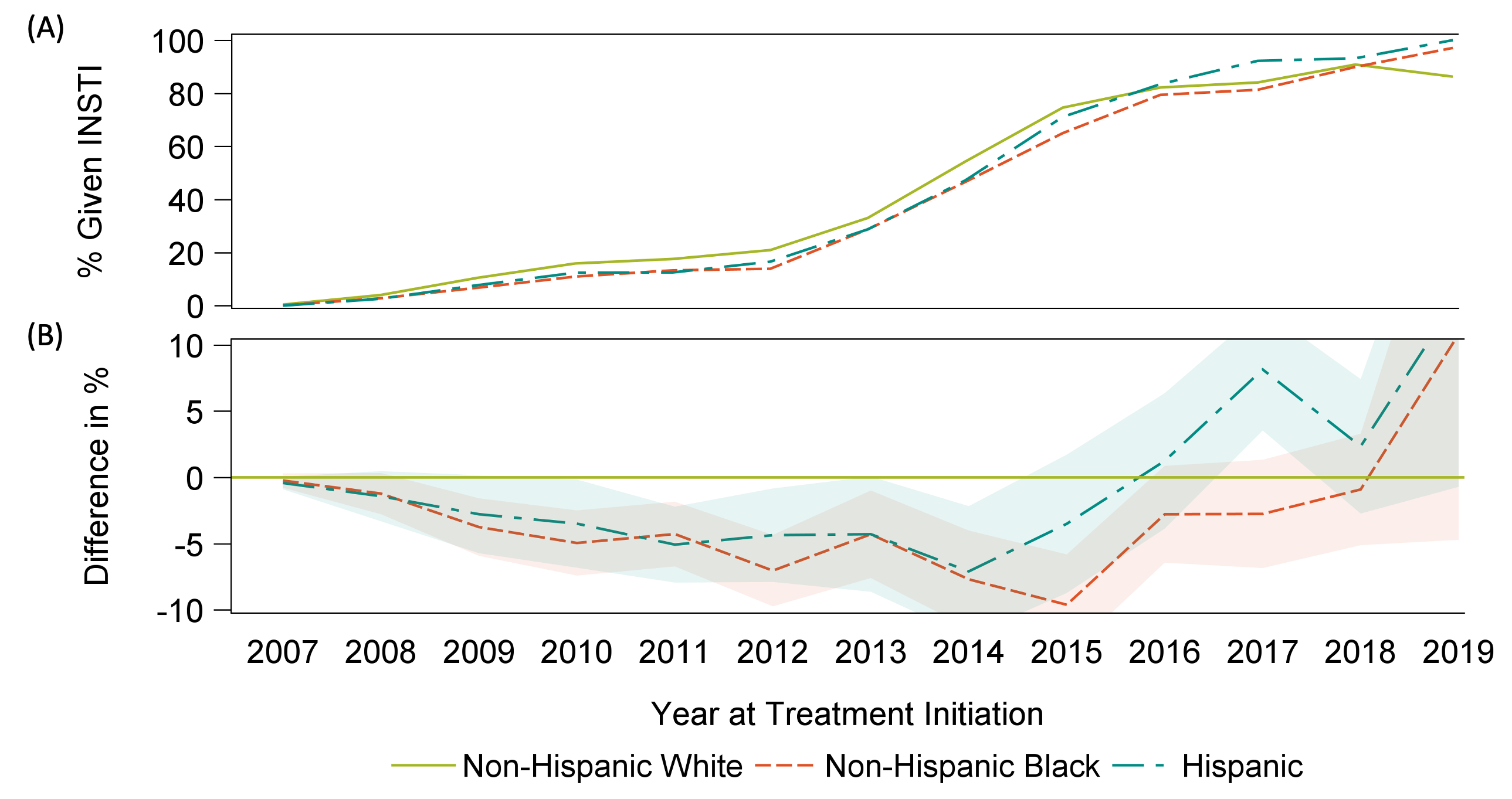
From 2007-2015, the probability of ART initiation within 1 month of care entry was 45% among NH White patients, 50% among Hispanic patients (difference: 5%; 95% CI 0, 9), and 47% among NH Black patients (2%; -4, 7). From 2016-2019, after guidelines strongly recommended treating all patients regardless of their CD4+ T-cell count, this probability increased to 68% among NH White patients, 68% among NH Black patients (0%; -8, 9), and 71% among Hispanic patients (3%; -6, 11). INSTIs were prescribed to 22% of NH White patients and only 17% of NH Black (-5%; -7, -4) and 17% of Hispanic (-5%; -6, -3) patients from 2009-2014, when INSTIs were FDA-approved as initial therapy but not yet guideline-recommended. Significant differences persisted for NH Black (-6%; -8, -4) but not Hispanic (-1%; -4, 2) patients from 2014-2017, when INSTIs were a guideline-recommended option for initial therapy; differences by race/ethnicity were not statistically significant from 2017-2019, when INSTIs were the single recommended initial therapy for most people with HIV.
Conclusions:
Updates to national treatment guidelines corresponded with increased pharmacoequity among adults initiating HIV treatment in the United States.
(A) Percent of patients prescribed INSTIs and (B) racial/ethnic differences in percent of patients prescribed INSTIs by year at treatment initiation among persons entering HIV care from 2007-2019 (shaded bands indicate 95% CI)