Background:
IMPAACT 2010 previously reported that low antepartum weight gain ( < 0.18 kg/week) was associated with higher hazard of adverse pregnancy outcomes compared to normal weight gain (HR: 1.4, 95% CI: 1.04, 2.00), and that rates of adverse pregnancy outcomes differed by randomized ART arm. In this exploratory analysis, we evaluated whether change in antepartum weight was a mediator of by-arm differences in adverse pregnancy outcomes.
Methods:
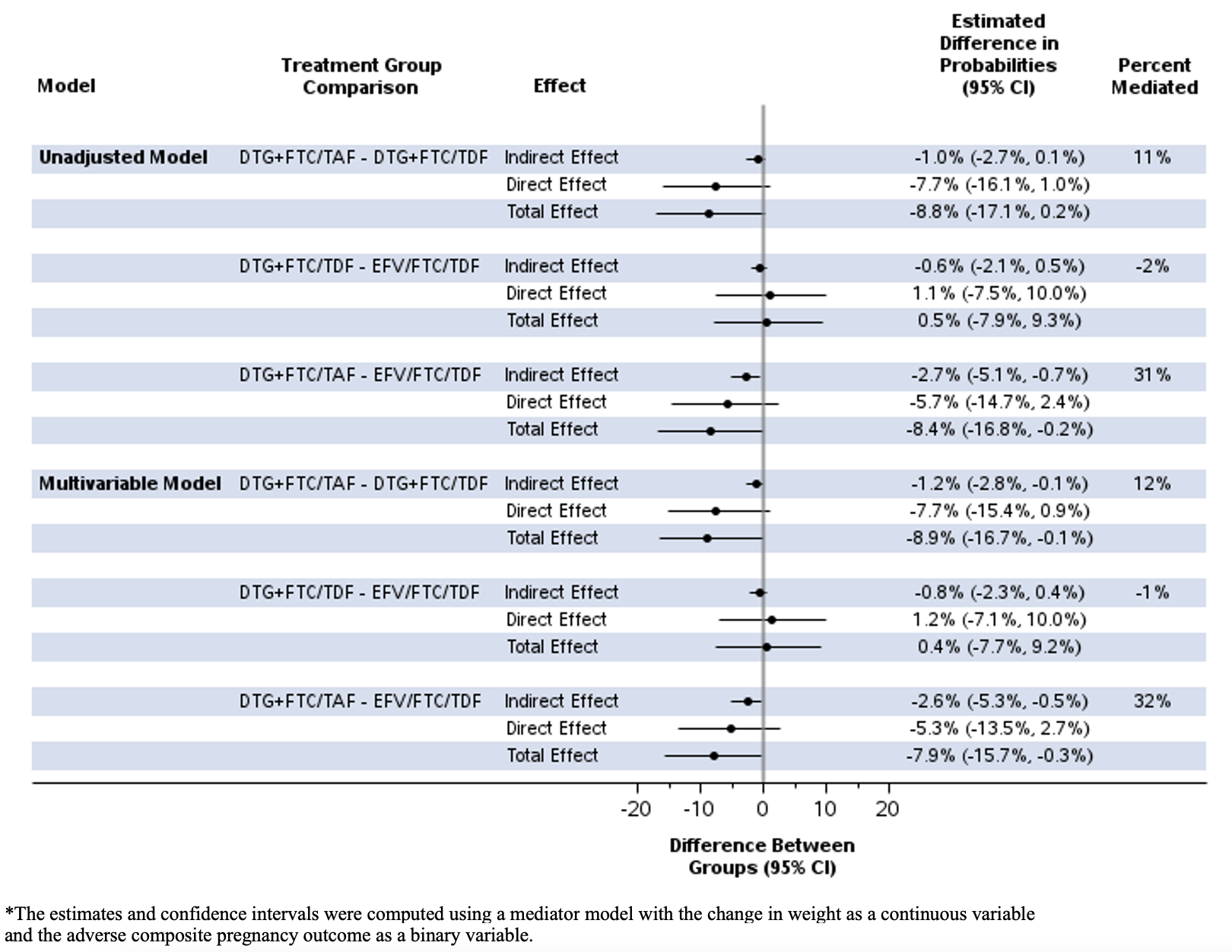
Women with HIV-1 in 9 countries were randomized at 14-28 weeks gestational age (GA) to start dolutegravir(DTG)+emtricitabine(FTC)/tenofovir alafenamide fumarate(TAF) vs. DTG+FTC/tenofovir disoproxil fumarate(TDF) vs. efavirenz(EFV)/FTC/TDF. We defined a composite adverse pregnancy outcome as occurrence of stillbirth (GA ≥20 weeks), preterm delivery (GA < 37 weeks), or small for gestational age (SGA) < 10th percentile. Causal mediation analysis was used to separate the estimated effect of study arm on the risk of the composite pregnancy outcome into two effects: 1) effect mediated through the change in weight (indirect effect, modeled continuously), and 2) effect not mediated through the change in weight (direct effect, modeled as a binary outcome). We also performed a multivariable analysis adjusting for baseline GA, body mass index (BMI), CD4 count, country, and age.
Results:
643 participants were randomized: 217 in DTG+FTC/TAF, 215 in DTG+FTC/TDF, and 211 in EFV/FTC/TDF arms. Baseline medians were: GA 21.9 weeks, HIV RNA 903 cp/mL, CD4 count 466 cells/uL, and BMI 26 kg/m2. The proportion with an adverse pregnancy outcome was lower in the DTG+FTC/TAF arm (24%) compared to the EFV/FTC/TDF (32%) and DTG+FTC/TDF (33%) arms. Low weight gain was least common in the DTG+FTC/TAF arm (15%) compared to EFV/FTC/TDF (30%) and DTG+FTC/TDF (24%). For comparisons with the DTG+FTC/TAF arm, the percent of risk of adverse pregnancy outcome mediated by weight change was 31% for DTG+FTC/TAF vs EFV/FTC/TDF and 11% for DTG+FTC/TAF vs DTG+FTC/TDF. These results did not differ after adjustment (Figure).
Conclusions:
In this population in which low antepartum weight gain was associated with a higher risk of adverse pregnancy outcomes, up to one-third of observed differences in adverse pregnancy outcomes between the randomized arms appear to be mediated by ART-related weight change. Further study is needed on the role of weight as well as additional ART-related mechanisms associated with these adverse outcomes in women living with HIV.
Mediation analysis of study arm, weight change, and the composite adverse pregnancy outcome*