Background:
Persons with HIV (PWH) have twice the risk of developing cardiovascular disease (CVD) and a greater burden of non-calcified coronary plaque, which is more likely to rupture. Although higher levels of systemic and local inflammation may contribute to altered plaque formation, there are few studies on coronary plaque content in PWH versus HIV-negative controls. We hypothesized that HIV alters the local inflammatory response within coronary plaques, thus contributing to the increased risk of CVD.
Methods:
We obtained coronary arteries with varying stages of atheroma from deceased PWH (n=13) and matched HIV-negative donors (n=15). We measured virus copies within coronary arteries using droplet digital polymerase chain reaction (ddPCR) for HIV, cytomegalovirus (CMV), and human endogenous retrovirus (HERV K). We performed an unbiased analysis with a spatial whole transcriptomic approach (n=7 per group) and defined specific immune markers by targeted spatial transcriptomics, proteomics, and immunohistochemistry. Comparisons of immunohistochemistry results used Mann-Whitney U tests, and comparisons of multiple regions of interest used linear models for microarray data (LIMMA) with Benjamini Hochberg correction.
Results:
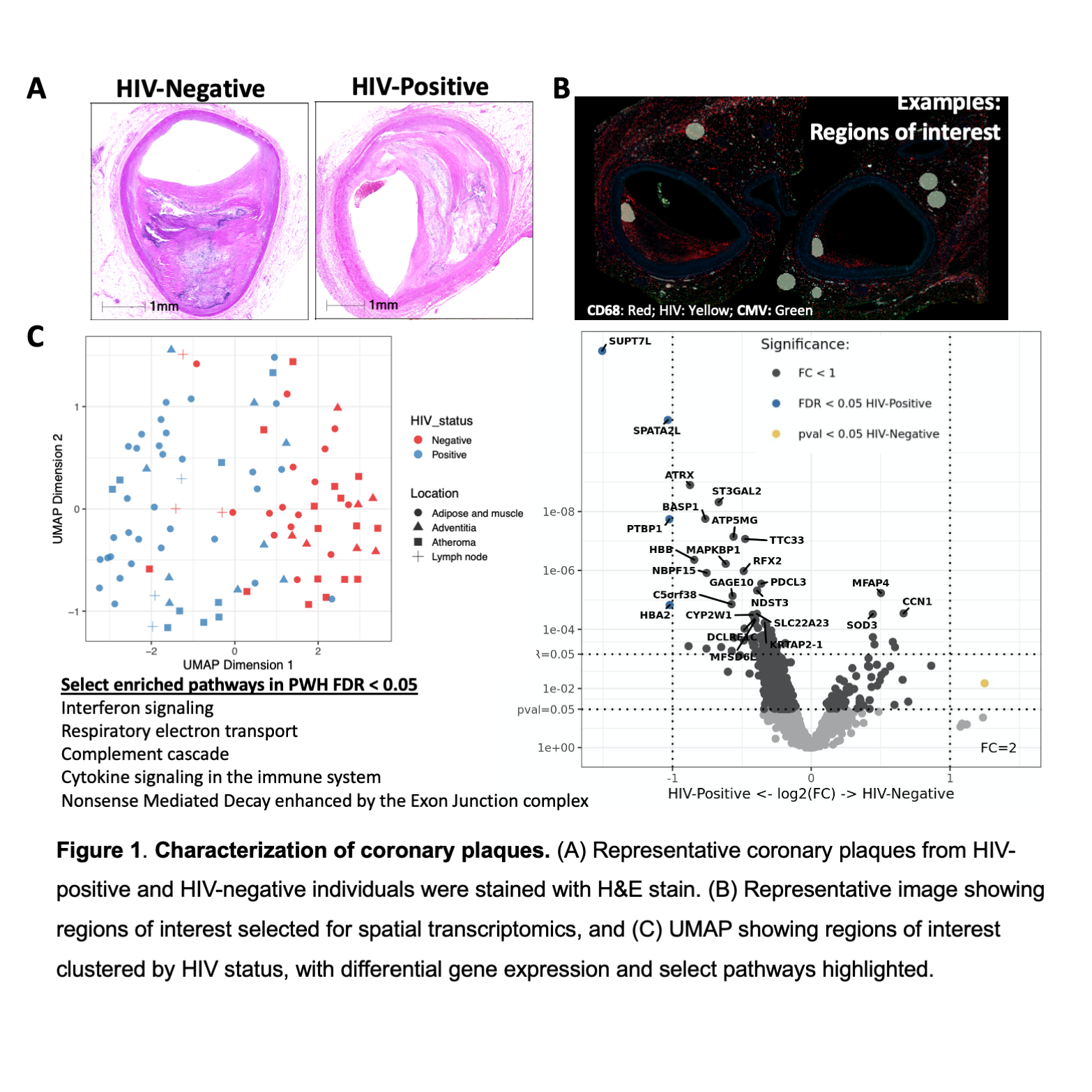
Among coronary arteries matched by plaque type (pathological intimal thickening, early and late atheroma), plaque area, and stenosis (Figure 1A-B), we detected viral RNA sequences for HIV in 77% (10/13) of coronary arteries from PWH, while CMV was detected in 46% (6/13) of PWH and 53% (8/15) of controls. Coronary arteries from all donors had detectable HERV-K. The RNA transcriptomes differed by HIV status with enrichment of genes in several inflammatory pathways including the interferon signaling and nonsense-mediated decay pathway in PWH (Figure 1C). Partial Spearman rank correlation adjusted for plaque type in the PWH showed a significant relationship between HIV copies with STING, CD3, and VCAM1 protein expression.
Conclusions:
The presence of HIV within the coronary arteries alters the immune environment with stimulation of several pathways such as interferon-gamma and the non-sense mediated decay pathway. Notably, the presence of other chronic viruses such as CMV or HERV K does not appear to differ by HIV status. HIV may be an important accelerator of atherosclerosis and increased CVD risk in PWH. Further studies are underway to establish whether intact virus, viral sequences or modified host DNA stimulate inflammation within coronary plaques.
Characterization of coronary plaques