Background:
Per UNAIDS 95-95-95 Fast-Track targets, reaching the “third 95” requires 86% of people living with HIV to achieve viral load suppression (VLS), defined by UNAIDS and WHO as < 1,000 HIV RNA copies/ml. Emerging evidence linking persistent lower-level viremia to HIV drug resistance has prompted calls to redefine VLS using lower cutpoints. However, it is unclear how lowering VLS cutpoints might impact achievement of the Fast-Track targets or resources required for delivering HIV treatment.
Methods:
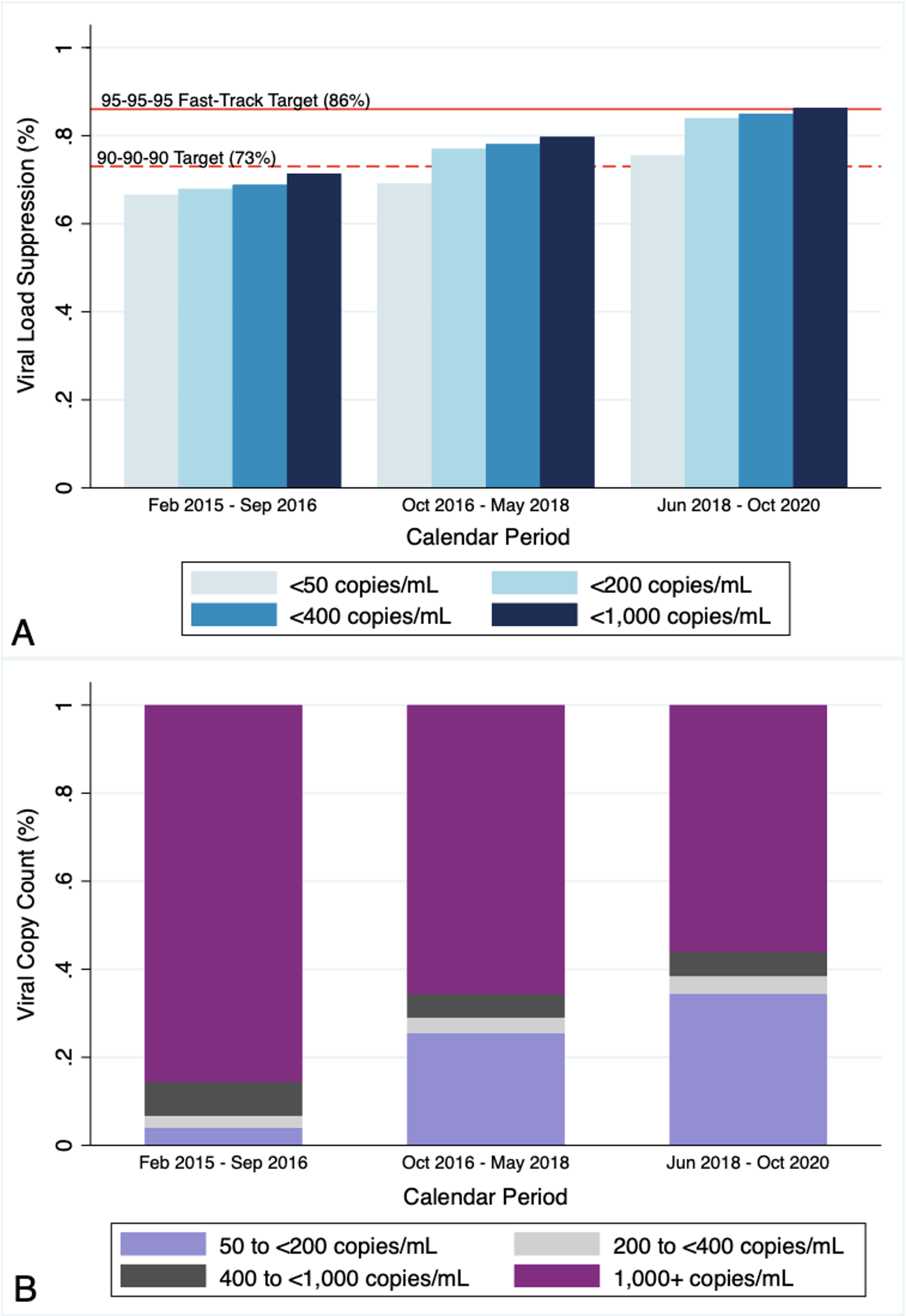
We used data from a prospective population-based survey in rural south-central Uganda, the Rakai Community Cohort Study, to assess the impact of lowering VLS cutpoints on estimated progress towards the 95-95-95 VLS target. We estimated VLS by calculating the proportion of serologically confirmed HIV cases with undetectable plasma viral loads or exhibiting viremia below specific cutpoints measured over 3 survey rounds in 40 communities (2015 to 2020). We ascertained differences in population VLS estimates across 4 routinely used VLS cutpoints: < 1,000, < 400, < 200, and < 50 copies/ml. We also assessed the relative increase in the fraction of viremic persons living with HIV if VLS cutpoints were lowered.
Results:
Overall, 5,814 people living with HIV (mean age: 33 years, 63% women) contributed 10,418 observations to the analysis. In the final survey (2018–2020), estimated population VLS (86%, 95% confidence interval [95%CI] 85–87%) met the 95-95-95 Fast-Track target using a cutpoint of < 1,000 copies/ml (Figure 1A). However, when using the more conservative cutpoints of < 200 and < 50 copies/ml, population VLS fell to 84% (95%CI 83–85%) and 76% (95%CI 74–77%), respectively. Among persons with detectable viral load, lowering the VLS cutpoint from < 1,000 to < 200 copies/ml increased the proportion of people living with HIV who were viremic by 17% (Figure 1B).
Conclusions:
Lowering VLS cutpoints may substantially impact Fast-Track target achievement, requiring countries and subnational units to reframe progress towards HIV epidemic control goals. It may also markedly increase programmatic resources needed for the clinical management of persons living with HIV who exhibit lower-level viremia.