Background:
HIV-associated cryptococcal meningitis caused by Cryptococcus neoformans causes 15-19% of HIV-related deaths globally. Underlying immune modulated mechanisms to be advanced to improve host survival on antifungal treatment was the challenge. We hypothesized that host immune response at diagnosis predicts host survival on antifungal treatment.
Methods:
In a cohort of HIV+ adults with cryptococcal meningitis, we interrogated B cells compartment in blood and CSF, CSF white cells, and representative CSF type-1 T helper response (Th1), Th2, Th17, and T follicular helper cell (Tfh) cytokines, chemokines, and immune checkpoint responses. We used principal component analysis (PCA) to compare baseline responses between those who died (cases) versus survived (controls) at 18 weeks.
Results:
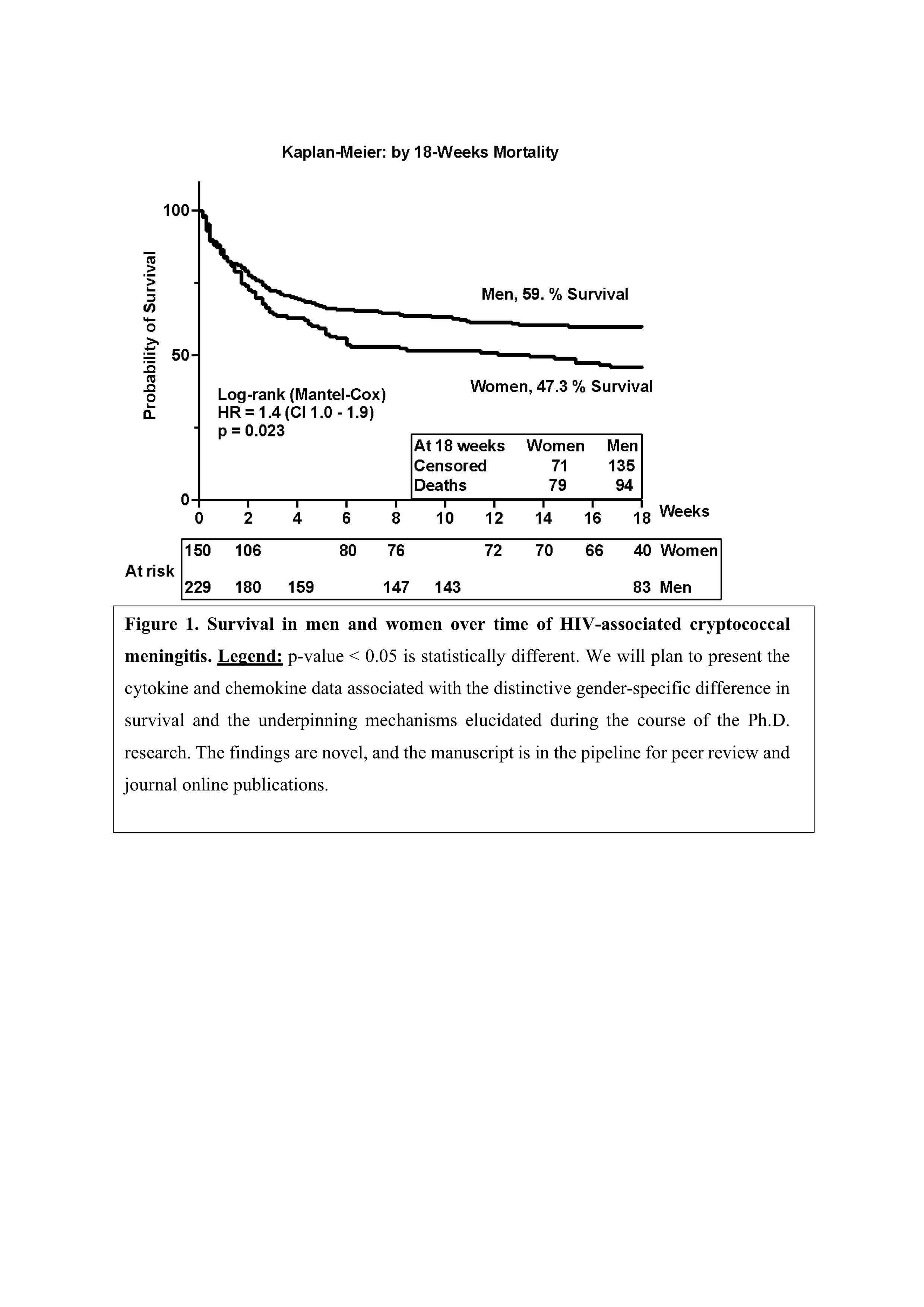
Survival was lower among women at 47% compared to men at 60%, hazard ratio, HR=1.4, 95% CI: 1.0 to 1.9; p=0.023. PCA demonstrated the downregulation of immune responses typical of severe immune senescence/exhaustion was associated with higher quantitative CSF Cryptococcus culture burden (CFU/mL) and a higher hazard of death. For example, low levels of IL-17A among women were highly predictive of death C-statistic=0.672, 95% CI, 0.585 to 0.758, p< 0.001. Elevation in CSF IL-10 and PD-L1/B7-H1 distinguished evoked immune regulated response, especially by biological sex-specific survival. Overall, better survival was associated with increase expression of blood PD-1 plasmablasts/plasma cells ( >20%), CSF white cell pleocytosis of >50 cells/μL, Th1 interferon-gamma >9 pg/mL, pro-inflammatory tumor necrosis factor (TNF)-alpha >85 pg/mL, Th17 interleukin (IL)-17 >4 pg/mL, anti-inflammatory IL-10 >300 pg/mL, immune checkpoint PD-L/B7-H1 >150 pg/mL, chemokine CXCL10 >2507 pg/mL, and CCL11/Eotaxin >15 pg/mL, and lower quantitative CSF culture < 10,000 Cryptococcus CFU/mL.
Conclusions:
In theory, survival among patients with HIV-associated cryptococcal meningitis depends on an evoked elevation of immune-regulated responses typical of a functional immune system. Elevations of a cluster of chemokines, cytokines, and immune checkpoint responses correlated with lower CSF cryptococcal fungal burden and better host survival. Hence, severe immune exhaustion typical of immune senescence/hijacked immune response presented the greatest risk of death. Immune modulation could be a customized therapeutic strategy to improve the survival of persons with cryptococcal meningitis.
Survival in men and women over time of HIV-associated cryptococcal meningitis.