Background:
We previously developed and validated a prediction model that used 44 electronic health record (EHR) data elements to identify patients who are at increased risk of HIV diagnosis and not using preexposure prophylaxis (PrEP). Implementing this EHR-based model in primary care has potential to increase linkage to PrEP care among patients likely to benefit from PrEP.
Methods:
We conducted a randomized controlled trial of a clinical decision support intervention for PrEP at Kaiser Permanente San Francisco from June-November 2021. Adult primary care providers (PCPs) were randomized to usual care or intervention arms. PCPs who also provide care to people with HIV (PWH) were balanced between trial arms. PCPs in the intervention arm were alerted via EHR-based secure email messages about patients with elevated model-generated risk scores (3-year risk of HIV of ≥0.2%) and upcoming in-person or virtual visits, with prompts to discuss HIV prevention and PrEP. Providers only received alerts for patients aged ≥18 years with no previously documented HIV diagnosis or PrEP prescription. The primary study outcome was the 90-day cumulative incidence of linkage to PrEP care, defined as a PrEP diagnosis code during a clinical encounter (reflecting a PrEP discussion), PrEP referral, or PrEP prescription fill. We report the intervention hazard ratio (HR) and 95% CI from Cox regression models using robust standard errors to account for clustering by provider, with adjustment for and stratification by providers who care for PWH.
Results:
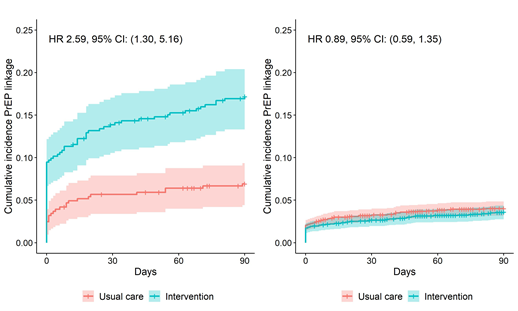
121 PCPs were randomized, including 13 with PWH on their panels, with 5051 eligible appointments (2,471 intervention, 2,580 control). The median age of eligible patients was 39 years (IQR 31-51), with 95.4% men and 42.6% non-Hispanic White, 18.7% non-Hispanic Black, 15.1% Hispanic, and 14.6% Asian. There was a nonsignificant increase in PrEP linkage in the intervention arm (6.0% vs 4.5%, HR 1.31, 95% CI 0.84, 2.1). There was a significant interaction by HIV provider status (see Figure 1), with an intervention HR of 2.59 (95% CI 1.30, 5.16) among providers with PWH on their panels and 0.89 (95% CI 0.59, 1.35) for those without (p-interaction < 0.001).
Conclusions:
A low-intensity intervention that leveraged an EHR-based HIV risk prediction model substantially increased linkage to PrEP care after in-person and video visits among PCPs who also care for PWH. More intensive interventions may be needed to increase PrEP linkage among PCPs less familiar with PrEP and HIV care.
Figure 1. Kaplan-Meier-based cumulative incidence curves for PrEP linkage among intervention and control providers, stratified by PCPs with (left) and without (right) PWH on their panels.