Background:
Coronary artery disease (CAD) is a leading cause of death among the 37 million people with HIV (PWH) globally. Available cardiovascular disease (CVD) risk predictors underperform in this population. While alleles that influence LDL-C concentration summed as a polygenic risk score (PRS) predict LDL-C and CAD in the general population, their influence among PWH is not well understood.
Methods:
A new PRS for LDL-C was constructed using PRS-CS, incorporating the weighted effects of over 1 million single nucleotide polymorphisms associated with LDL-C from over 1.9 million individuals without HIV from the Global Lipids Genetics Consortium, European Network for Genetic and Genomic Epidemiology, Biobank Japan, Genes and Health Study, and Million Veterans Program. Scores were trained in the UK Biobank then calculated using TOPMed-imputed genotypes from a global cohort of ART-treated PWH with low-to-moderate CVD risk enrolled in Randomized Trial to Prevent Vascular Events in HIV (REPRIEVE). Genotyping was performed on Illumina Infinium HTS. Linear and logistic regressions were performed to predict baseline lipid profiles in 4177 genotyped participants and markers of subclinical CAD including presence of plaque, calcification, or stenosis in a subset of 639 participants who received coronary computed tomography angiography (CT sub-study).
Results:
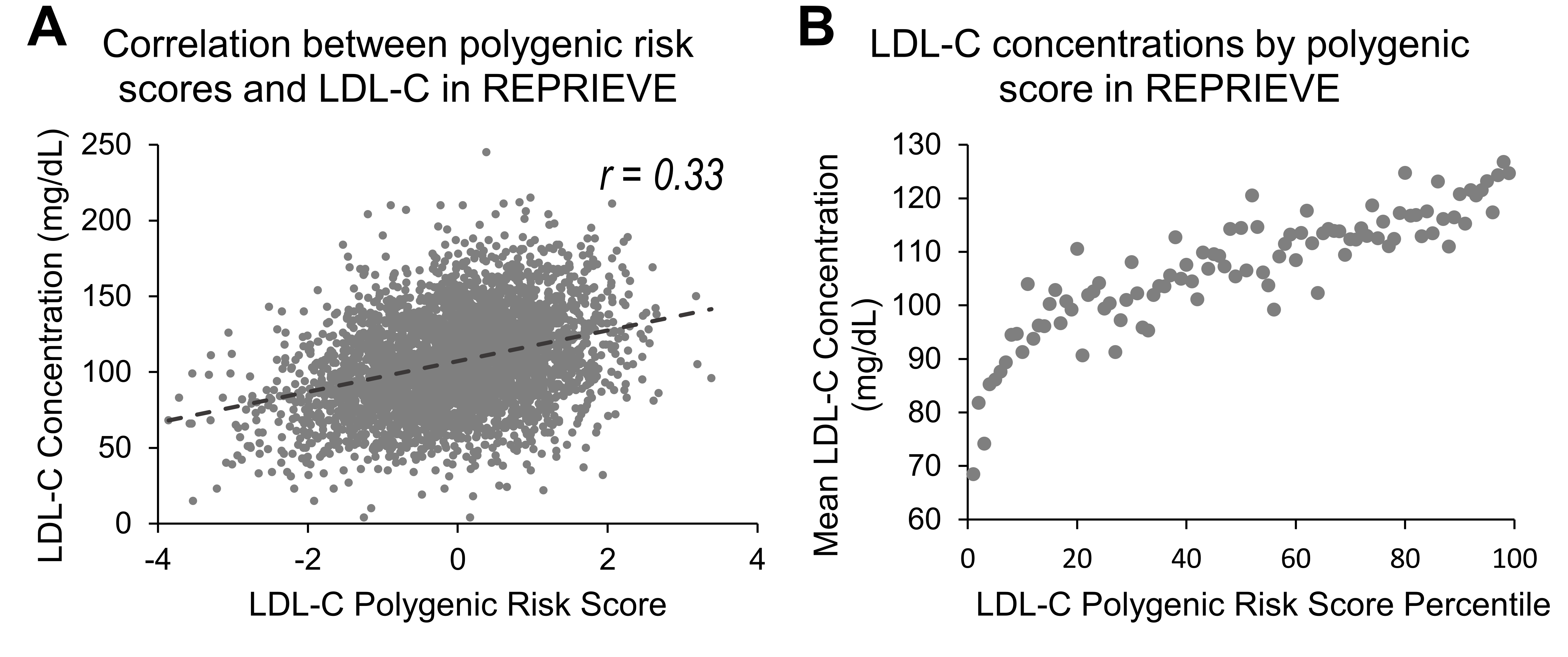
Among a cohort of 4177 REPRIEVE participants (mean [SD] age 49.8 [6.3] years, 36.1% female; 56.5% African, 12.6% East Asian, 21.2% European, 9.6% South Asian ancestries), LDL-C PRS was correlated with fasting LDL-C (r = 0.33, p < 1E-97; Figure 1A), total cholesterol (r = 0.29, p < 1E-72), and oxidized LDL-C (r = 0.15, p < 1E-3). The mean [SD] LDL-C was 107.2 [30.7] mg/dL. Each standard deviation of the LDL-C PRS was associated with a 10.2 (95% CI 9.3 – 11.1, p< 0.001) mg/dL increase in LDL-C. The difference in LDL-C between the top and bottom one percentiles of the LDL-C PRS in REPRIEVE was 56.2 mg/dL (Figure 1B). Similar association results were identified in subgroups stratified by self-reported ancestry and sex. Among 639 participants in the CT sub-study, we did not detect an association between LDL-C PRS and markers of subclinical CAD.
Conclusions:
Among ART-treated PWH in REPRIEVE, a newly developed PRS for LDL-C was associated with levels of LDL-C, total cholesterol, and oxidized LDL-C, but not with subclinical CAD. Future analyses within REPRIEVE will assess whether LDL-C PRS predicts major adverse cardiovascular events in this at-risk population.
Figure 1