Background:
Interactions between chronic co-infections, HIV persistence, and immune response have been implicated in persistent inflammation and cognitive disorders in people with HIV (PWH), but findings have been inconsistent. Most data are based on serology and have not examined sex effects. We aimed to assess the relationships among viral DNA, IgG, and cognition and whether they are influenced by assigned sex at birth.
Methods:
Participants included 486 PWH (81 female) who had prior comprehensive cognitive testing, HIV RNA< 200 copies/mL on antiretroviral therapy and stored blood. Digital droplet PCR quantified CMV, EBV, and total HIV DNA in peripheral blood mononuclear cells. EBV VCA IgG and CMV IgG were measured in plasma by commercial immunoassays in a subset (Nf267 and 300, respectively). Using linear regression, we tested the association of viral DNA and IgG on cognition and whether associations were affected by sex. Analyses were adjusted for age, race, ethnicity, estimated duration of HIV infection (EDI), current CD4+ T-cells, and AIDS diagnosis.
Results:
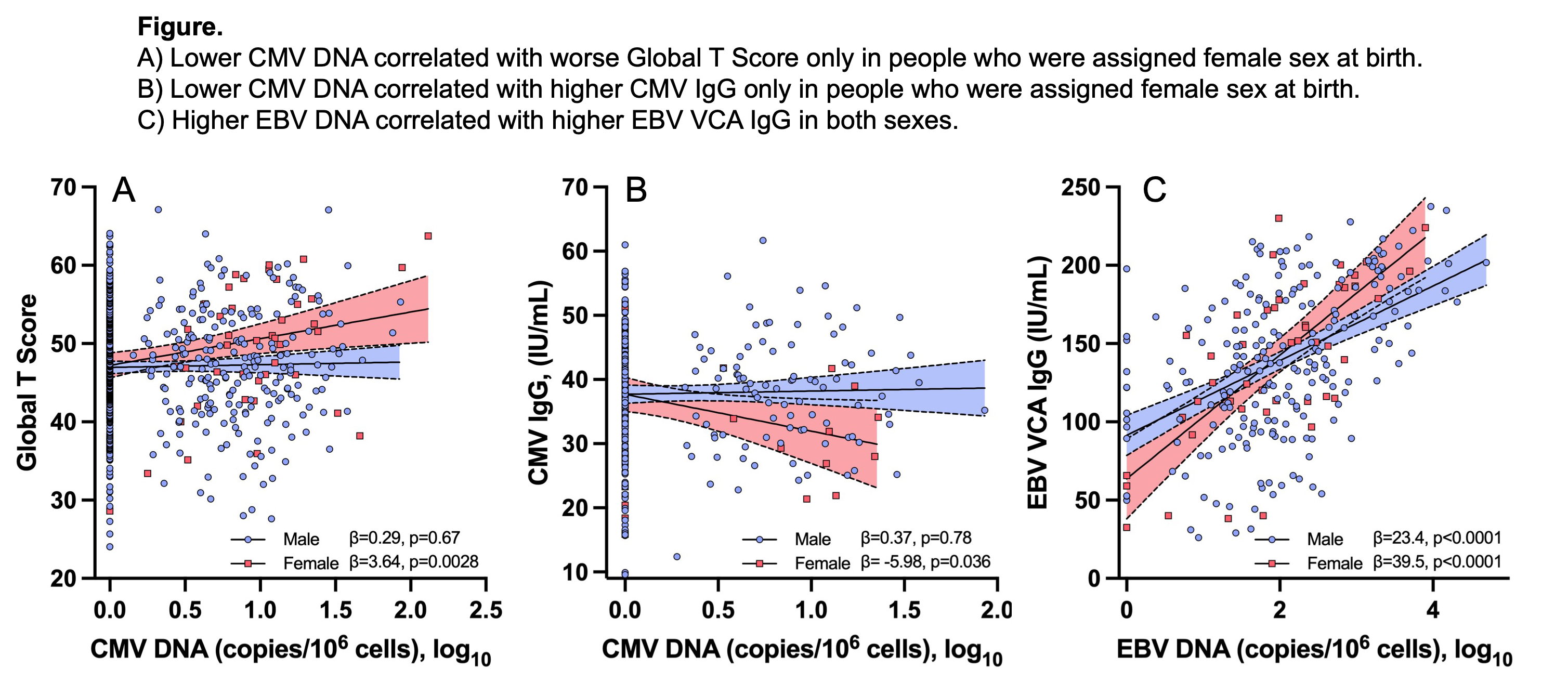
Cohort characteristics: Median age 55 years, 17% female, 55% white, median CD4+ T-cells 629/µL, EDI 21 years, and 65% with AIDS diagnosis. CMV DNA was detected in 45.4% and EBV DNA in 95.5% of samples. Overall, lower levels of CMV DNA tended to associate with worse Global cognitive T score (p=0.095). Sex and CMV DNA interacted (p=0.004) in relation to Global T score: lower CMV DNA was associated with worse Global T score only in women (p < 0.0001). Among women, lower CMV DNA correlated with worse processing speed (p=0.0017), executive functioning (p=0.002), working memory (p=0.025), learning (p=0.026) and recall (p=0.018). In unadjusted analyses, lower CMV DNA also correlated with higher CMV IgG only in women (p=0.036, interaction p=0.05). CMV IgG, EBV VCA IgG, EBV DNA, and HIV DNA levels did not significantly correlate with global T scores. Higher EBV DNA correlated significantly with higher EBV VCA IgG in both sexes (p< 0.001) with trend toward sex interaction (p=0.06).
Conclusions:
In PWH, lower CMV DNA levels were associated with higher CMV IgG and worse cognitive performance only in women. These sex-specific effects emphasize the complex interactions between co-infections, host immune factors, and cognition. Further research is needed to confirm our findings in an independent cohort that includes more women with and without HIV and to identify specific immune mechanisms, which might be targeted to improve or prevent cognitive decline.
Associations Between Viral DNA, Antibody Titers and Cognition (unadjusted linear regression)