Background:
Smoking is highly prevalent in people living with HIV/AIDS (PLHA) producing detrimental effects in different organs and leading to illness. There is limited evidence about pharmacological interventions for treating nicotine dependence in PLHA. We examined if Nicotine replacement therapy (NRT) is an option for smoking cessation and ameliorates vascular health in this specific population
Methods:
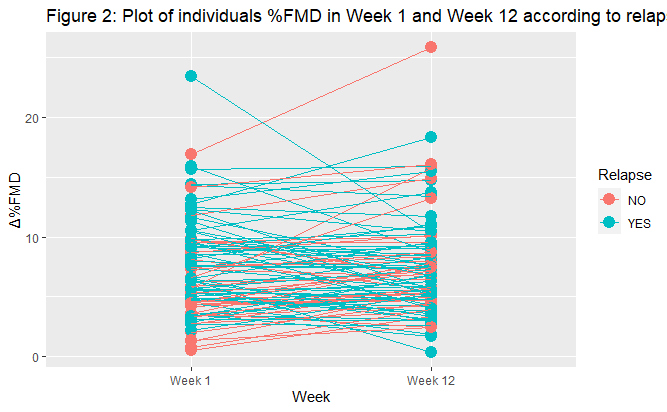
From December 2019 to April 2022, we prospectively enrolled PLHA who were actively smoking in our center. The primary outcome of interest was to assess the effect of NRT plus counseling on smoking cessation and endothelial function measured by brachial artery flow-mediated dilatation (FMD). Statistical analysis evaluated the change in %FMD (Δ%FMD= %FMD at week12-%FMD at baseline) to test the hypothesis that Δ%FMD would improve among participants who quit smoking compared to those who relapse. To confirm the results, we have run multiple linear regression to account for classical cardiovascular (CV) confounders. Results are presented in medians (interquartile ranges) and percentages
Results:
We included 117 participants with median age of 45.5 years (IQR= 36.4-54.8); 29 (25.4%) had hypertension, 10 (8.8%) had diabetes and 33 (28.4%) had dyslipidemia, almost half were smoking 20+ cigarettes/day (41.4%). Individuals were living with HIV for a median of 10.9 years (5.6-17.6) and were on antiretroviral therapy for 8.6 years (3.7-13.6) with median Nadir of CD4 of 307 (153-490.5). Baseline of median brachial artery diameter was 3.6 mm (IQR= 3.2-4.1). Unadjusted analysis showed that years of smoking, younger age and white race were associated with poor %FMD (75th per centile). After 12 weeks 44.4% participants quit smoking. Comparison of Δ%FMF change from baseline to week 12 showed that among participants adherent to therapy, there has been an increase in Δ%FMD when compared to those who relapsed (1.17% [0.29-2.98] vs -0.19% [-1.9-0.91], p< 0.001). After adjustment for CV factors, multiple linear regression showed that participants who quit smoking present a mean of 2.54 (p=0.001) points increase in Δ%FMD in comparison to those who continued to smoke.
Conclusions:
This study provides evidence that a strategy of NRT and counseling is effective for smoking cessation in PLHA leading to an improved vascular health in a short period of time. This reinforces the importance of the widespread anti-tobacco programs in HIV clinics and the expected impact lowering the incidence of future cardiovascular events