Background:
Since the latent HIV reservoir persists on antiretroviral therapy (ART), additional interventions are needed to achieve remission and potentially HIV cure. Therapeutic vaccination to enhance HIV-specific T cell immunity is a focal strategy in the pursuit of the cure. Here, we evaluated safety and immunogenicity of a novel heterologous SIV vaccine in combination with immune modulators in macaques.
Methods:
Naive rhesus macaques (n=6/group) were immunized with a chimpanzee adenovirus (ChAd) and self-amplifying mRNA (samRNA)-based vaccine alone or in combination with either anti-PD-1 antibody (aPD-1), anti-CTLA4 antibody (aCTLA4) or FLT3R agonist (FLT3Ra). ChAd and samRNA vectors encoding full length SIV Gag, Pol and Env antigens were administered intramuscularly on weeks 0 & 24 (ChAd) and 4, 12 & 42 (samRNA). aPD-1 and aCTLA4 were dosed subcutaneously and/or intravenously concomitant with immunization. FLT3Ra was dosed intravenously 1 week prior to immunization. Immunogenicity was characterized by IFNγ ELISpot and multi-parameter flow cytometry.
Results:
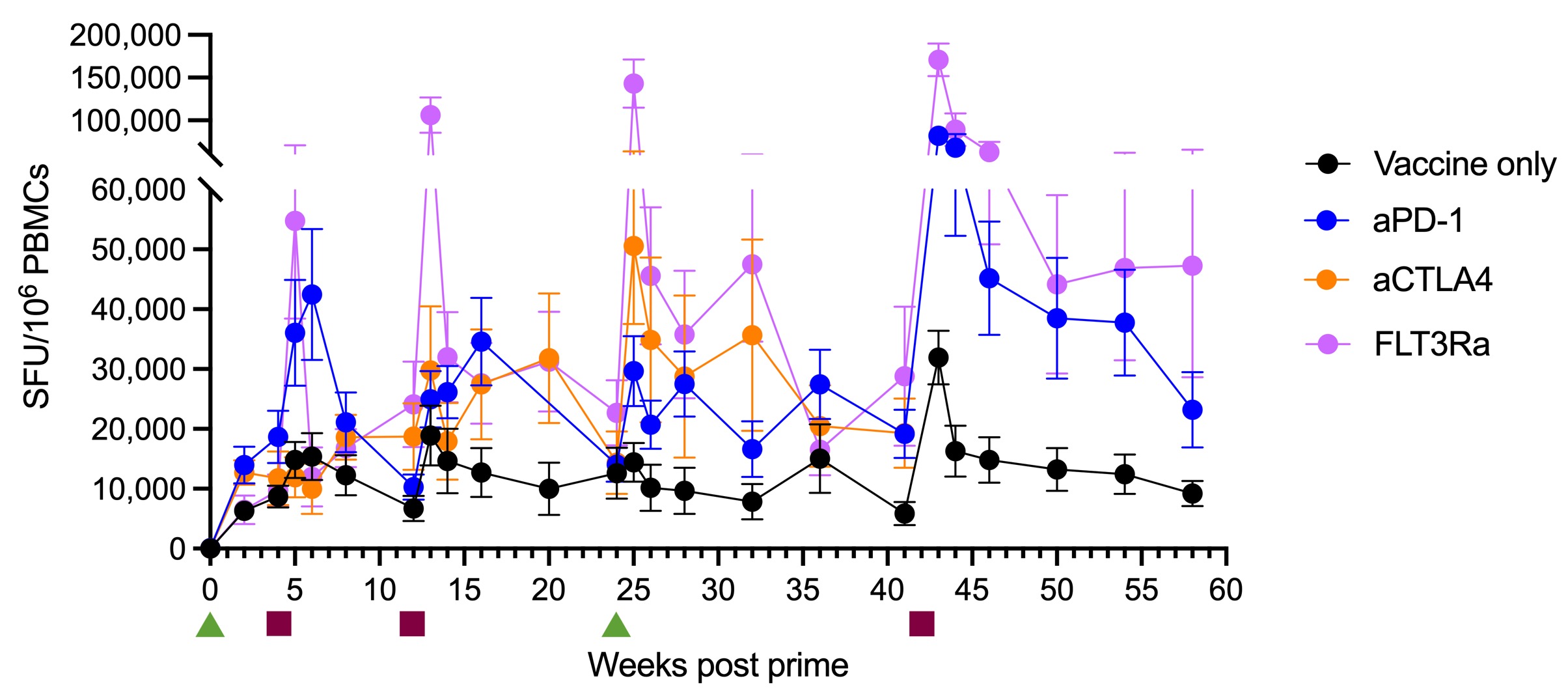
All regimens were well tolerated with transient small increases in inflammatory markers and body temperature. The vaccine elicited strong IFNγ ELISpot responses 4 weeks post-ChAd prime (8,724±1,845 SFU/106 PBMCs, mean±SEM), which were further augmented by boosts with samRNA (mean 1.8, 3.7, and 11.5-fold increase post each boost, respectively) and ChAd (1.7-fold increase). The responses peaked at 32,234±4,433 SFU/106 PBMCs (mean±SEM) and were durable through at least 16 weeks post last immunization (range 3,398 – 15,360 SFU/106 PBMCs). Combination with either aPD-1, aCTLA4 or FLT3Ra further augmented mean peak T cell response magnitude by 2.8, 2.4 and 5.7-fold, respectively. When assessed using antigen-derived overlapping peptides, the breadth of responses at week 13 was greater in combination with aCTLA4 or FLT3Ra than with vaccine alone (p< 0.05). Vaccine alone elicited predominantly CD8+ T-cell responses (1.9% IFNγ+/CD8+ and 0.6% IFNγ+/CD4+, week 13), while FLT3Ra also robustly enhanced CD4+ T cell responses (2.0% IFNγ+/CD8+ and 3.5% IFNγ+/CD4+, week 13). T cell responses were polyfunctional (predominantly IFNγ+TNFα+) in all groups.
Conclusions:
ChAd/samRNA heterologous SIV vaccine was well tolerated and induced robust and broad antigen-specific T cell responses. The immune responses were augmented by aPD-1, aCTLA4 or FLT3Ra warranting their further exploration as part of a combination therapeutic approach for HIV cure.
Figure 1. Strong and durable SIV-specific T cell response in rhesus macaques following vaccination with ChAd/samRNA is enhanced by co-administration of aPD-1, aCTLA4 or FLT3Ra. IFNgamma ELISpot, sum of Env, Pol and Gag overlapping peptide pools, background subtracted. Mean +- SEM. Green triangles represent ChAd immunizations and red squares represent samRNA immunizations.