Background:
Dolutegravir (DTG) is now recommended as a first-line treatment for people living with HIV. However, clinical trials among adults have risen concerns regarding DTG-associated weight gain, and real-life data addressing weight gain in adolescents are still scarce. Anthropometric changes are hard to evaluate and a concern, especially during adolescence, a period characterized by changes in body composition. We compare the evolution of a cohort of children and adolescents who switched to DTG-based regimens vs. those who maintained their previous regimens.
Methods:
Retrospective study within the Spanish Cohort of Pediatric HIV. Patients < 18 years of age switching to a DTG-containing regimen before December 2020 and with at least 6 months of follow-up data were included. Patients under follow-up in the same cohort and not receiving DTG or bictegravir were included for comparison. The WHO growth charts were used to estimate zBMI. Linear mixed models were built to model the treatment effects on zBMI over 48 months.
Results:
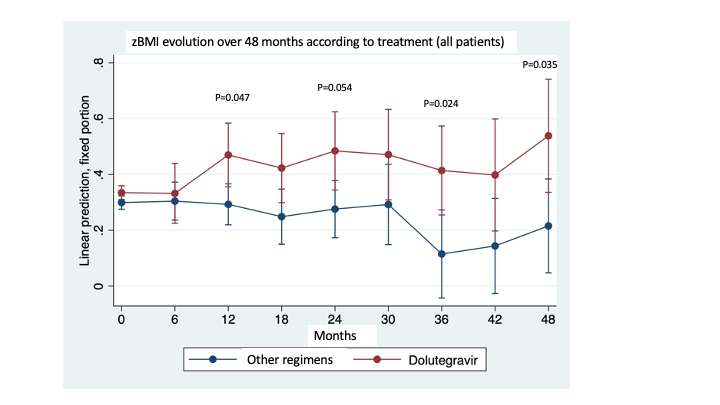
We included a total of 275 patients (135 switching to DTG), 49% female. The median age was of 13.6 ± 2.9 years (48% Caucasian, 28% Black, 9% Latino). DTG regimens mostly included abacavir plus lamivudine (75%). The third drug in the control group included protease inhibitors (45%) efavirenz (32%), or elvitegravir/raltegravir (21%). At baseline, the prevalence of overweight and obesity were 20% and 6.5%, respectively. Both groups were comparable regarding age, gender, ethnicity and zBMI. After controlling for age, sex, ethnicity and baseline zBMI as covariates, subjects switching to DTG experienced a greater adjusted zBMI increase than those remaining on their previous treatment (p=0.027) (Figure 1), with no significant changes in overweight/obesity. Subanalyses indicated that the effect was driven by participants of black ethnicity (n=76), in which the adjusted zBMI gain was especially marked while losing significance in the non-black population.
Conclusions:
Our observational study shows an effect of DTG switch on zBMI, already significant at 12 months and maintained up to 48 months of follow-up, mainly affecting black adolescents. Despite the risk of residual confounders, our results are consistent with previous experience in adults suggesting a higher risk of weight gain in the black population. Larger studies are needed in order to analyze the long-term effects of DTG among children and adolescents, ideally including more precise assessments of body composition.
Figure 1. Anthropometric evolution according to treatment (all patients)