Background:
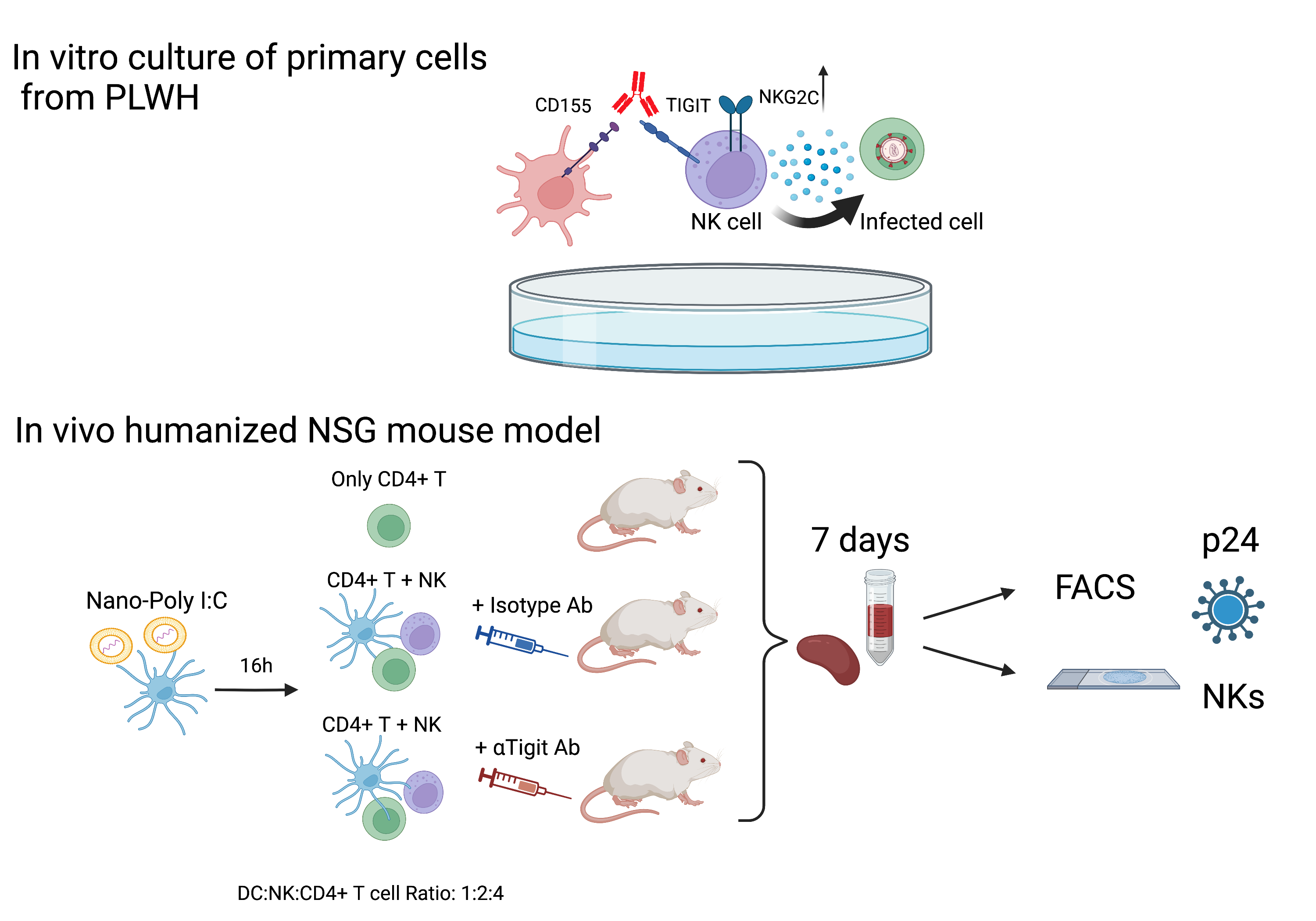
Expression of TIGIT on Natural Killer (NK) cells from People living with HIV (PLWH) limits induction of adaptive NKG2C+ CD57- cells and promotes a dysfunctional state after stimulation with dendritic cell (DC) immunotherapy. Here, we asked whether blockade of TIGIT enhances functional adaptive NKG2C+ NK cells in vitro and in vivo.
Methods:
Monocyte-derived dendritic cells (DCs) from n=9 PLWH on ART and activated with nanoparticle-loaded Poly I:C (Nano-PIC) were cultured with autologous NK cells in the presence of anti-TIGIT or isotypic control mAbs. Reduction of proportions of HIV-1 p24+ cells CD4+ T cells in the presence of NK cells, Romidepsin and Raltegravir was evaluated by FACS. In vivo efficacy of TIGIT blockade on NK cells was addressed by transplanting n=42 immunodeficient NSG mice with CD4+ T cells from the same PLWH alone (n=14) or with NK cells and Nano-PIC DC in combination with either anti-TIGIT (n=14) or Isotypic mAbs (n=14) in three independent experiments. After 7 days, mice were sacrificed and proportions of circulating human CD45+ p24+ CD4+ T cells were analysed by FACS. In addition, histological distribution of p24+ infected cells in the spleen was analysed by confocal microscopy.
Results:
Blockade of TIGIT combined with Nano-PIC DC enhanced the ability of NK cells from PLWH to significantly reduce by 70% the proportions of autologous HIV-1 p24+ CD4+ T cells ex vivo compared to cells receiving an Isotypic mAb (p=0.0078). Importantly, i.p. administration of anti-TIGIT into NSG mice xenotransplanted with CD4+ T cells from PLWH and autologous NK cell and Nano-PIC-DC immunotherapy led to a more significant reduction of p24+ cells (mean reduction 57%, p= 0.0019) within human circulating CD4+ T cells compared to mice receiving only CD4+ T cells, in contrast to mice receiving isotypic control mAb (mean reduction 23.6%, p=0.0479). In addition, significantly lower areas of p24+ foci (Median 1,452 mm2 vs 1,766 mm2; p=0.0078) as well as a trend to larger areas free of infection (Median 1,296.308 mm2 vs 862.210 mm2) were detected in the spleen of mice injected with aTIGIT compared to Isotype mAbs. Interestingly, control of spread HIV-1 infection in spleen was associated with a reduction of CD57 expression (38% aTIGIT vs 63% Isotype mAbs; p=0.0011) on adaptive NKG2C+ cells in this tissue.
Conclusions:
Collectively, combination of DC immunotherapies and TIGIT blockade is a promising strategy to enhance functional NKG2C+ NK responses and limit HIV-1 replication in tissue in vivo.
Schematic Representation of in vitro and in vivo models used to study impact of modulation of TIGIT in functional restoration of NKG2C+ NK cells