Background:
Few data exist on maternal eicosanoid/lipid profiles in pregnant women living with HIV (WLHIV) and their relationship to infant insulin sensitivity.
Methods:
We measured ∼800 eicosanoids/lipid subspecies via liquid chromatography mass spectrometry in fasting plasma samples collected at 24-28 weeks gestational age (GA) from pregnant WLHIV and HIV-seronegative (HIV-) pregnant women enrolled in the Tshilo Dikotla study in Botswana. To evaluate insulin sensitivity in their infants at 1 month (mo) of age, the Homeostasis Model Assessment for Insulin Resistance (HOMA) was assessed and log-transformed; Z scores for birth weight (BWZ) and length (BLZ) were calculated. Volcano plots were used to visualize differences in eicosanoids/lipid subspecies between groups. Lasso regression models were fit to assess maternal factors (age, gestational diabetes) and eicosanoid/lipid subspecies predictive of infant log HOMA at 1 mo of age, stratified by maternal HIV status.
Results:
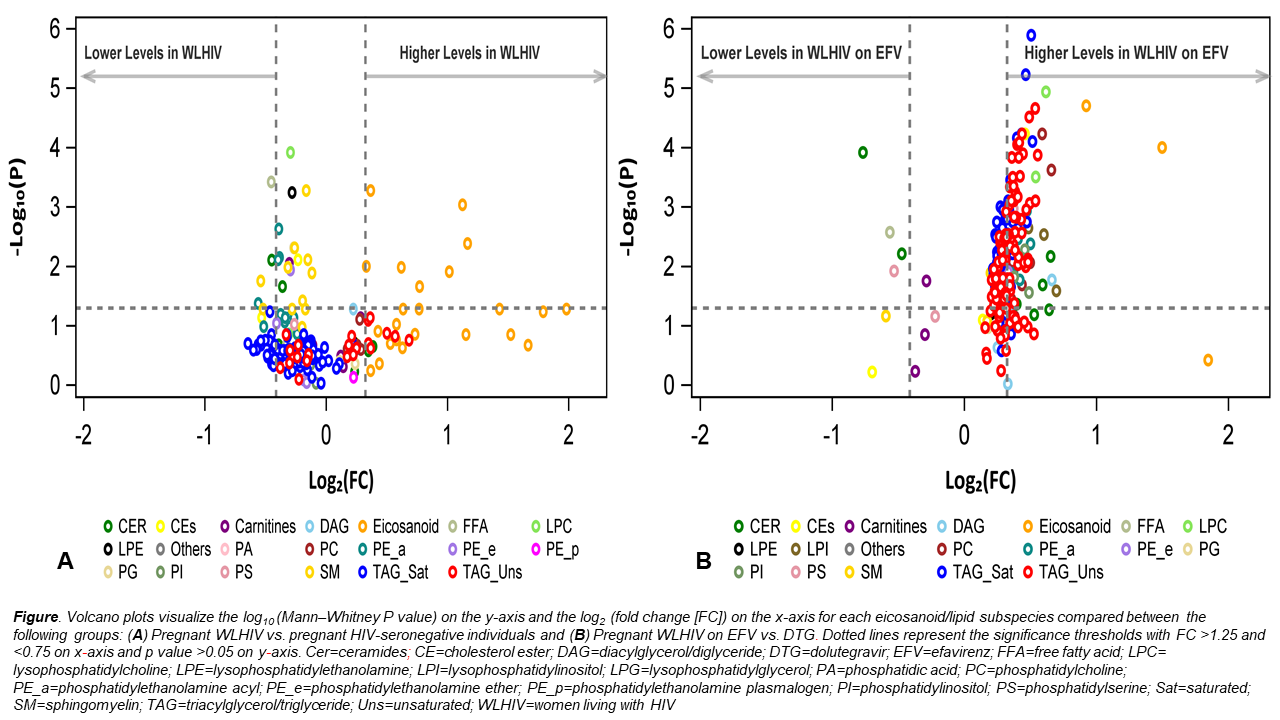
Of 223 pregnant individuals, 146 were WLHIV. Maternal age (30 vs. 26 years, p< 0.01) and gravidity (3 vs. 1, p< 0.01) were higher in WLHIV compared to HIV- women; family history of diabetes, maternal BMI, gestational diabetes, as well as infant GA, BWZ, BLZ, and exclusive breastfeeding were similar between groups. Among WLHIV 47% had a CD4 >500 cells/mm3 and 92% a viral load < 40 copies/mL at enrollment. All WLHIV received tenofovir/emtricitabine plus dolutegravir (DTG) (55%) or efavirenz (EFV) (45%); their infants were randomized to 4 weeks of zidovudine (50%) or nevirapine (50%). Pregnant WLHIV exhibited an eicosanoid profile indicating a presence of pro- and anti-inflammatory mediator production compared to HIV- women. Findings were similar comparing EFV- and DTG-treated women separately to HIV- women. However, EFV-treated women had higher levels of complex lipids, unlike DTG-treated women. (Fig) This maternal dyslipidemic profile included lipid subspecies (lysophosphatidylcholine 20:4 and 22:4) predictive of infant HOMA at 1 mo among WLHIV in lasso regression. No maternal lipid subspecies were associated with infant HOMA in HIV- women.
Conclusions:
In our cohort WLHIV showed partial compensation of pro-inflammatory eicosanoid mediator production. Compared to DTG, EFV was associated with maternal dyslipidemia in pregnancy which was predictive of lower infant insulin sensitivity. Further studies are warranted to delineate whether enhancement of anti-inflammatory mediator production may benefit maternal/infant metabolic outcomes.
Volcano plots comparing eicosanoid/lipid profiles in pregnancy between (A) WLHIV and HIV-seronegative women and (B) WLHIV on EFV vs. DTG