Background:
According to the 2022 UNAIDS report, up to 70% of new HIV infection occur among youths, women, young girls, and key populations and their partners. The HIV prevalence in Cameroon is 2.7%. To reach the UNAIDS testing goal, innovative strategies such as HIV self-test (HIVST) are needed. The objective of this study was to evaluate the effectiveness of HIVST in Cameroon and identify predictors of seropositivity among self-testers (ST).
Methods:
The study was conducted from 2021 to 2022 in 3 regions (Centre, Littoral & South) of Cameroon. The HIVST kits (Oraquick HIV1/2) were distributed according to 5 models: (i) Antenatal, postnatal and maternal and child clinics (ANC/PNC/MCH) (M1), (ii) partners of other HIV+ people (M2), (iii) workplace (M3), (iv) community (M4) & (v) others (M5, including HIV testing services). Tests were performed in private or not using oral fluid. Reactive/invalid tests were confirmed using the national algorithm. Logistic regression was performed to identify predictors of HIV seropositivity among HIV ST.
Results:
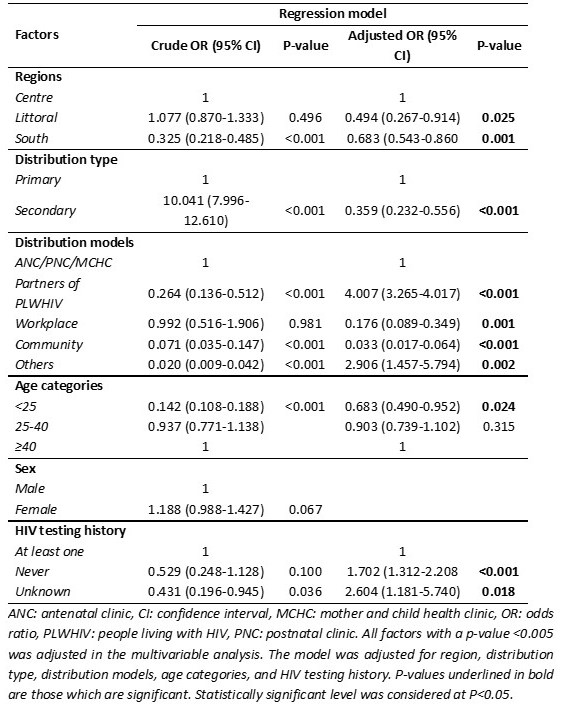
Overall, 42697 people received an HIVST kits, 15.6% were HIV first-testers (FT). 84% (n=35934) reported the test outcome, with M3 showing the lowest proportion (68.2%) vs. 99.0% in M4, P < 0.001. About 2.3% (n=825) of the tests were reactive; of them, 75.8% came for confirmation (M1: 74.0%, M2: 85.7%, M3: 71.8%, M4: 47.1% & M5: 71.4%, P < 0.001). 11.3% (n=93) of reactive tests were non-reactive after confirmation. Overall HIV seroprevalence through HIVST was 1.5% [95% CI: 1.4-1.6] (M1: 1.9%, M2: 6.9%, M3: 0.5%, M4: 0.1% and M5: 7.0%, P < 0.001), with 1.2% positivity among FT. Youths < 25 yrs showed a lower seroprevalence (0.4%) vs. older age (2.6% & 2.7% for 25-39 and ≥40 yrs respectively), P < 0.001. Seropositivity was negatively predicted by secondary distribution vs. primary, M3 & M4 vs. M1, < 25 vs. ≥40 years; while M2 [aOR: 4.007 (3.265-4.017)] & M5 [aOR: 2.906 (1.457-5.794)] vs. M1, and FT [aOR (95% CI): 1.702 (1.312-2.208)] vs. those who tested ≥1 time) positively predicted seropositivity (Table 1). Of the HIV+, 95.5% (95% CI: 93.5-97.0) were linked to ART. According to distribution model, a lower proportion was seen in M4 (87.5%) vs. 98.7% in M2, P < 0.001. Those who were tested ≥1 time for HIV showed a higher proportion linked to ART (96.2%) vs. first-testers (93.2%), P=0.034.
Conclusions:
HIVST using M1, M2 & M5 distribution models is an effective testing strategy in Cameroon. Moreover, linkage to treatment is very high through HIVST strategy.
Predictors of HIV seropositivity among HIV self-testers in Cameroon.