Background:
Immunocompromised hosts with prolonged SARS-CoV-2 infections have been associated with the emergence of novel mutations, especially in the Spike protein, a key target for vaccines and therapeutics. Here, we conducted a case-control study to measure the genetic diversity of SARS-CoV-2 and to search for immunocompromised-specific minority variants.
Methods:
SARS-CoV-2-positive patients with lung/cardiac/kidney transplant, HIV-positive, or treated with high doses of corticosteroids for auto-immune diseases were considered as immunocompromised hosts. SARS-CoV-2-positive healthcare workers with no auto-immune disease were used as controls. Samples were analyzed by RT-qPCR at Pitié-Salpêtrière and Bichat Claude-Bernard university hospitals (Paris, France). Samples with Cycle threshold < 30 were selected for SARS-CoV-2 whole-genome sequencing using Oxford Nanopore protocol. Raw sequence data were mapped onto the Wuhan-Hu-1 reference genome, and consensus sequences were produced to determine the lineage. Only sequences covering at least 95% at ≥50X depth of the Spike gene were investigated. In-house algorithms were developed to identify all majority and minority mutations in Spike. We defined a minority variant when it was present in ≥6% and < 50% of the reads; and a majority variant when it was present in >50%.
Results:
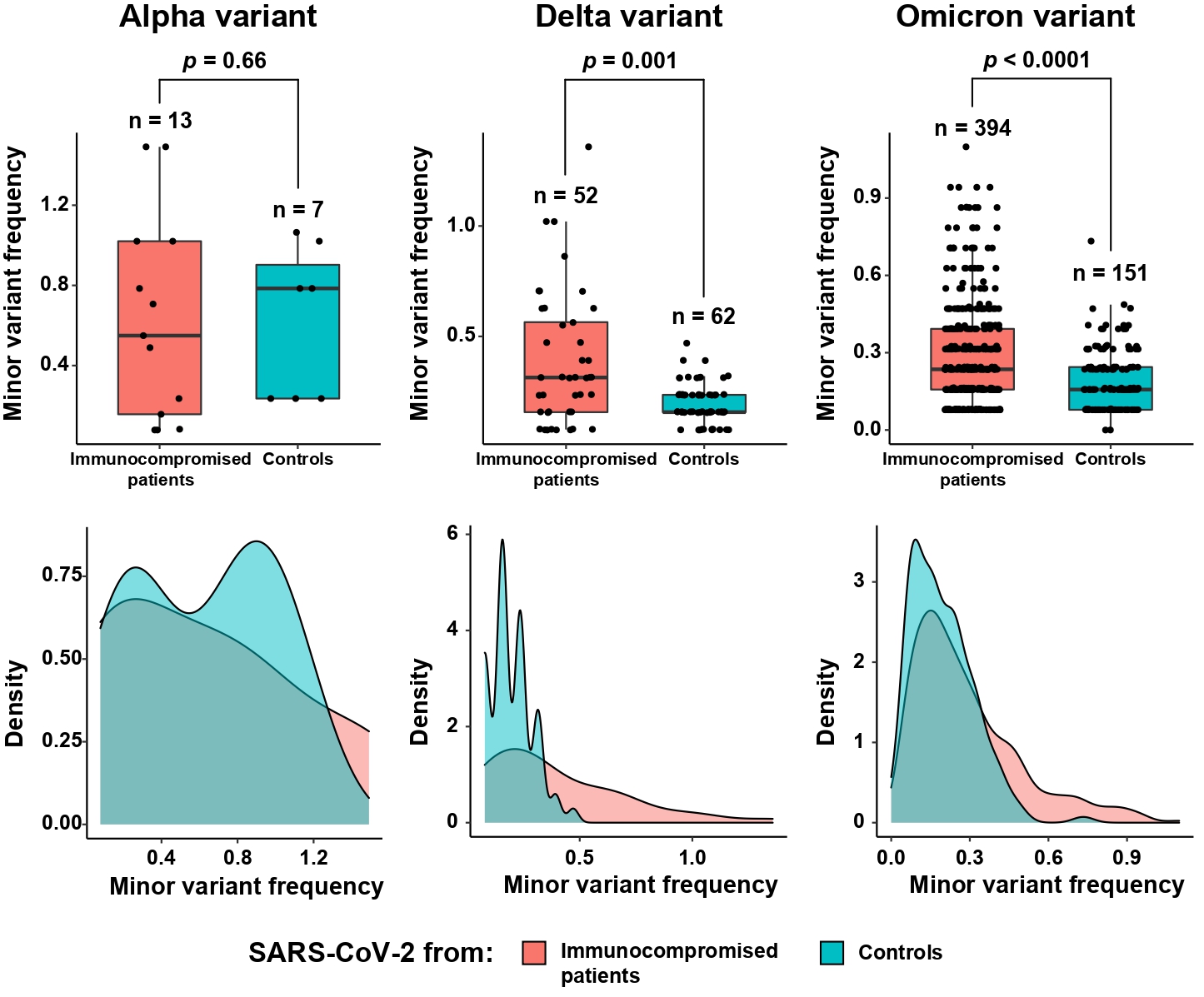
We sequenced SARS-CoV-2 genome from 478 COVID-19-positive immunocompromised patients and 234 controls. More minority non-synonymous mutations in Spike were detected in viruses from immunocompromised hosts, compared to viral genomes from controls, in both Delta (p=0.001) and Omicron (p< 0.001) lineages, but not in Alpha (p=0.66) (Figure 1). Interestingly, among the 52 patients infected with the Delta variant, we concomitantly detected at low frequencies the mutations H655Y, N764K, D796Y, in three patients (associated with different auto-immune disease), that are part of Omicron variants signature mutations. Similarly, some patients (n=7) infected by Omicron BA.1 lineage had R346T at low-frequency, later fixed in Omicron BA.4.6 and BQ.1.1 lineages. None of these mutations were observed in the viral genomes from controls.
Conclusions:
Here, we report a higher genetic diversity in Spike gene among SARS-CoV-2 sequences from immunocompromised hosts for Delta and Omicron lineages. These results suggest that immunocompromised patients are more likely to allow viral genetic diversification and are associated with a risk of emergence of novel SARS-CoV-2 variants.
Variable levels of Spike gene evolution for different SARS-CoV-2 lineages in immunocompromised hosts and care workers “controles” without autoimmune disease.