Background:
People living with HIV (PLWH) on long-term ART who maintain virological suppression continue experiencing blood telomere length (BTL) gain. However, ART containing NRTIs, such as tenofovir (TFV) or abacavir (ABC), which are potent inhibitors of human telomerase activity, has been shown to negatively affect the BTL increase. We investigated the effect on BTL at 1 year after switching to a dual therapy (DT) with dolutegravir (DTG) plus lamivudine (3TC) as the only NRTI vs maintaining a standard triple therapy (TT) with an anchor drug plus two NRTIs, one of which was TDF/TAF or ABC.
Methods:
This was a prospective, longitudinal, matched, controlled study. We enrolled adults on stable (≥1 year) 3-drug ART and HIV-RNA< 50cps/mL who switched at baseline (BL) to DT or maintained TT; DT and TT groups were 1:1 matched for age, sex, years since HIV diagnosis, years on ART and anchor drug in the BL 3-drug regimen. BTL was assessed by a monochrome multiplex qPCR at BL and after 48 weeks (W48) and it was calculated as the telomere to albumin single copy gene (T/S) ratio. Comparison of BTL between and within groups was evaluated with parametric tests. Linear regressions were carried out to identify the variables associated with BL BTL and BTL changes over time.
Results:
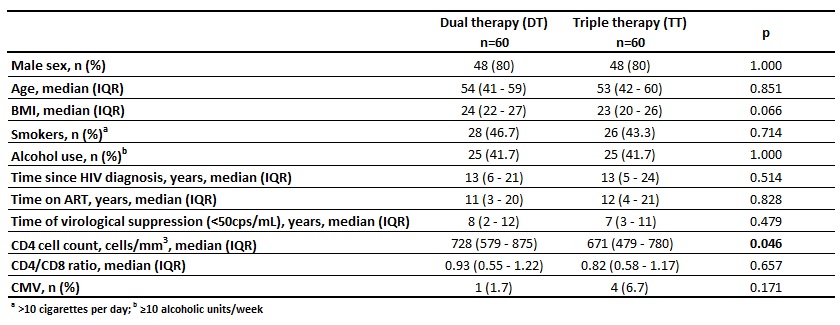
Between 2018-2021 we enrolled 120 PLWH, 60 in each group. The two groups were homogeneous for all main characteristics, except for slightly higher CD4 count in DT (Table 1). At BL, the BTL means (95%CI) were comparable between the two groups: 1.03 (0.98-1.08) for DT and 1.02 (0.96-1.07) for TT (p=0.704). At W48, viro-immunological status was stable and an overall increase in the mean (95%CI) BTL was observed, +0.05 (0.02-0.08) (p=0.001). However, a within-group analysis showed a significant mean BTL gain in the DT group [+0.08 (0.04-0.12), p< 0.001], but not in the TT group [+0.03 (-0.02-0.072), p=0.285]. In a multivariable regression, younger age (-0.009 per +1 year increase; -0.011/-0.006; p< 0.001), being female (vs male +0.098; 0.014/0.181; p=0.022) and higher CD4/CD8 ratio (+0.060; 0.0002/0.119; p=0.050) were independently associated with higher BL BTL. Higher BTL change was associated with DT group (+0.060; 0.003/0.117; p=0.041) and with shorter BL BTL (-0.297; -0.440/-0.153; p< 0.001).
Conclusions:
In this setting, switching to a dual regimen with 3TC plus DTG was associated with higher gains in BTL than maintaining triple therapy after the 1-year follow-up. These data suggest that dual therapy could have a positive effect on BTL.
Table 1. Characteristics of participants at baseline