Background:
Antibodies (Ab) against the receptor-binding-domain of the spike protein (anti-S-RBD) elicited by SARS-CoV-2 infection or vaccination are deemed to be a correlate of protection. We aimed at assessing whether anti-S-RBD titer is associated with the outcome of subjects hospitalized with COVID-related pneumonia.
Methods:
Adults hospitalized between Jul 2021 and Jul 2022 for COVID-19 with respiratory failure (SpO2 < 93% on room air) or radiological evidence of pneumonia were included if anti-S-RBD titer was measured within 72h of admission.Time between admission and death/need for intubation was described using Kaplan-Meier curves. Cox Regression analysis, stratified by vaccination status, was used to explore the association between anti-S-RBD titer and survival. Age, gender, days since symptom onset, immunosuppressive conditions and use of monoclonal Ab (mAb) were explored as possible confounders.
Results:
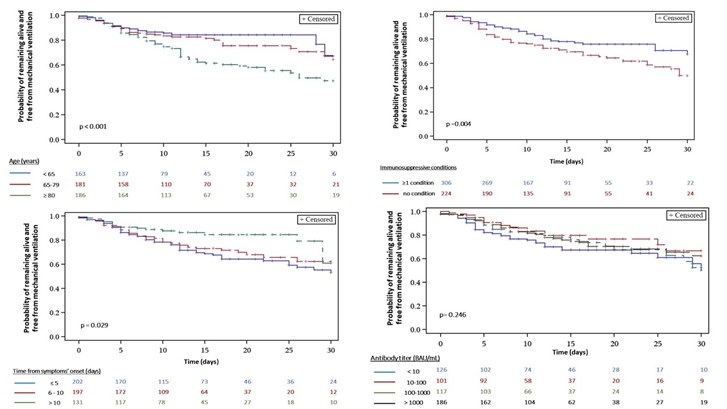
534 patients were enrolled. Their mean age was 71 years, 63% were male and 61% vaccinated; 42% had ≥1 immunosuppressive condition among hematological or solid malignancy, HIV, diabetes, end-stage renal failure, liver cirrhosis, organ transplant or immunosuppressive treatment. Antibody titer was significantly higher among vaccinated than among unvaccinated patients (1166 vs 158 BAU/ml; p< 0.001). Among vaccinated subjects, lower titer of anti-S-RBD were measured among those with hematological malignancies (1282 vs 471 BAU/mL; p< 0.001) or who were receiving immunosuppressive therapy (1287 vs 537 BAU/ml; p< 0.001). Older age, shorter time between onset of symptoms and hospitalization and immunosuppressive conditions were associated with higher rates of death or intubation (Fig 1).Using Cox regression stratified for vaccination, a significant association between anti-S-RBD titer and risk of death/intubation was observed (per log2 BAU/ml increase, HR 0.93; 95%CI 0.88-0.99; p=0.020), independently of age (per year increase, HR 1.03; 95%CI 1.01-1.04), male gender (HR 1.00; 95%CI 0.70-1.42) and presence of immunosuppressive conditions (HR 1.46; 95%CI 1.01-2.10). Adjustment for mAb treatment did not change the results to a significant extent.
Conclusions:
Low anti-S-RBD titer was associated with poor outcome among patients hospitalized for COVID19-related pneumonia, regardless of vaccination. In addition, older age and presence of immunosuppressive conditions remain important predictors of mortality.
Kaplan-Meier Curves for intubation-free survival according to age, days from symptoms’ onset, presence of immunosuppressive conditions and anti-S-RBD titer.