Background:
Thanks to modern HIV therapy, people living with HIV now have a far longer lifespan; however, people aging with HIV are more likely to develop chronic diseases. Syndemic of viral infections is also associated with increased risk of end-stage renal disease (ESRD). Additionally, hypertension and diabetes are important risk factors for ESRD. We assessed the impact of HBV, HCV and HIV mono-, co- and triple infections on incident ESRD, in people with and without hypertension or diabetes.
Methods:
All people who were tested in British Columbia (BC) between 1990 and 2015 for HBV, HCV, and HIV are included in the BC Hepatitis Testers Cohort and linked to administrative health databases. Individuals tested for all three infections were followed from the date of their last test until 1) incident ESRD 2) death or 3) 2021/03/31. We adjusted for sex, birth year, ethnicity, material/social deprivation, alcohol use, drug dependence, major mental illness, opioid agonist therapy and injection drug use, and estimated subdistributional hazard ratios (sHRs) for incident ESRD with Fine-Gray competing risk models. The impact of infections on ESRD by baseline hypertension or diabetes status was examined.
Results:
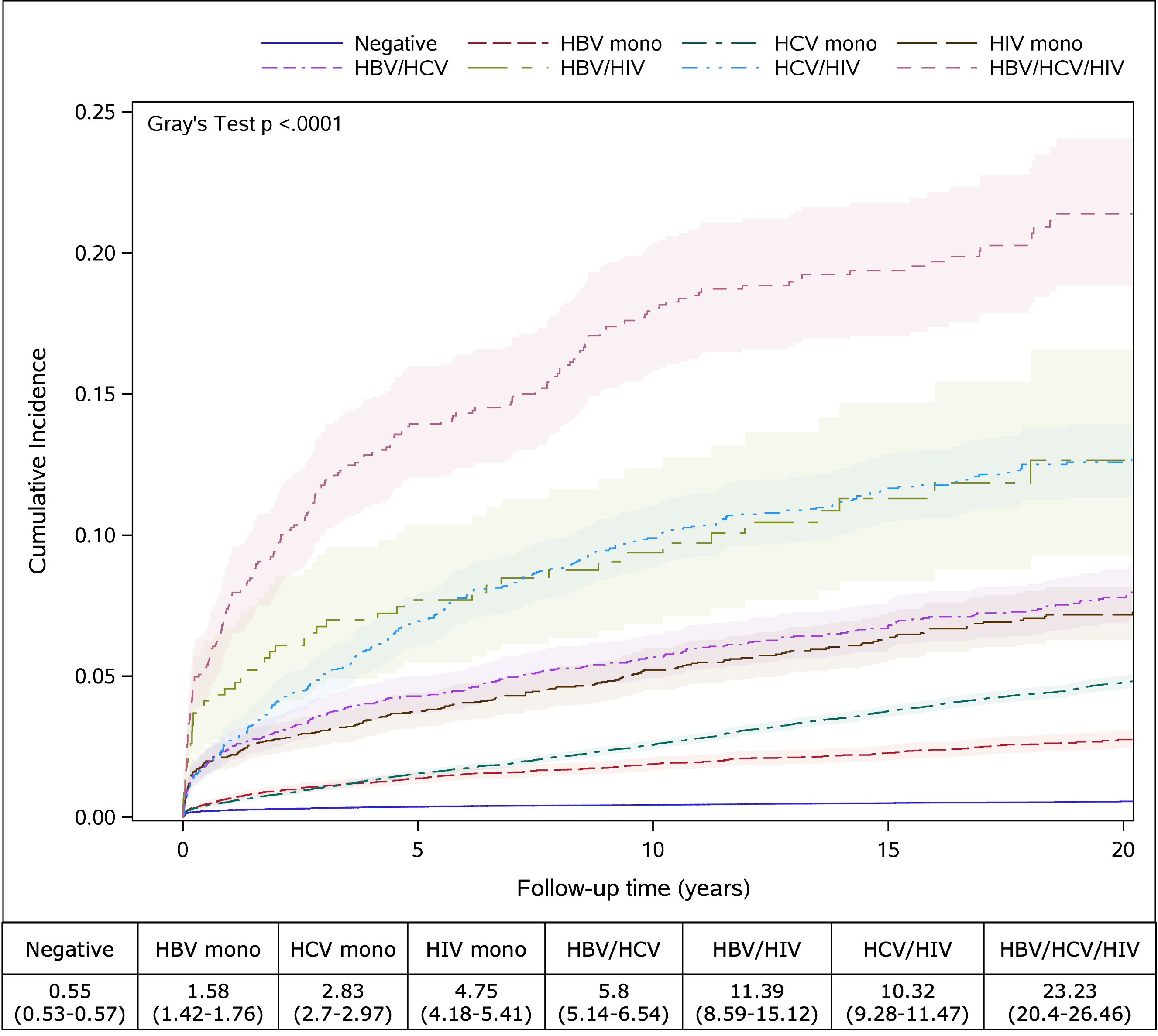
The study included 690,873 people after excluding those with prevalent ESRD. There were 5,552 incident ESRD (0.8%) and 49,752 deaths (7.2%) during a median follow-up of 6.3 years. The highest ESRD incidence rate (per 1,000 person-years) was in persons with triple HBV/HCV/HIV infection (23.23), followed by HBV/HIV (11.39), HCV/HIV (10.32), HBV/HCV (5.8) coinfections, and HIV (4.75), HCV (2.83) and HBV (1.58) monoinfections. In multivariable analysis, compared to those with no infection, people with triple infection had the greatest ESRD risk (asHR 16.9, 95%CI 14.4-19.9). In people with no baseline diabetes or hypertension, those with triple infection had the highest asHRs for ESRD (22.5, 95%CI 19.0-26.5, and 30.5, 95%CI 25.6-36.3, respectively). Among those with diabetes or hypertension, people with HBV/HIV coinfection had the highest asHRs (39.9, 95%CI 20.8-76.9, and 41.3, 95%CI 22.9-74.5, respectively), though 95% CIs overlapped with asHRs for those with triple infection (27.7, 95%CI 16.1-47.9, and 36.8, 95%CI 23.9-56.6, respectively).
Conclusions:
Syndemic of HBV, HCV and HIV infections and chronic comorbidities significantly increased the risk of ESRD. Prevention and surveillance for ESRD is crucial for the aging population with viral infections, especially among those with hypertension or diabetes.
Figure: Cumulative incidence curves of incident ESRD among individuals with viral infections; table shows ESRD incidence rates per 1,000 person-years (95% confidence interval)