Background:
While a low CD4/CD8 ratio during HIV treatment correlates with immune activation, its predictive value for identifying people living with HIV (PWH) at increased risk of serious non-AIDS events (SNAEs) remains debated. We used data from the Spanish CoRIS cohort to assess whether the CD4/CD8 ratio at year 2 of antiretroviral therapy (ART) predicts the incidence of SNAEs in the following 5 years.
Methods:
Eligible individuals were PWH with ART initiation up to 2014 (to allow for a 7-year follow-up) and HIV-RNA < 50 copies/mL at 2 years. Participants with a history of AIDS events or SNAEs were excluded. The predictor variable was achieving a CD4/CD8 ratio above the cutoff (0.25, 0.5, and 1.0) at year 2 of ART initiation. The primary outcome was the cumulative incidence of SNAEs (major adverse cardiovascular event, neoplasia, or death) during the subsequent 5 years. Follow-up started at year 2 after ART initiation and ended at the earliest of loss to follow-up, ART discontinuation, or administrative end of follow-up. We estimated the 5-year risk via a double-weighted pooled logistic regression to account for selection bias due to censoring. Covariates included age, sex, date of enrolment, risk group, education level, geographical origin, AIDS diagnosis, HIV-1 RNA, and CD4/CD8 at ART initiation. We computed survival curves introducing a time-varying intercept to allow the hazard to vary over time.
Results:
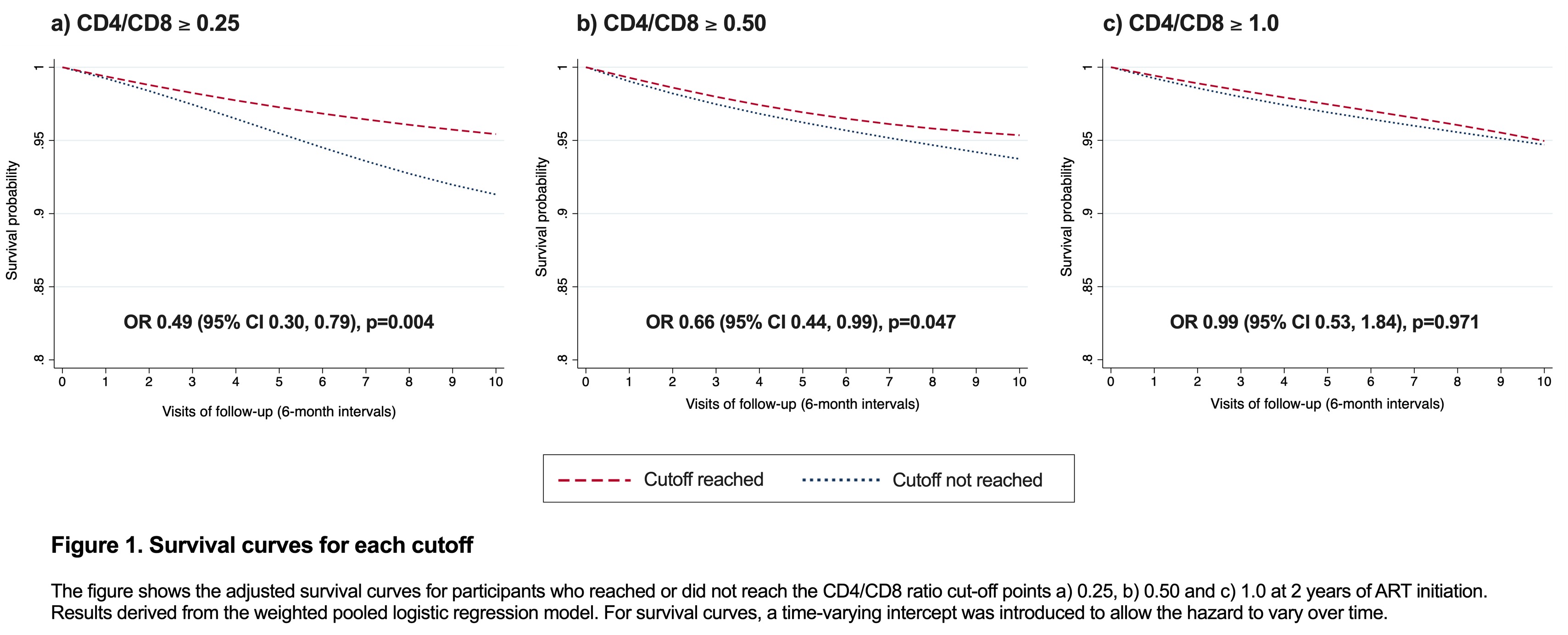
We included 4625 participants. Median age was 37 years, 87% were male, median CD4/CD8 ratio at ART initiation was 0.29 (IQR 0.17, 0.46). At 2 years after ART initiation, 75%, 53%, and 16% of participants achieved a CD4/CD8 ratio >0.25, >0.5, and >1.0, respectively. 11% were censored due to loss to follow-up or ART discontinuation, and 4% had a SNAE during follow-up. Figure 1 shows the survival curves and the odds ratio for the event during follow-up. Participants who did not reach a CD4/CD8 ratio of 0.5 had a significantly increased risk of SNAEs, which was higher if CD4/CD8 < 0.25. Sensitivity analyses with additional adjustment for CD4+ at year 2 yielded similar results. Exploratory analyses for each 0.10 increase in CD4/CD8 showed that 0.50 was the highest ratio that maintained a statistically significant association with the incidence of SNAEs.
Conclusions:
This study provides new evidence that a low CD4/CD8 ratio (< 0.5) after 2 years of ART is associated with an increased risk of SNAEs during the following 5 years. Future studies should address possible differences over the longer term.