Background:
Assessing national HIV epidemics requires accurate data on new HIV infections and HIV-related deaths. Mortality estimates are challenging in settings with incomplete vital statistics. We used unique survey data on household-level mortality and HIV status to estimate excess mortality associated with HIV epidemics. We compared mortality between individuals in households (HH) with and without people living with HIV (PLWH) and explored how a diagnosis of tuberculosis (TB) may modify mortality estimates.
Methods:
We used publicly available data from 6 Population-based HIV Impact Assessment (PHIA) surveys conducted in Cameroon, Cote d’Ivoire, Ethiopia, Malawi, Tanzania, and Zimbabwe between 2015-2018. Heads of HH of randomly selected HH were asked to list all usual HH members and whether any usual HH members died in the 3 years before the survey. For each death reported, they indicated sex of the deceased, age at death and date of death. All consenting HH members answered questions about their TB status and provided blood for rapid HIV testing. We calculated the number of reported deaths per 1,000 for the 3-year period before the survey, and measured mortality differences associated with the presence of documented HIV and/or self-reported TB among HH members. Analyses included all usual HH members. Multi-country weighted deaths per 1,000 were calculated.
Results:
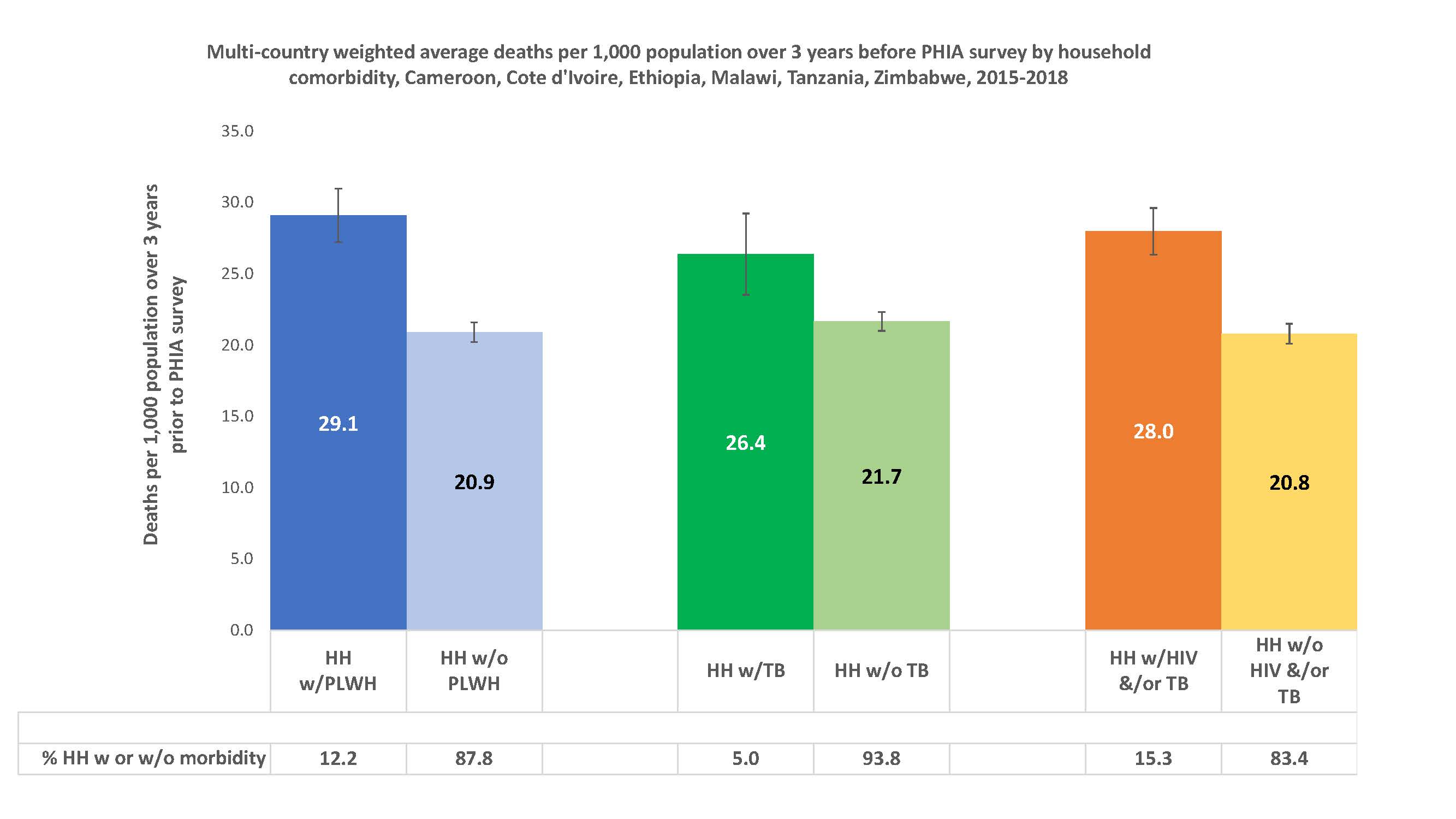
The number of HH in each survey ranged from 8,983 in Cote d’Ivoire to 14,811 in Tanzania. The percent of HHs reporting any deaths in the prior 3 years ranged from 3.7%-12.9%. The estimated crude number of deaths in the prior 3 years ranged from 11.4 in Ethiopia to 32.7 per 1000 in Cameroon. In multi-country analyses, the number of weighted deaths per 1,000 were 29.1 (95% Confidence Interval (CI): 27.2-31.0) versus 20.9 (95% CI: 20.2-21.6) for individuals in HH with and without PLWH; 26.4 (95% CI: 23.5-29.2) versus 21.7 (95% CI:21.0-22.3) for those in HH with and without TB case(s); and 28.0 (95% CI: 26.3-29.6) versus 20.8 (95% CI: 20.1-21.5) for those in HH with HIV and/or TB versus without HIV or TB (Figure).
Conclusions:
In this first description of mortality using PHIA data from 6 nationally representative surveys, HH with residents who had HIV and/or TB had significantly higher numbers of deaths compared to HHs with residents who had neither. These findings suggest a new approach, which captures indirect effects of HIV on mortality of HH members, to tracking progress towards zero AIDS-related deaths.
Multi-country weighted average deaths per 1,000 population over 3 years before PHIA survey by household comorbidity, Cameroon, Cote d’Ivoire, Ethiopia, Malawi, Tanzania, Zimbabwe, 2015-2018