Background:
In mid-2022, New York City (NYC) became the epicenter of the US mpox epidemic. Health authorities were in need of forecasts to anticipate the timing and magnitude of the outbreak. We provided mathematical model-based projections with methodologies that evolved alongside the epidemic. Here, we retrospectively evaluate our mpox case projections and reflect on potential reasons for accuracies and inaccuracies.
Methods:
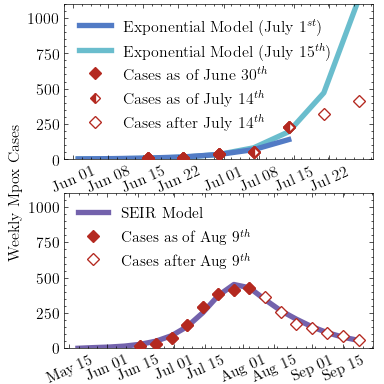
Early in the outbreak (July 1 – 15, 2022), when the size of the at-risk population was unknown, we performed short-term (2-week) forecasting using exponential regression. Once epidemic growth was no longer exponential (July 15 – Aug. 9), we consulted with the NYC Department of Health and Mental Hygiene regarding populations most-at-risk of mpox based on available epidemiological data. Modelers and epidemiologists collaboratively developed an estimate of 70,180 people at risk, informed by estimates of LGBTQ adults with male sex at birth who had 2+ partners in the last 3 months. We combined this with NYC case count data, NYC vaccination data, and global mpox natural history data to develop a Susceptible-Exposed-Infected-Recovered (SEIR) model, taking into account immunity accrued through vaccination and prior exposure, for longer-term forecasting.
Results:
Initial exponential forecasts of the NYC mpox outbreak were only accurate for very short-term predictions (< 2 weeks) (Figure, top panel). Forecasts were more accurate after 1 week (mean absolute error: 83.0 cases/wk) than after 2 weeks (mean absolute error: 351.4 cases/wk). In contrast, the SEIR model accurately predicted the decline in cases through the end of Sept. 2022, when cases fell to < 70/wk. Over the period from Aug. 10 to Sept. 24 2022, the mean absolute error of the SEIR-based projection was 8.2 cases per week (Figure, bottom panel).
Conclusions:
Model-based NYC mpox projections provided only short-term accuracy in the early epidemic, but long-term accuracy once the epidemic exited exponential growth and an SEIR model was developed. Cumulative cases and vaccinations when exiting exponential growth, and the epidemiology of those most-at-risk, provided evidence for the likely size of the most-at-risk population – a crucial input for an accurate SEIR model. The ability of the SEIR model to accurately forecast mpox cases was in part attributable to lack of vaccine or immune escape by mpox, in contrast to more rapidly-evolving viruses such as SARS-CoV-2.
Weekly Mpox Cases and Model Projections