Background:
Broadly neutralizing antibodies (bNAbs) targeting HIV-1 Env are under study as a strategy in cure research. Viral env is genetically diverse, with distinct bNAb sensitivity profiles across hosts. Here, we developed a pipeline to analyze bNAb-associated resistance genotypes in intact and defective HIV DNA genomes. We hypothesize that intact genomes will have distinct bNAb resistance profiles relative to defectives.
Methods:
HIV-1 DNA genomes were sequenced from 1 viremic and 11 virologically suppressed individuals on long-term ART via single genome amplification (HXB2 638-9632). Genomes were classified as intact or defective using HIVSeqinR software. Resistance features against CD4 binding site-, V2-, and V3-targeting bNAbs examined include specific env residues, as well as hypervariable loop characteristics such as total length, number of N-linked glycosylation sites (PNGs), and electric charge.
Results:
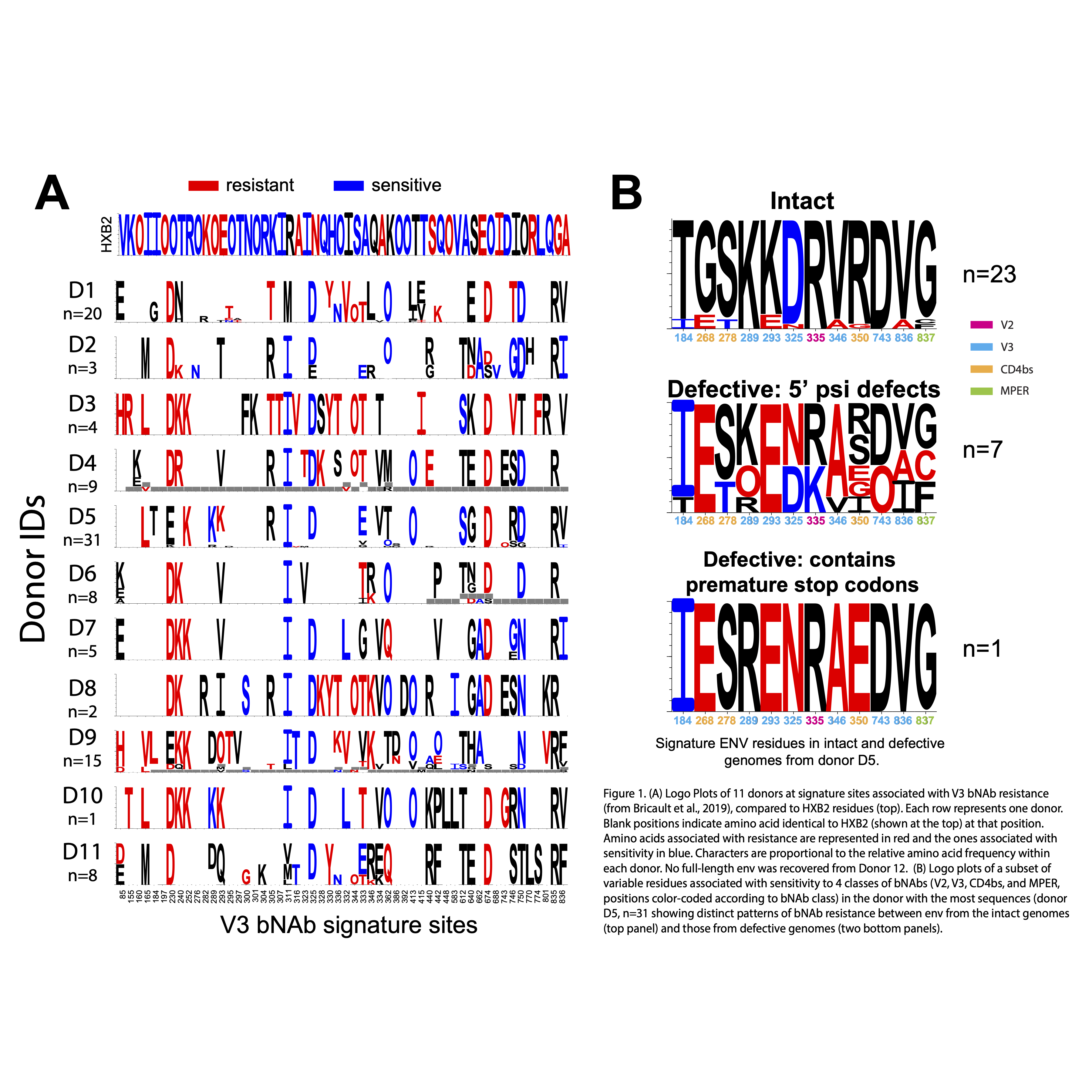
Of the 477 genomes obtained, 72 were intact, while full-length HIV-1 env was only present in 26% (106/405) of defective genomes. All 12 study donors displayed distinct resistance profiles against CD4bs-, V2- and V3-targeting bNAbs (Figure 1A), and all env in intact genomes were genetically unique compared to env in defective genomes within host. In the viremic donor, 91% defective viruses lacked env, whereas the 20 intact genomes had two distinct bNAb resistance profiles, equally split, one with significantly more resistant residues, as well as longer V1+V2 loop lengths and a higher number of PNGs (p< 0.004) – all characteristics associated with higher V3 bNAb resistance (Bricault et al., 2019). In-depth analysis of the virologically suppressed donor with the most sequences revealed that resistance profiles in intact env were more homogeneous and displayed more sensitive profiles when compared to the defective envs (Figure 1B). Env in defective genomes had significantly longer V1+V2 hypervariable loops than intact env (p=0.005) and were more negatively charged (p=0.002). Two glycans, at positions 289 and 743, both associated with increased V3 bNAb resistance, were exclusively found in defective genomes.
Conclusions:
Our results reveal that resistance profiles across all bNAb classes in env are diverse across hosts and distinct between intact and defective genomes within host, and highlight the importance of understanding intact-genomes resistance profiles when screening individuals for enrollment in bNAbs clinical trials.
Figure 1.