Background:
Treatment guidelines recommend genotypic HIV drug resistance testing (DRT) prior to treatment initiation and at virologic failure. While many DR assays are validated for samples with plasma viral loads (VL) >1000 HIV RNA c/mL, the BC Centre for Excellence in HIV/AIDS (BC-CfE) is accredited to test samples with VL >250 c/mL; low viral load (LVL) samples with VL of 50–250 c/mL are tested under a research-use-only protocol. As LVL DRT is resource-intensive and the clinical relevance of results is unclear, we investigated the frequency of emergent DR in LVL samples and the clinical factors associated with newly detected resistance.
Methods:
A retrospective analysis of physician-requested LVL DRT from the BC-CfE’s Drug Treatment Program database was performed. HIV Protease-RT and IN sequences from LVL samples were compared against all prior resistance genotypes from the same participants to identify newly emergent or evolving resistance. DR was interpreted using Stanford HIVdb v9.0. Associations between emergent resistance and clinical factors were investigated using the Mann-Whitney U test or Fisher’s Exact Test.
Results:
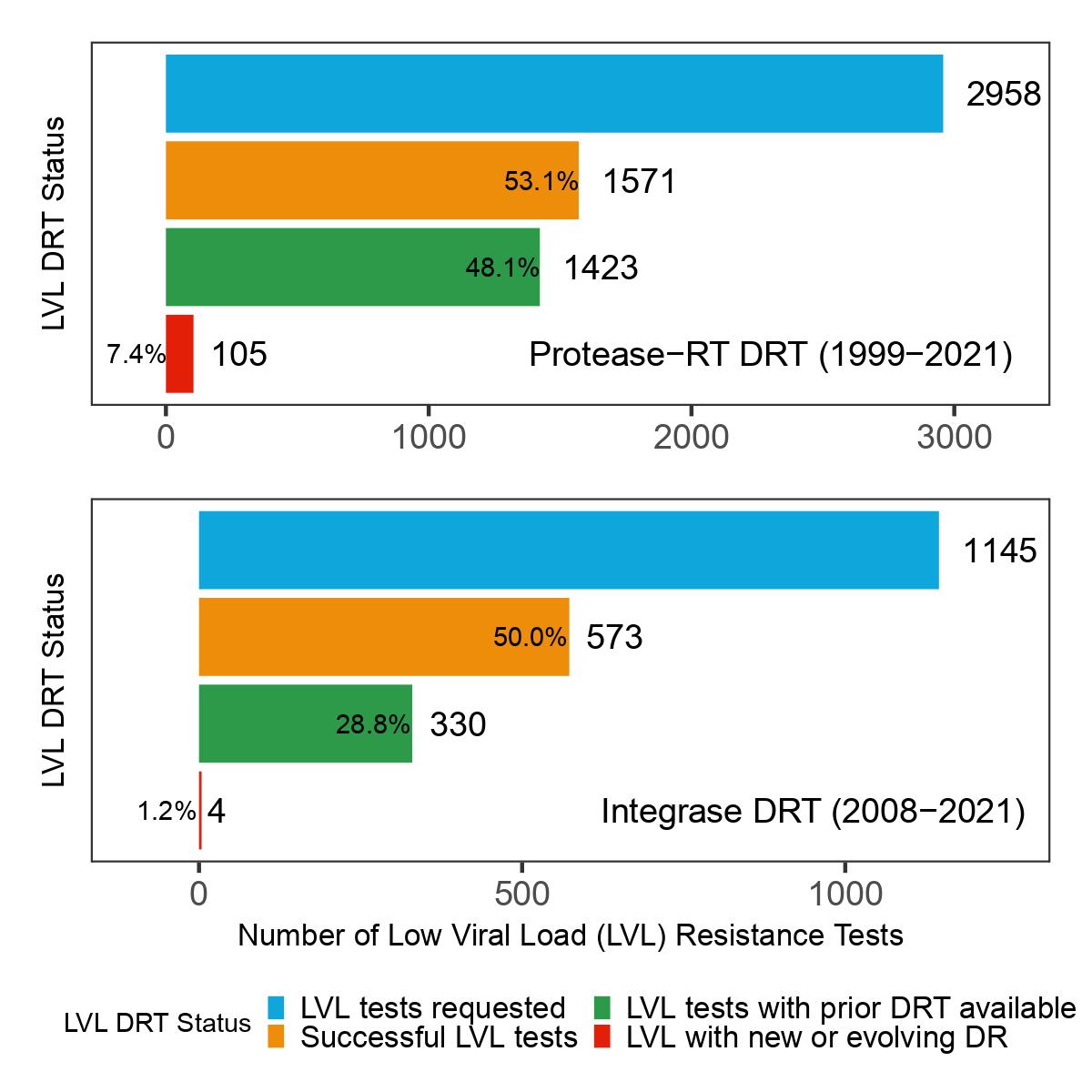
A total of 44,301 Protease-RT DRTs were performed in 1999-2021, of which 2958 (6.7%) were on LVL samples. Testing was successful for 1571 (53.1%) LVL samples compared to 81.4% and 94.4% of samples with VL 250-999 and VL ≥1000 c/mL, respectively (p< 0.001). Of the LVL DR tests, 1423 (48.1%) were from participants with prior DRT (median 4, Q1-Q3 2–7 samples/participant), where the LVL samples were collected a median 417 days (Q1-Q3 113-1502) after the previous test. A total of 105 (7.4%) cases of new or evolving DR were identified, of which 49.5%, 42.9% and 22.9% exhibited new NRTI, NNRTI and PI resistance, respectively. LVL samples with new resistance were collected a median of 2.6 years (Q1-Q3 0.65-6.7) after the prior test vs. 1.1 years (Q1-Q3 0.28-3.9) in samples without resistance (p< 0.001). New resistance was not observed more frequently during persistent low-level viremia versus virological blips (p=0.14). Of 9309 Integrase DR tests performed in 2008-2021, 1145 (12.3%) were LVL. Of 330 (28.8 %) successful LVL DR tests from participants with prior DRT, only 4 (1.2%) new or evolving integrase DR cases were found.
Conclusions:
DRT of samples with VL of 50–250 c/mL infrequently identifies new or evolving DR not captured by prior testing. LVL DRT may be useful in specific clinical scenarios; however, given its resource-intensive nature, it may not be generally warranted.
Low Viral Load HIV Resistance Testing Volumes in British Columbia, Canada