Background:
Pre-existing coronavirus-specific antibody responses may affect SARS-CoV-2 responses. We evaluated longitudinal samples obtained before and during the pandemic in participants from Kenya, Nigeria, Tanzania and Uganda; 90% were people living with HIV.
Methods:
Serum samples were tested using a multiplex bead-based immunoassay to measure antibody binding against 22 antigens including Nucleocapsid (N) and Spike (S) proteins of the 7 human coronaviruses and one malaria antigen.
Results:
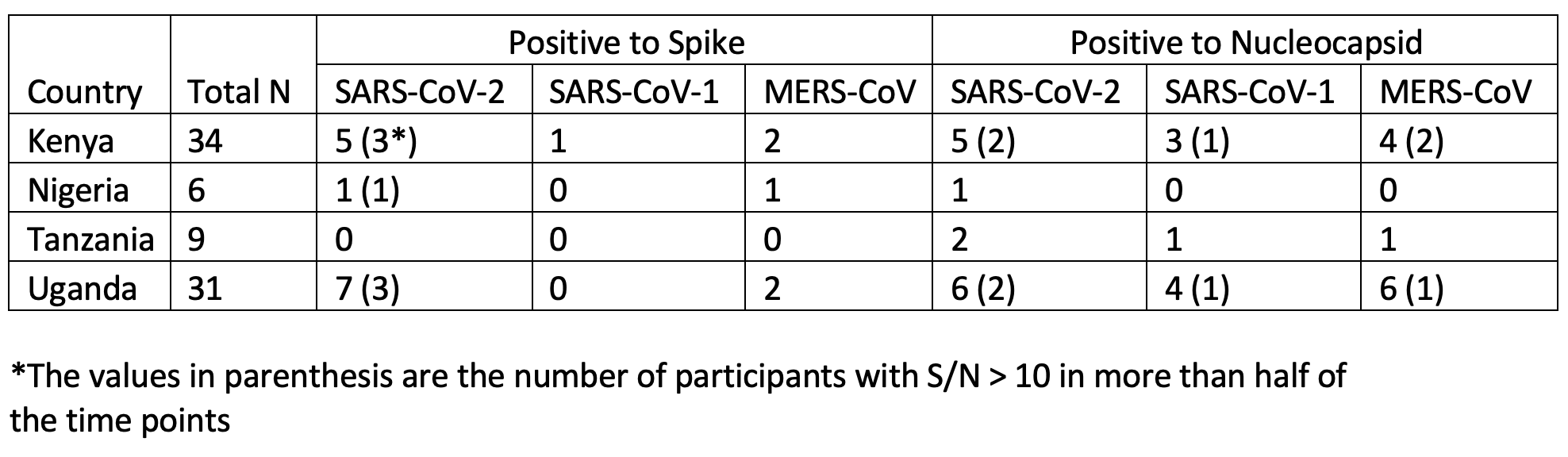
We tested 819 longitudinal samples from 80 participants collected between July 2013 and May 2021 (3-16 samples per participant). Using a signal to noise ratio (S/N) >10, 13, 1, and 5 participants showed at least one time point with IgG responses to S of SARS-CoV-2 (ancestral), SARS-CoV-1 and MERS-CoV respectively while 14, 8, and 11 participants showed responses to N before 2020. Across individuals, IgG binding to SARS-CoV-2 S subunit S2 was most frequently detected and it showed the highest within-host fluctuations over time. A few individuals had elevated responses that persisted over years towards multiple antigens, most frequently to different SARS-CoV-2 antigens and rarely to distinct viruses. One individual showed high RBD-specific IgG responses to distinct coronaviruses at a single time point before 2020. Responses against coronaviruses measured post-2020 generally correlated with responses measured before 2020, except for a subset of infected individuals whose responses against SARS-CoV-2 dramatically increased post-pandemic. IgG responses against the ancestral SARS-CoV-2 variant were most correlated with responses against Alpha and Gamma (then to Beta and Delta, rho >0.75) variants. Using an IgM S/N >10, 31 participants were Malaria positive and 22 showed concurrent elevated coronavirus IgM responses. However, about half of the malaria positive participants had no IgG responses against any coronavirus antigen and the rest presented limited and variable patterns of association between responses against coronaviruses and malaria.
Conclusions:
Our study confirmed that a small subset of individuals in Africa had long-lasting IgG coronavirus-specific antibodies before the pandemic. While there was an association between coronavirus IgM responses and responses against malaria, there was no correlation between IgG responses and malaria infection. Further analysis is needed to better understand the interactions between antigens in the development of antibody immunity to coronaviruses.
Table 1. Numbers of the coronavirus responders in IgG by country