Background:
Long-Acting Antiretroviral Therapy (LAART) has demonstrated efficacy in virally suppressed people with HIV (PWH), and clinical trials are ongoing to evaluate its use in ART-naïve and ART-experienced, unsuppressed PWH. LAART has the potential to reduce non-adherence and promote retention in HIV care, but its potential effects on local HIV epidemics remain unclear.
Methods:
We used the Johns Hopkins HIV Epidemiologic and Economic Model (JHEEM), a model of local HIV epidemics, to simulate the potential impact of rolling out LAART in four US cities: Atlanta, Baltimore, Los Angeles, and Miami. We simulated LAART roll out at two levels for three separate indications, separately and in combination: (1) Transitioning either 25% or 50% of “durably suppressed” PWH (suppressed for ≥ 2 years on oral ART) onto LAART; (2) starting either 25% or 50% of ART-experienced PWH who were unsuppressed on LAART yearly; and (3) starting either 25% or 50% of ART-naïve PWH on LAART (instead of oral ART).All interventions ramped up from 2025 to 2028 and continued through 2035. We assumed LAART had equivalent efficacy to oral ART, but randomly allowed LAART to range from equally as likely to keep PWH engaged in care to twice as likely across simulations. Our primary outcome was the reduction in the projected number of incident HIV infections from 2025 to 2035. Secondary outcomes included proportion of PWH in care with resistance to antiretroviral medications after LAART.
Results:
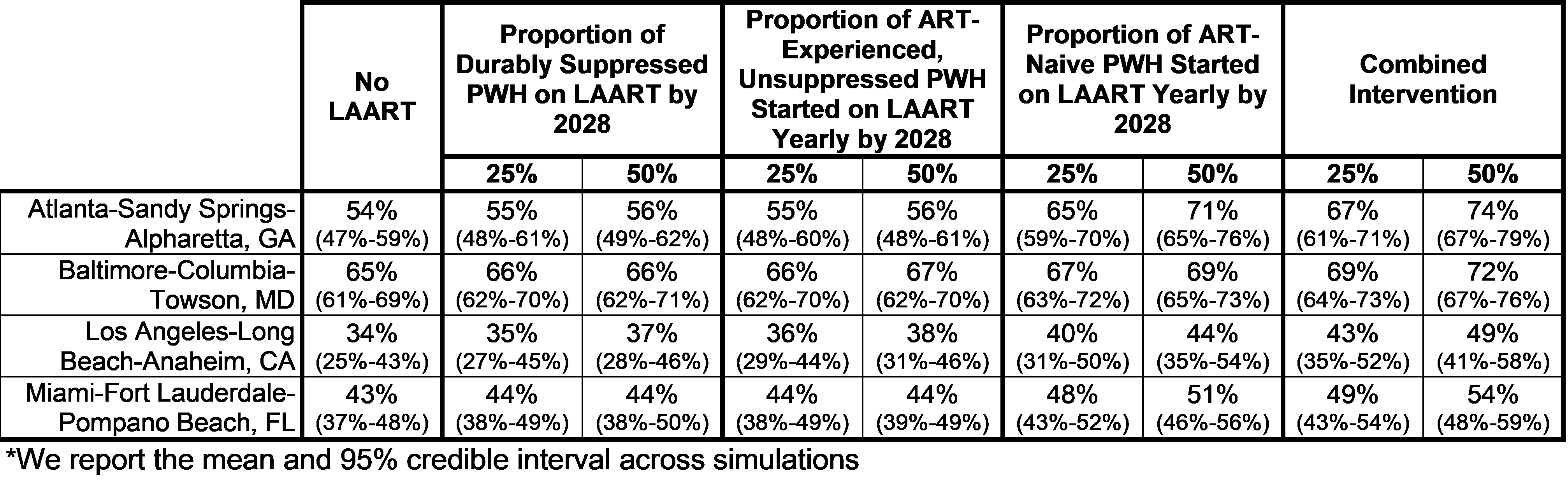
Simulations with no LAART projected incidence reductions ranging from 34% in Los Angeles to 65% in Baltimore between 2025 and 2035 (Table). Switching 50% of durably suppressed PWH yielded an additional reduction ranging from 1.2 percentage points in Los Angeles to 1.7 percentage points in Atlanta. Starting 50% of unsuppressed, ART-experienced PWH on LAART yearly yielded an additional reduction ranging from 1.3 percentage points in Atlanta to 3.4 percentage points in Los Angeles. Starting 50% of ART-naïve PWH on LAART yielded additional reductions ranging from 4.1 percentage points in Baltimore to 16.6 percentage points in Atlanta. Across all simulated interventions, the projected proportion of PWH in care in 2035 who would have ART resistance after LAART ranged from 0% to 2%.
Conclusions:
LAART has the potential to modestly reduce HIV incidence in local epidemics. Its effect will depend strongly on the degree to which LAART promotes engagement in HIV care, particularly among unsuppressed PWH.
Table: Reduction* in HIV Incidence from 2025 to 2035 Under Interventions Rolling Out Long-Acting Antiretroviral Therapy for Different Indications Among People with HIV in Care