Background:
Antiretroviral therapy (ART) has greatly improved health outcomes in people living with the human immunodeficiency virus (HIV), but the persistence of viral reservoirs remains a barrier to viral eradication. Given that HIV-infected elite controllers (ECs) can naturally suppress plasma viremia to undetectable levels without ART, systematic analyses of their viral reservoirs may be key to understanding how to achieve ART-free virologic control in infected individuals. Previous studies have found that ECs have relatively small HIV DNA burdens, potent HIV-specific immunity, and integration patterns that contribute to long-term HIV control. However, few have compared the inducibility of infectious HIV between ECs and chronically infected, aviremic individuals receiving ART (CAs).
Methods:
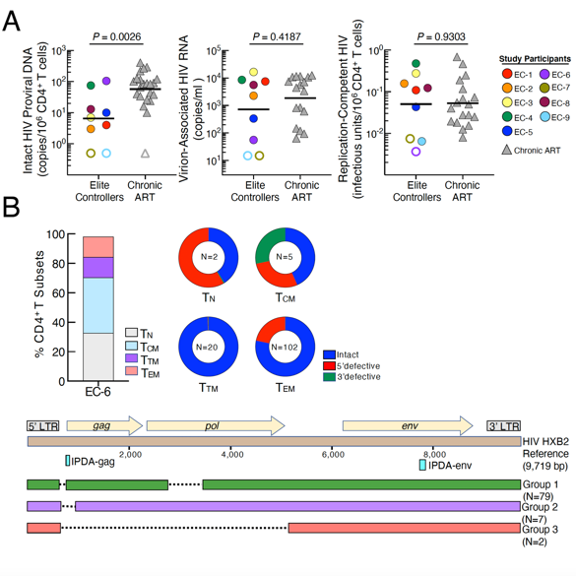
HIV reservoirs of 9 ECs and 22 CAs were compared by measuring intact proviral DNA, defective DNA, and cell-associated HIV RNA in CD4+ T cells with PCR-based assays. Cellular assays were used to measure inducible virion-associated HIV RNA and replication-competent virus. HIV-specific immune responses were measured following stimulation with HIV Gag peptides. Near-full length (NFL) sequencing of proviral DNA in effector memory CD4+ T cells was performed. Statistical analysis was performed with the Mann-Whitney test.
Results:
Levels of intact proviral DNA, defective DNA, and cell-associated HIV RNA were lower in ECs compared to CAs. However, the levels of inducible and replication-competent virus were similar between both groups, and ECs had higher frequencies of HIV-specific CD8+ T cells, suggesting the presence of viral antigen expression. Of three ECs with extraordinarily low inducible/infectious viral reservoirs, one had high copy numbers of intact proviral DNA by IPDA, but NFL sequencing revealed that all clonotypes were defective.
Conclusions:
We demonstrated that ECs have lower levels of intact proviral DNA and cell-associated HIV RNA but comparable levels of inducible and replication-competent virus compared to CAs. The discordance observed between the PCR- and cellular-based assays may suggest that many identified intact proviral DNA in our CA group are, to a certain extent, replication-defective, as seen in one EC. Thus, although PCR-based methods provide insight into the composition of viral reservoirs, it is essential to perform assays that detect replication-competent virus in certain populations of HIV-infected individuals, such as ECs, to accurately estimate the size of the viral reservoir.
Analyses of HIV reservoirs in elite controllers and chronically infected aviremic study participants