Background:
The 2022 mpox outbreak required rapid scale-up of testing and treatment, yet limited resources constrained access to care and may have contributed to disparities. We analyzed the characteristics of persons with mpox and tecovirimat (TPOXX) provision in King County, WA from May to October 2022.
Methods:
Public health staff collected demographic, testing, and treatment data by interviewing patients, with mpox, reviewing laboratory and case report forms, and contacting medical providers. We analyzed patient demographics and time to testing and treatment (care metrics). We used chi-square testing (p< 0.05) to assess differences in TPOXX receipt by race/ethnicity or diagnosing site. We evaluated differences in care metrics over time using linear regression, and by race/ethnicity using Kruskal-Wallis testing.
Results:
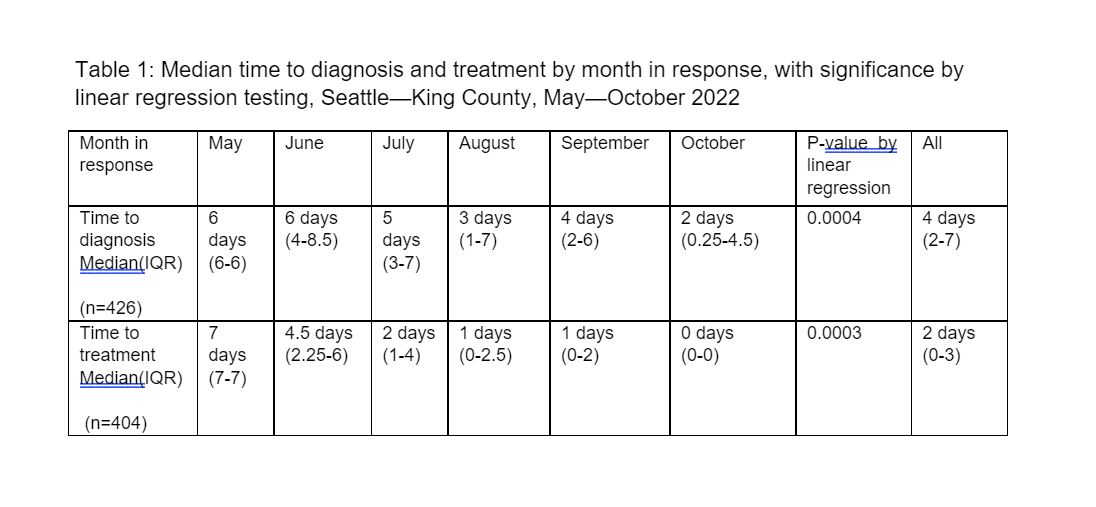
During 5/22-10/26/2022, 465 patients had laboratory-confirmed mpox. The median age was 37 years [interquartile range (IQR) 31-45 years. 205 (44%) identified as non-Hispanic White, 118 (25%) as Hispanic/Latinx, 45 (10%) as non-Hispanic Black, 26 (6%) as Asian, 16 (3%) as American Indian/Alaska Native; 55(12%) were other or unknown. 346 (74%) lived in Seattle. Of 420 patients with clinic site data, 159 (38%) were at the county sexual health clinic (SHC); 125 (30%) were at university-affiliated medical centers. Of 404 patients with treatment data, 311 (77%) started TPOXX. The proportion of patients treated within race-ethnicity groups was 73% (n=149) non-Hispanic White persons, 69% (n=82) Hispanic/Latinx, 69% (n=27) Black, 71% (n=17) Asian, and 85% (n=11) American Indian/Alaska Native persons (p=0.6). Of patients with data on both TPOXX status and clinic site, 126 of 159 (79%) at SHC received POXX, 109 of 120 (87%) at university-affiliated medical centers, and 62 (55%) of 113 at other sites combined (p< 0.001). Of 426 patients with clinical data, the median time from symptom onset to testing was 4 (IQR 2-7) days. Median time from testing to treatment was 2 (IQR 0-3) days. Both metrics decreased over time [p=0.0004 and p=0.0003, respectively (Table 1)] and did not vary by race/ethnicity (p=0.6 and p=0.5, respectively).
Conclusions:
Public Health and healthcare organizations rapidly scaled-up mpox testing and treatment over the course of the 5-month epidemic allowing for most patients to receive TPOXX without significant racial disparities. Testing and treatment was largely dependent on a single sexual health clinic and university-affiliated sites.
Table 1: Median time to diagnosis and treatment by month in response, with significance by linear regression testing, Seattle—King County, May—October 2022