Background:
Maternal HIV is associated with preterm birth risk. In resource-rich settings among women without HIV, spontaneous preterm birth has been linked to biomarkers of stress. We examined the association between a composite allostatic load index (ALI) and spontaneous preterm birth among women with HIV in Lusaka, Zambia.
Methods:
We conducted a nested case-cohort analysis using data from IPOP, a trial of weekly intramuscular progesterone to prevent preterm birth in women with HIV. Our primary outcome was spontaneous preterm birth (delivery before 37 weeks preceded by spontaneous labor or pre-labor rupture of membranes). We measured 15 biometric and circulating markers of allostatic load at the 24-week visit from 4 domains: cardiovascular, immune, metabolic, and neuroendocrine. Z-scores were calculated for each marker by standardizing for gestational age at collection to a mean of 0 and a standard deviation of 1; a composite ALI was calculated by summing individual component Z-scores from all 15 indicators (ALI-15) and from a subset of 7 (ALI-7) that met a prespecified criterion of difference in Z-scores between outcome groups of >0.1. ALI-15 and ALI-7 were categorized into quartiles for risk assessment. We estimated time-to-event curves and hazard ratios associated with ALI quartiles and employed robust errors to account for the case-cohort design.
Results:
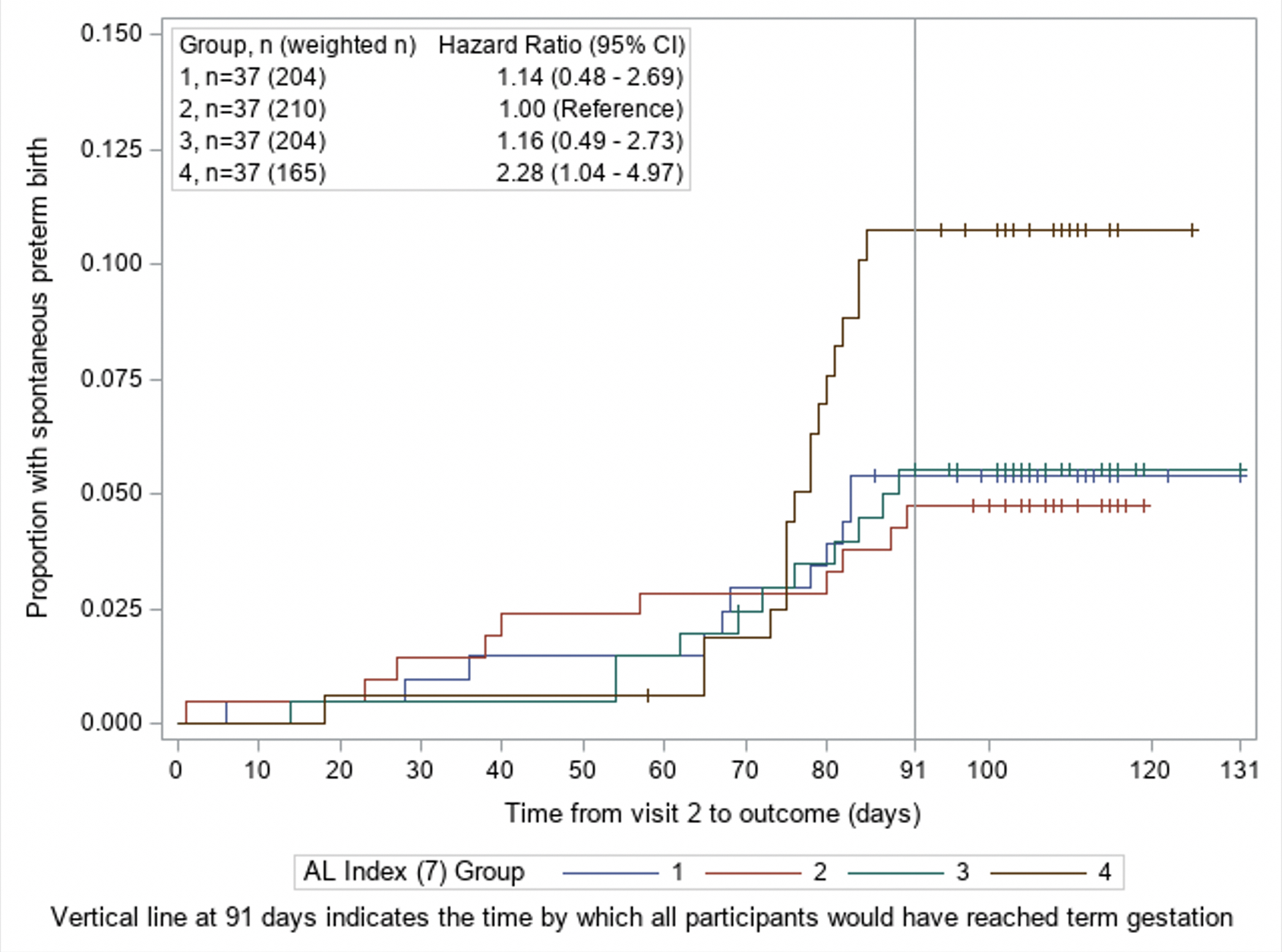
From 2017-2019, 800 women were enrolled in the IPOP trial; 51 (6%) delivered spontaneously before term (cases). We randomly selected 107 participants for inclusion in the sub-cohort, 6 of whom were cases. We then selected all remaining cases of spontaneous preterm birth (n=45), yielding a final case-cohort population of 152. Z-score distributions of systolic blood pressure, maternal heart rate, high-density lipoprotein, triglycerides, hemoglobin A1C, albumin, and 25-OH Vitamin D met criteria for inclusion in the subset ALI. ALI-15 was not associated with spontaneous preterm birth. However, in time-to-event analysis between quartiles of ALI-7, participants in the fourth quartile had higher hazard of the primary outcome (HR 2.28, 95% CI 1.04-4.97) compared to those in the second quartile.
Conclusions:
High allostatic load index among pregnant women with HIV was associated with spontaneous preterm birth. Early detection and preventive intervention among high-risk women with HIV could have a substantial public health benefit.
Figure 1. Incidence curves of spontaneous preterm birth over time by z-score quartile of allostatic load index