Background:
Despite improvements in the care continuum approximately 35% of persons with diagnosed HIV (PWH) in the US were not virally suppressed in 2020. Interventions to improve re-engagement with care are needed. We report interim data for Instacare: a prospective randomized trial evaluating the behavioral intervention “60-minutes-for-health” combined with rapid restart of antiretroviral therapy (ART) on re-engagement with care.
Methods:
PWH in San Diego, California who were not on ART for the previous 2 weeks and either out of care or poorly engaged with care (PWH-OOC) were randomized to “60-minutes-for-health” or control at study entry. All participants were offered rapid ART within 7 days of contact. Case management with linkage to care, adherence counseling and financial counseling were provided over the first 4 weeks. Study follow up was performed at 4, 24 and 48 weeks. The primary outcomes were viral suppression (VL ≤50 copies/ml) and engagement with care (2 HIV care visits ≥90 days apart) at 24 weeks.
Results:
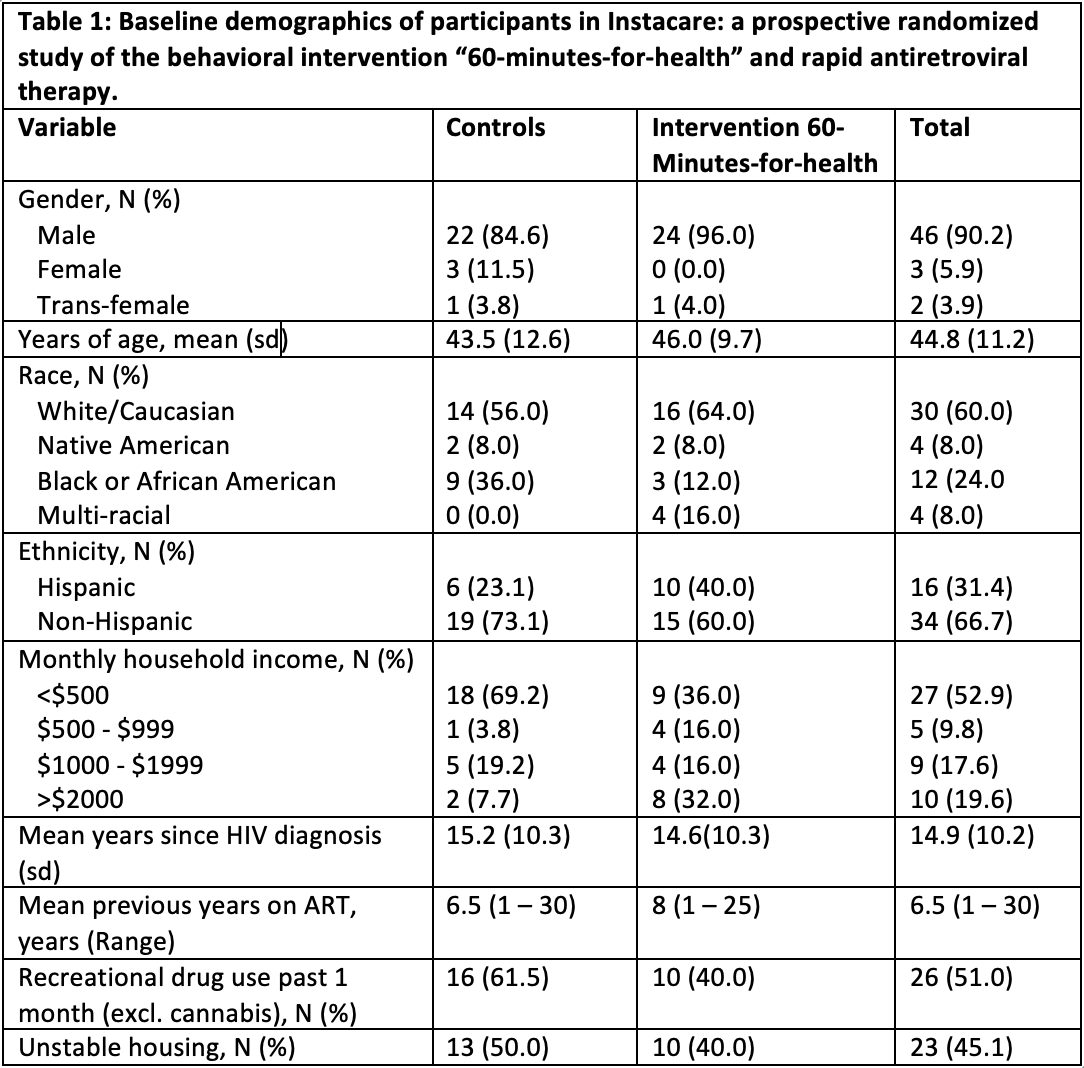
Between November 2020 and August 2022, 51 participants were enrolled with demographics and baseline data shown in Table 1. The most common reported reasons for previously stopping ART were housing instability (29.8%), insurance barriers (27.7%), mental health barriers (25.5%) and substance use barriers (25.5%). 28 persons (54.9%) reported being too sad or depressed to seek HIV care, 25 (49.0%) had previous mental illness diagnosis and 44 (86.3%) had a history of substance use. Among 31 participants on study for at least 24 weeks, only 15 (48%) participants attended week 24 follow up with just 11 participants (35.5%) achieving viral suppression. Among the 15 participants with follow up 5 (62.5%) in the intervention arm and 6 (66.7%) from the control arm were virally suppressed. Among 33 participants with ≥36 weeks on study or who had attended their week 24 visit, 6/16 (37.5%) in the intervention group and 10/17 (58.8%) in the control group were engaged with HIV care.
Conclusions:
This randomized trial of a behavioral intervention to improve re-engagement in care among PWH-OOC did not show a significant difference in HIV primary care attendance or viral suppression at 24 weeks. The loss-to-follow up was substantial ( >50%) and highlights the challenges of performing studies in this hard-to-reach population. It is probable that very significant additional resource allocation will be required to improve engagement in care and viral suppression for this treatment experienced population.