Background:
Many hormones in pregnancy regulate fetal growth. Few data exist on fetal growth-related hormones in pregnancy in women living with HIV (WLHIV) and whether maternal hormonal alterations are associated with infant anthropometrics.
Methods:
The Tshilo Dikotla study prospectively enrolled pregnant women in Botswana. WLHIV receiving dolutegravir/tenofovir/emtricitabine and HIV-seronegative (HIV-) women were included in this analysis. Levels of estradiol (E2), sex-hormone binding globulin (SHBG), cortisol, growth hormone 1 (GH1), insulin-like growth factor 1 (IGF-1), and insulin-like growth factor binding protein 1 (IGFBP-1) were measured by ELISA in plasma collected between 24-28 weeks gestation. Bioavailable E2 (bE2) was calculated using measured values of E2 and SHBG. Infant anthropometrics were converted to weight-for-age and length-for age Z-scores (WAZ, LAZ) at birth and 1 year-of-life. Data was normalised by log transformation. Generalized linear models were fit to evaluate associations between each hormone and 1) HIV status (model #1), 2) infant anthropometrics at birth and 12 months (model #2). The anthropometrics model included an interaction term between HIV status and each hormone to assess effect modification by HIV status.
Results:
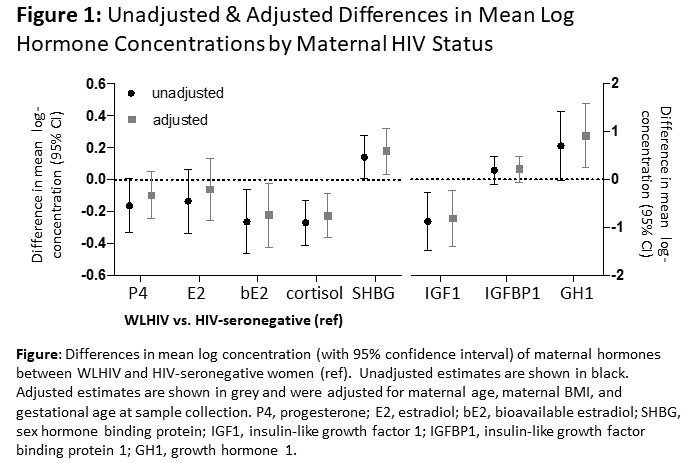
Plasma specimens were available from 114 women (46 WLHIV), of which 95 had a live birth while in the study. WLHIV were older (27 vs. 26 years), had higher gravidity (3 vs 1), and were less likely to breastfeed (78% vs. 100%) than HIV- women. Among WLHIV, median enrollment CD4 count was 494 cells/mm3, and 90% had HIV RNA levels < 40 copies/mL at enrollment. After adjusting for maternal age, BMI, and gestational age of specimen draw, WLHIV had lower mean log bE2 (β: -0.22, p=0.028), cortisol (β: -0.22, p=0.001), and IGF1 (β: -0.81, p=0.007), but higher GH1 (β: 0.91, p=0.011) (Fig 1). Log bE2 was positively associated with birth WAZ (b 0.91 (95% Confidence Interval (CI) 0.41, 1.40, p< 0.001) for all infants. HIV status modified the associations of log GH1 (β:-0.22, p=0.05) and log IGF1 (β: 0.40, p=0.004) with infant WAZ at 12 months after adjusting for maternal age and BMI, duration of exclusive breastfeeding, and birth WAZ.
Conclusions:
Growth hormone levels are dysregulated in WLHIV suggestive of impaired placenta function. The dysregulation, particularly of GH1 and IGF1, may influence growth in the first year of life among infants exposed to HIV.