Background:
Transgender women are at increased risk for acquiring HIV and earlier studies observed low retention in HIV care, as well as lower rates of antiretroviral therapy (ART) uptake, adherence and viral suppression. We compared HIV care retention between transgender women and men who have sex with men (MSM) in the Netherlands. Additionally, we compared the proportion of new HIV diagnoses those in care per year and proportion of late presenters.
Methods:
Using data from the ATHENA cohort and a repeated cross-sectional design, we assessed the different stages of the HIV care continuum (linkage to care, retention in care, ART use, and viral suppression) among transgender women and MSM between 2010 and 2020. We described new HIV diagnoses among all individuals living with HIV within a calendar year. The proportion of individuals with a late diagnosis was calculated by dividing the number of late presenters (defined as a CD4 count of < 350 cells/µl or an AIDS-defining event) by the number of newly diagnosed individuals in a given year.
Results:
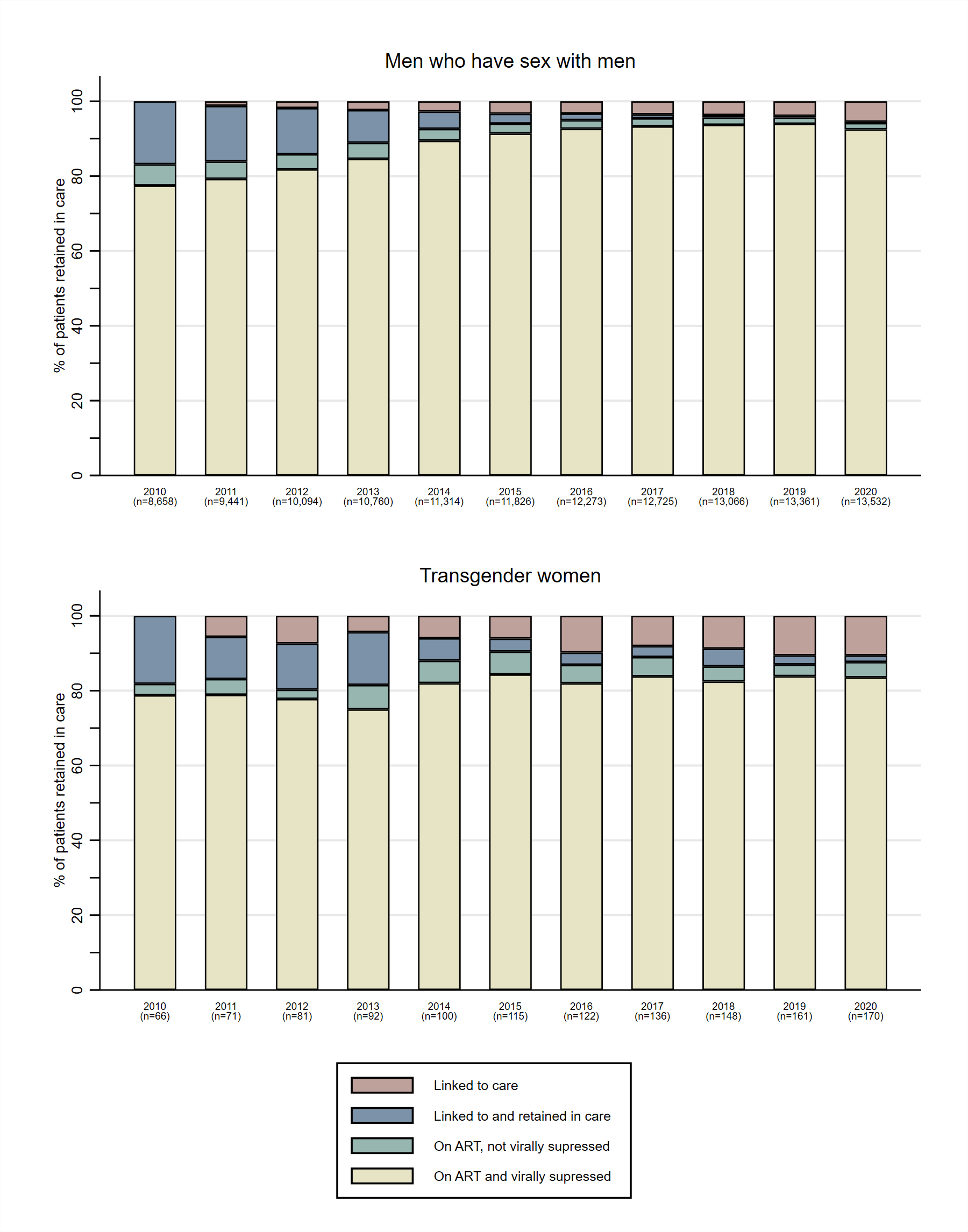
Between January 2010 and December 2020, 15,371 individuals attended at least one clinic visit; 188 (1%) transgender women and 15,183 (99%) MSM. Over time, the majority of transgender women and MSM were retained in care, received ART and were virally suppressed (Figure), albeit with greater gaps for transgender women than MSM. Of 170 transgender women and 13,532 MSM linked to care in 2020, fewer transgender women than MSM were retained in care (89% vs 95%, p=0.004), used ART (88% vs. 94%, p< 0.001) and were virally suppressed (84% vs. 92%, p< 0.001). The proportion of transgender women newly diagnosed with HIV ranged from 6% (4/67) in 2010 to 6% (9/156) in 2020; for MSM, this varied from 8% (699/8,756) in 2010 to 2% (215/12,892) in 2020. The proportion of transgender women who were late presenters varied between 25% and 75% over time, while for MSM it varied between 37% and 46%.
Conclusions:
Over a 10 year time period, the vast majority of transgender women and MSM diagnosed with HIV in the Netherlands were linked to and retained in care, received ART and were virally suppressed. the HIV care continuum for transgender women continues to lag behind across its stages and late presentation remains more common. Identifying barriers to HIV care and designing targeted interventions, jointly with the transgender community, will be crucial to improve HIV care retention and outcomes.
Linkage to and retention in care, cART use and viral suppression among transgender women and men who have sex with men between 2010 and 2020, the Netherlands