Background:
HIV time-space (TS) cluster detection is routinely conducted by CDC and by state and local health departments to identify U.S. counties where diagnoses are elevated compared with historical levels. These analyses generate “alerts” for review that may indicate clusters or outbreaks needing response. Previously, national TS cluster detection primarily focused on persons who inject drugs (PWID). Differences in the frequency, characteristics, and reoccurrence of alerts among men who have sex with men (MSM) versus alerts among PWID have not been previously described.
Methods:
HIV diagnoses reported to the National HIV Surveillance System were analyzed quarterly during 2018–2021 to detect TS alerts using standard CDC methods. Each quarter, for each county, the number of HIV diagnoses during the preceding 12 months among the group of interest (PWID and MSM) was compared with the annual average from the preceding 3 years. An alert was generated if the number of diagnoses in the year of interest was >2 standard deviations and >2 diagnoses above the baseline number of diagnoses. Within each alert type — PWID and MSM — alerting counties were stratified by urban-rural classification. For counties with initial alerts during 2018–2019, reoccurrences of alerts during the following 8 quarters were identified.
Results:
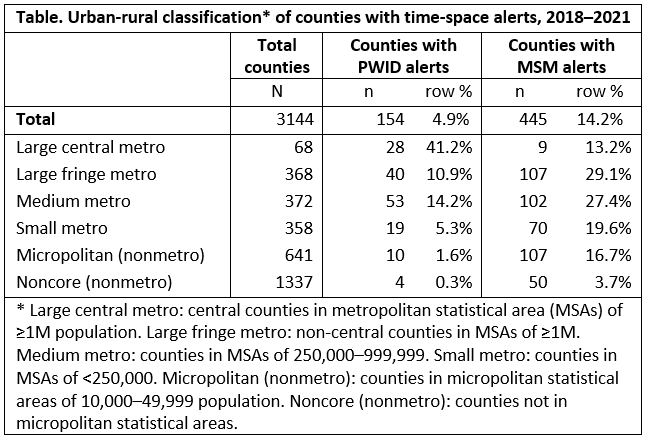
During 2018–2021, PWID alerts occurred in 154 (4.9%) counties and MSM alerts occurred in 445 (14.2%) counties (Table). PWID alerts occurred in a higher percentage of large central metro areas (41.2%) than other areas (0.3–14.2%). MSM alerts occurred in a higher percentage of large fringe (29.1%) and medium (27.4%) metro areas than other areas (3.7–19.6%). Multiple subsequent alerts were more common for PWID than for MSM alerts: 30% of counties with PWID alerts had ≥2 subsequent alerts in the following 8 quarters, compared with 19% of counties with MSM alerts.
Conclusions:
The occurrence of PWID alerts in >41% of large central metro areas is concerning, as it might suggest expanding HIV transmission among PWID in these areas. Application of similar time-space alert criteria to assess TS clusters among MSM yields nearly three times as many alerts among MSM as among PWID. Compared with PWID alerts, a lower percentage of MSM alerts reoccur, suggesting that increases detected typically are not sustained. Additional work to refine TS cluster detection criteria, or to prioritize additional follow-up or investigation, is needed for MSM alerts.
Table. Urban-rural classification* of counties with time-space alerts, 2018–2021