Background:
Each year >150,000 children are newly infected with HIV, majority during breastfeeding. Early life infection forces adherence to life-long ART. Development of autologous virus neutralizing antibodies or broadly neutralizing antibody (bNAb) therapy has been associated with delay in viral rebound after analytical treatment interruption (ATI). However, viral variants that escape neutralization response limit the therapeutic potential of these strategies. Our objective is to map the neutralization escape mutations in orally SHIV-infected infant rhesus macaques (RMs) following ATI with and without therapeutic immunization.
Methods:
Infant RMs (n=19) were orally challenged with SHIV.C.CH505 and started on triple ART at 8 weeks post-infection (wpi). Nine animals were immunized with two doses each of SHIV-DNA-rhCD40L, SHIV-MVA and CH505 Env SOSIP protein. At 60 wpi, ART was interrupted and all RMs were monitored for viral rebound. SHIV.C.CH505 virus neutralization titer in plasma was measured. To assess autologous virus neutralization escape variants, single genome amplification was performed on HIV-Env gene, and Env variants were compared to SHIV challenge stock. Finally, mutations previously associated with bNAb resistance were identified.
Results:
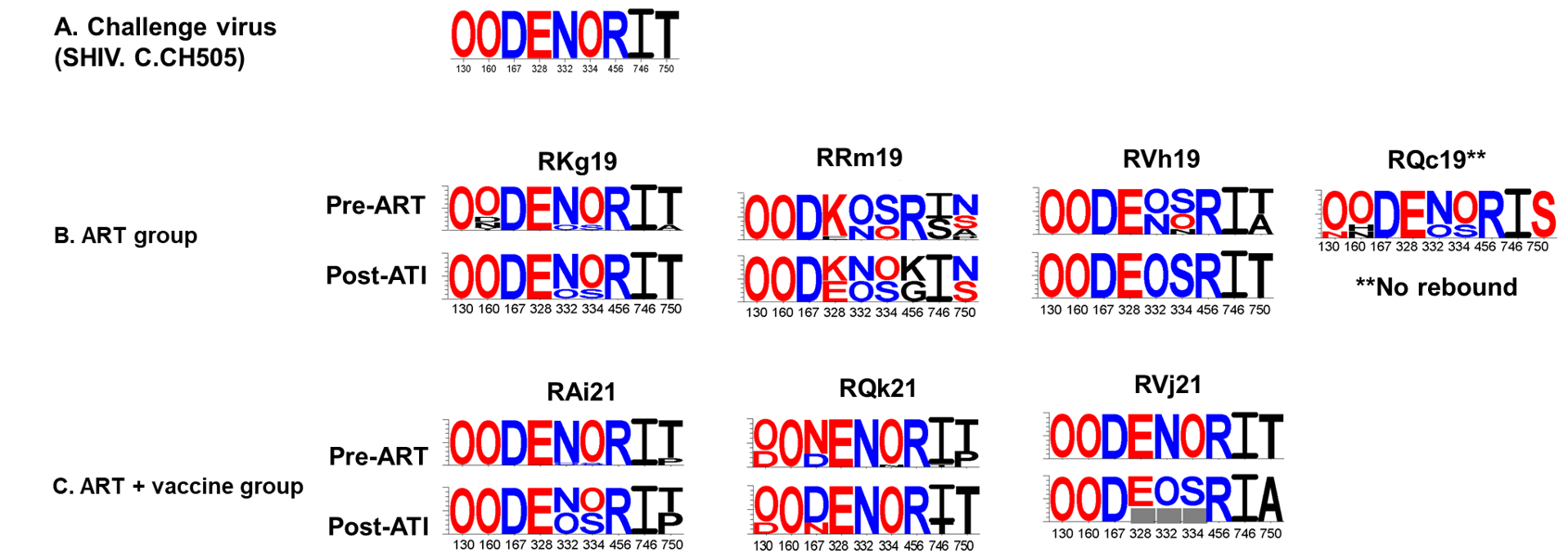
While equivalent numbers of RMs from ART and ART+vaccine group developed autologous virus neutralizing antibodies (ART:5/10; ART +vaccine:5/9), the median titer was ~five-fold higher in the vaccine group (ID50=557) vs. the ART group (ID50=124) RMs, who developed response (p=0.4). However, there was no difference in median time to viral rebound post-ATI between ART (18 days) or ART+ vaccine group (14 days) (p=0.16). Individual assessment of HIV-Env sequences from animals who rebounded, even after development of autologous virus neutralization titers, demonstrated resistance against CD4bs (D130), V2 (N167) and V3-targeting bNAbs (T746). Interestingly, RMs showed a glycan gain at position 332, which is associated with V3 bNAb resistance, even before ART start (Fig 1). No specific differences in patterns of mutation in the HIV-Env region was observed in ART vs. ART+vaccine group.
Conclusions:
Using an infant RM model mimicking breast milk HIV transmission and therapy, we identified HIV-Env mutations associated with bNAb escape. Identifying specific neutralizing antibody escape-mutations will guide development of future active and passive immunization regimens that will minimize viral escape, leading to sustained drug-free HIV remission in infants.
Figure 1. BNAb resistance and sensitivity in HIV-Env variants in infant rhesus macaques (RMs). Logo plots of the viral sequences for (A) SHIV.C.CH505 challenge virus, (B) ART group and (C) ART+ DNA/MVA/SOSIP-based therapeutic vaccine group RMs. For each animal, pre-ART (top) and post-ATI (bottom) sequences are shown for panels B and C. Residues are color-coded red if they confer resistance to one of the broadly neutralizing antibody classes or blue if they confer sensitivity instead (Bricault et al. 2019 and Roark et al, 2021). O indicates a glycosylation site.