Background:
Mycobacterial immune reconstitution inflammatory syndrome (myco-IRIS) occurs in people with HIV (PWH) who are also at risk of Kaposi sarcoma herpesvirus (KSHV)-associated inflammatory diseases (KAD) which are associated with elevated IL-6 and clinically resemble myco-IRIS. Differentiating these syndromes is essential as treatments vary markedly. IFNγ-IL18 axis biomarkers can distinguish pediatric hyperinflammatory syndromes and have been implicated in both myco-IRIS and KAD pathogenesis. We evaluated clinical and immune biomarkers in patients with myco-IRIS or KAD to identify markers that could differentiate these syndromes.
Methods:
Plasma samples were obtained from PWH on antiretroviral therapy with active myco-IRIS or inflammatory KAD (multicentric Castleman disease, primary effusion lymphoma, KSHV inflammatory cytokine syndrome). All participants were enrolled in NIH IRB-approved protocols. We measured clinical labs and immune markers (IL6, IL10, IL18, IL18BP, IFNγ, CXCL9, sCD163, CRP, ferritin) and performed Wilcoxon test, principal component (PCA), and receiver operating curve analyses.
Results:
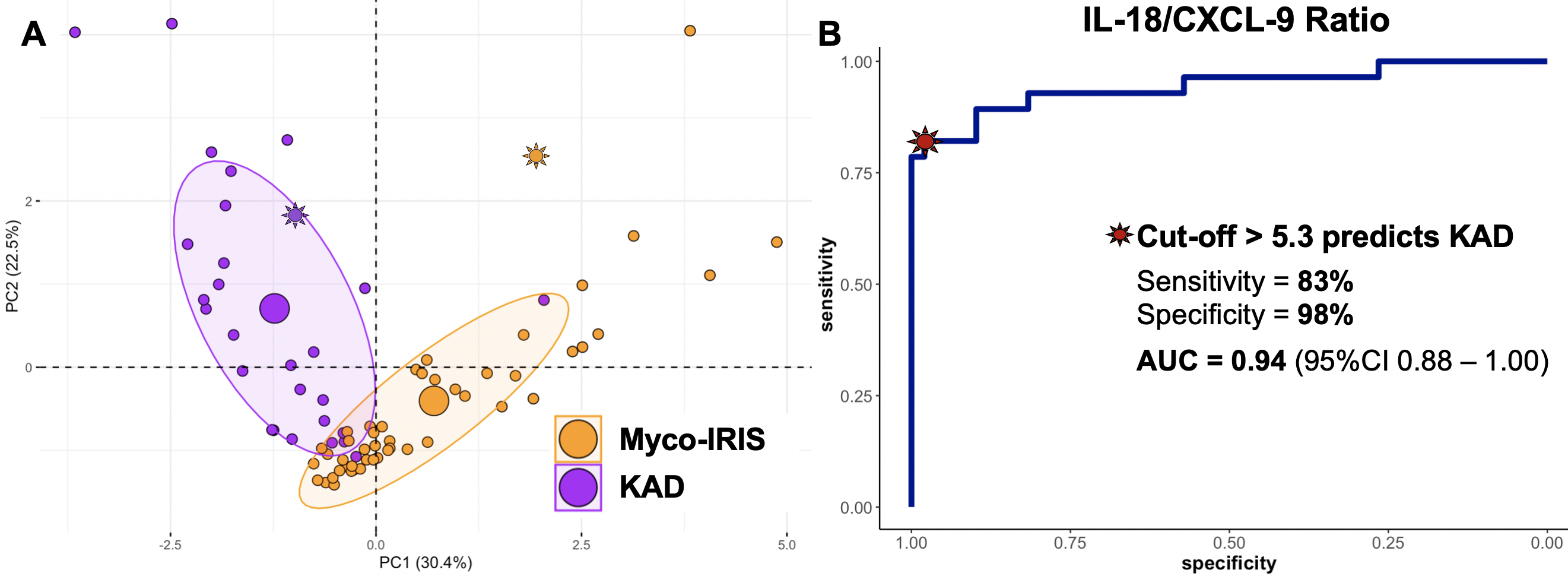
Overall, 77-PWH were included (median age 39yrs [IQR 33-45]) with 59 (77%) cis-men. Fifty had myco-IRIS (tuberculosis, n=21; nontuberculous, n=29), and 27 had KAD. Two with myco-IRIS also had detectable KSHV PCR. There was no difference in CRP, IL6, ferritin, CD4 T-cells, or HIV viral load between the two groups. PCA incorporating all biomarkers revealed distinct clustering of the two inflammatory syndromes (Fig1A). The 2 patients with myco-IRIS and possible KAD mapped to separate inflammatory clusters (stars) suggesting unique pathophysiology in each. There were higher IFNγ and CXCL9 levels (T-cell activation) in myco-IRIS (IFNγ 135pg/mL [IQR 35.8-353]; CXCL9 786pg/mL [IQR 429-1863]) vs KADs (IFNγ 25.4pg/mL [IQR 19.4-37.6]; CXCL9 272pg/mL [IQR 171-437]) (p< 0.001). IL18 (inflammasome activation) was increased in KAD (IL18 4202pg/mL [IQR 2042-5923]) compared to myco-IRIS (IL18 1018pg/mL [IQR 670-1705]) (p< 0.001). The IL18/CXCL9 ratio showed the greatest discrimination capacity for KAD (Fig1B).
Conclusions:
Although clinically indistinguishable, myco-IRIS and inflammatory KAD demonstrate unique immune profiles involving the IFNγ-IL18 axis suggesting different pathogenesis. These biomarkers, after validation, may help risk stratification and diagnosis of patients even in resource-limited settings, but also highlight possible therapeutic targets of these distinct hyperinflammatory syndromes.
Comparison of immune profiles between mycobacterial-IRIS and KSHV inflammatory syndromes by principal component analysis (A), ROC analysis shows the IL18/CXCL9 ratio best distinguishes these syndromes (B)