Background:
Accessing feminizing hormone therapy (FHT) is essential to trans women. Concern of negative drug interactions between their FHT and antiretroviral therapy (ART) can be a barrier to acceptance of ART in trans women with HIV. In this study, we measured serum estradiol concentrations in trans women with HIV taking FHT and integrase strand transfer inhibitor (INSTI)-based ART versus trans women without HIV taking FHT.
Methods:
This was a single-center, parallel group, clinical cross-sectional study of trans women with and without HIV, 18 years or older, and taking at least 2 mg/day of oral 17-beta estradiol plus a form of anti-androgen therapy, with no medication changes for at least one month prior to inclusion. Women with HIV were to be on suppressive ART. Blood was collected prior to ART and estradiol dosing and then at 2, 4, 6, and 8 hours post-dose and estradiol concentrations were measured from serum using CMIA (LifeLabs). Median estradiol concentrations at each time point, estradiol Cmax, and Tmax were calculated and compared between groups using Wilcoxon rank-sum tests.
Results:
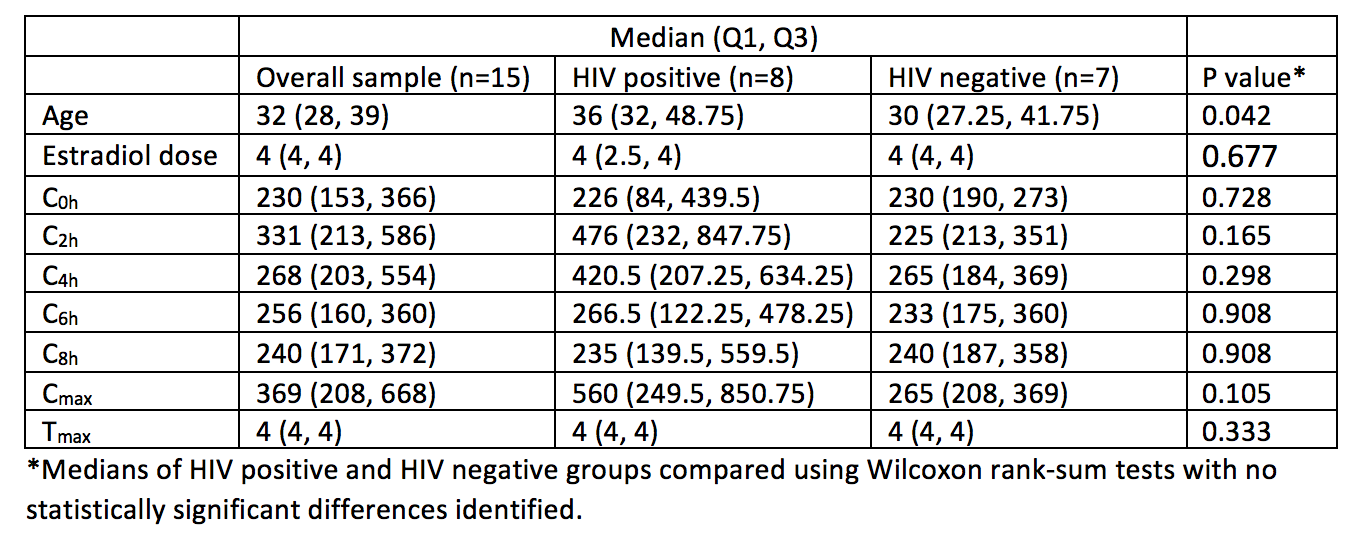
Participants (n=15) were enrolled March to August 2022 and had a median age of 32 (IQR: 28, 39); 8 participants with HIV had a median age of 36 (IQR: 32, 48.75) years compared to 30 (IQR: 27.25, 41.75) years for 7 participants without HIV (p=0.042). Among trans women with HIV, the median duration of HIV was 9.5 years (IQR: 5.0, 23.0); 6 were taking bictegravir/emtricitabine/tenofovir alafenamide and 2 were taking dolutegravir/abacavir/lamivudine. Among all participants (n=15), the median oral estradiol dose was 4 mg (range 2-6 mg). Anti-androgen therapy (some on multiple) included spironolactone (n=8), orchidectomy (n=6), central hypogonadism (n=1), and cyproterone (n=1). Three participants were taking progesterone. Participants had been taking FHT for a median of 4 years (IQR: 2, 8). Eleven (73%) participants had ideal estradiol concentrations of 200 to 735 pmol/L at C4h (75% among women with HIV and 71% among those without HIV). Table 1 summarizes oral estradiol concentrations overall and by HIV status. No statistically significant differences were identified by HIV status.
Conclusions:
In trans women on FHT, estradiol concentrations were similar between trans women on ART and trans women without HIV with a slightly higher Cmax among those with HIV. This suggests a low probability of clinically relevant drug-drug interactions between FHT and INSTI-based ART.
Table 1: Summary of oral estradiol concentrations overall and by HIV status