Background:
Ethiopia adopted the 95-95-95 UNAIDS goal for controlling HIV by 2030. The country subsequently strengthened viral load (VL) testing services and implemented interventions to improve viral load suppression (VLS) among 95% of people on antiretroviral (ARV) treatment. We present the trend of VL coverage (VLC) and VLS by age-band in the past three years.
Methods:
We used aggregate national VL data from Data for Accountability, Transparency, and Impact (DATIM) for 2019-2022. Annual trend analysis of VLC (number tested/total eligible on ART) and VLS (number suppressed/number tested) are presented. Percentage is computed to describe the trend in VLC and VLS and the absolute number of VL unsuppressed (>1,000 copies/ml) cases is also presented.
Results:
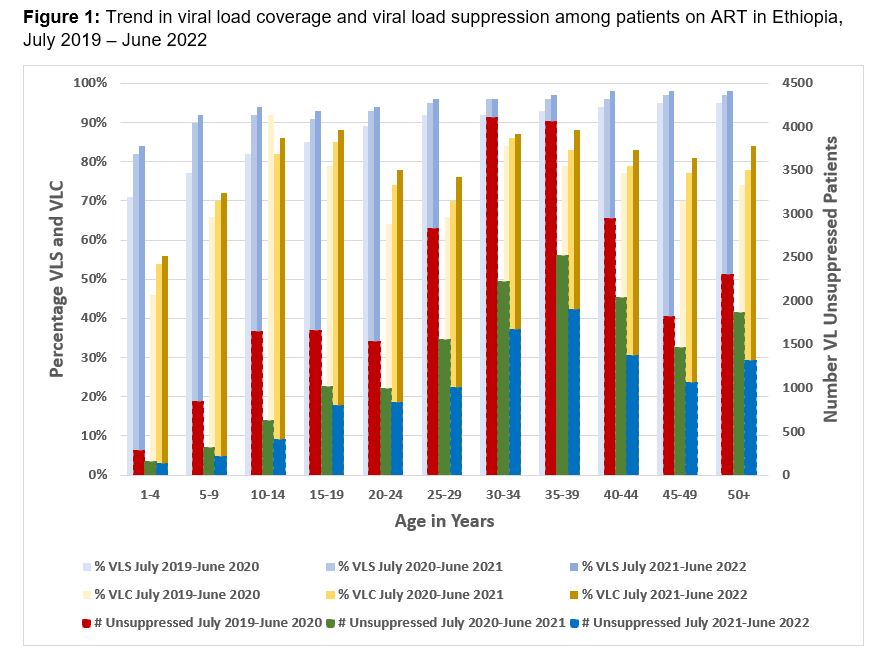
At baseline (July 2019-June 2020), the VLS in the age group 1-4 and 5-9 years was in the lowest range, 71% and 77% respectively. The highest baseline VLS (95%) was reported among the age group 45-49 and 50+. The baseline VLC was relatively lower in the age group 1-4 (46%), 5-9 (66%), 20-24 (64%) and 25-29 (66%) while the VLC in the remaining age groups at baseline was above 70%. After two years, VLS in age group 1-4 and 5-9 showed a relative improvement (84% and 92% respectively) while all other age bands beyond 25 years exceeded the 95% target. The two years result showed that VLC increased modestly among younger children: 56% and 72% for 1-4- and 5–9-year-old respectively. In July 2021- June 2022, the only adult age groups with VLC less than 80% were 20-24 and 25-29 corresponding with their relatively lower baseline result. A total of 24,042 unsuppressed cases were reported in July 2019-June 2020 most of which (88.4%) were in the adult age group above 15 years of age. The number of unsuppressed patients significantly reduced over the three years in all age groups and reached at 10,739 in July 2021-June 2022 (reduced by 55.3% from the baseline) and the adult proportion was 92.9% with relative increase from the baseline.
Conclusions:
Ethiopia is on track in achieving the UNAIDS third 95 target within all age groups in 2030 provided the VLS performance gap among younger children is addressed. Improving VLC among children and young adults is beneficial to distinctly understand their VL suppression status. Understanding the root causes of low VLC and VLS among children on ART and devising targeted interventions is very important. The progressive reduction in the absolute number of unsuppressed cases is an encouraging result.
Trend in viral load coverage and viral load suppression among patients on ART in Ethiopia, July 2019 – June 2022