Background:
Clinical impact of anticholinergic (AC) burden in people with HIV (PWH) and how to routinely detect it in clinical practice have been poorly investigated. We assessed the screening effectiveness of 3 AC scales in detecting AC symptoms and their clinical correlates in our cohort.
Methods:
This cross-sectional analysis enrolled adult PWH who attended the Infectious Disease Unit of Padua Hospital (Italy) for their clinical checks (November 2021-March 2022). The AC burden scale (ABS), AC risk score (ARS), and AC drug score (ADS) were calculated. We recorded clinical data, comedications and the presence of 17 AC signs/symptoms over the last 3 month. High AC risk was defined by validated cut-offs: ABS score≥2, ARS, and ADS score≥3. Nonparametric tests and logistic regression were used; screening effectiveness of the three AC scales was assessed by the Area Under the Receiver Operating Characteristic curve (AUROC).
Results:
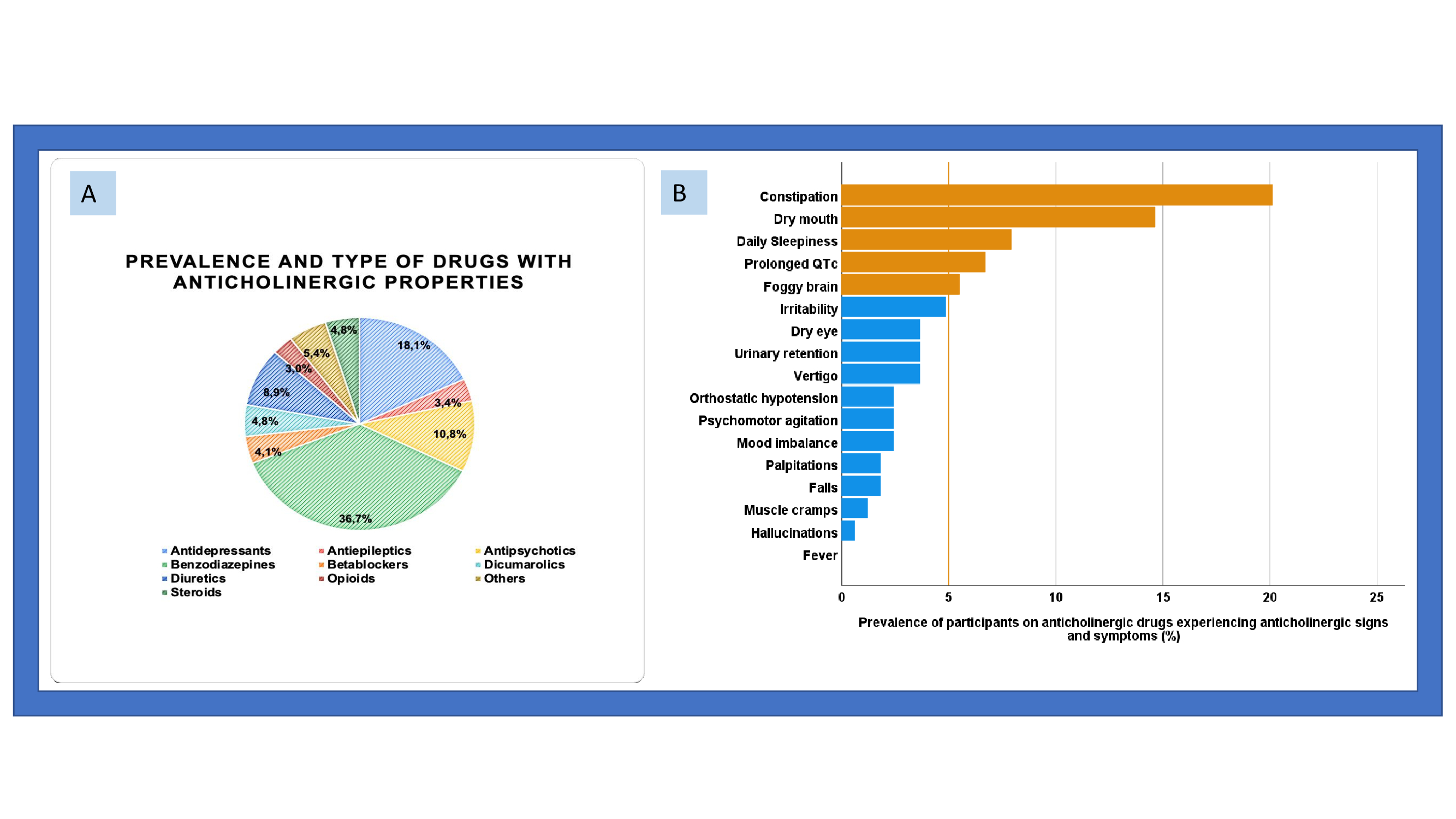
We included 721 participants (median age 53 years, 72.0% males). Polypharmacy was present in 21.1% and 164 PWH (22.7%) were at least on 1 drug with AC properties (drug prevalence/type in Fig.1A). 4.4% PWH were classified as high AC risk by at least 1 scale (1.1%, 3.5% and 3.1% according to ARS, ABS, and ADS, respectively). Agreement between ARS and the other scales was poor (Cohen’s k 0.33 and 0.22) and moderate between ABS and ADS (k 0.60). Among PWH on AC drugs, 28.6% experienced at least 1 AC sign/symptom (prevalence/type in Fig.1B). After adjusting for univariate significant variables, factors independently associated with AC signs/symptoms were the type of antiretroviral regimen (aOR 15.2 and 32.0 for triple INSTI- and NN-based regimen vs. dual therapy, p=0.024 and 0.009; aOR 82.6 for triple protease inhibitors-based vs. dual therapy, p=0.082) and the overall number of AC drugs (aOR 9.7, p< 0.001). AUROC of ARS, ABS and ADS were 0.73 [0.63-0.82], 0.85 [0.78-0.92], and 0.84 [0.75-0.92], respectively (p< 0.001 for all). Nevertheless, at the cut-offs established for the general population the correct classification rate (78.0%, 82.9% and 84.8%) was affected by low sensitivity (34.0%, 46.8% and 46.8%).
Conclusions:
AC drug use affected almost 1 out of 4 PWH in our cohort and the risk of developing AC manifestations was correlated both with the type of antiretroviral regimen and the number of drugs with AC properties. Current scales for screening AC risk in the general population showed promising use even in PWH but may require a tailored reassessment of the best cut-off.
Figure 1. Prevalence of drugs with AC properties and signs/symptoms detected in our population.