Background:
COVID-19 vaccine booster uptake remains low and preventable COVID-19 deaths continue to occur, making access to oral antivirals for those most at risk of severe COVID-19 outcomes essential.
Methods:
We estimated age and gender adjusted prevalence ratios of oral nirmatrelvir-ritonavir (NMV/r) uptake by sociodemographics, clinical characteristics, and prescription eligibility (based on age, underlying medical conditions, body mass index, physical inactivity, pregnancy, or smokers), among participants in a large U.S. national prospective cohort who were infected with SARS-CoV-2 between December 2021 and October 2022. Among participants who reported NMV/r uptake, we also described the proportion who reported (1) taking NMV/r as directed and (2) NMV/r was helpful for reducing COVID-19 symptoms.
Results:
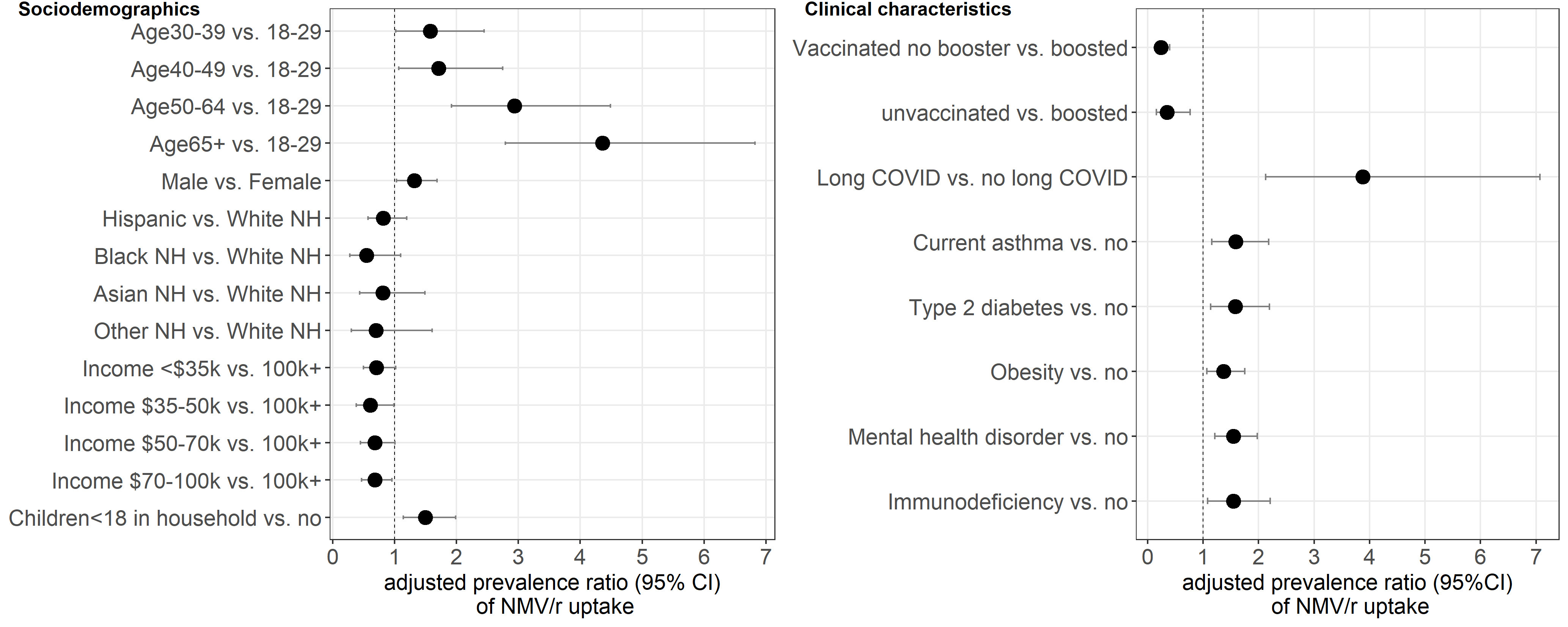
Among 1,594 participants with a SARS-CoV-2 infection as of October 2022, 1,356 were eligible for NMV/r prescription; of whom 209 (15.4% [95%CI:13.5–17.3]) reported receiving NMV/r. NMV/r uptake increased from 2.2% (95%CI:1.0–3.4) between December 2021 and March 2022 to 16.5% (95% CI:13.0–20.0) between April and July 2022 and 28.6% (95%CI:24.4–32.8) between August and October 2022, respectively. Participants ≥65 years of age reported the highest uptake of NMV/r (30.2% [95%CI:22.2–38.2]). Black non-Hispanic participants (7.2% [95%CI:2.4–12.0]) and those in the lowest income group (10.6% [95%CI:7.3–13.8]) had lower uptake than white non-Hispanic (15.8% [95%CI:13.6–18.0]) and high-income individuals (18.4% [95%CI:15.2–21.7]), respectively. Participants with type 2 diabetes had greater uptake (28.8% [95%CI:20.4–37.3]), compared to those without it (12.4% [95%CI:4.8-20.0]). Among a subset of 278 participants who had a prior SARS-CoV-2 infection, those who had a history of long COVID reported greater uptake (22.0% [95%CI:13.9–30.1]) for a subsequent SARS-CoV-2 infection than those without a history of long COVID (7.9% [95%CI:3.9–11.8]). Among all participants who were prescribed NMV/r (Nf216), 89% (95%CI:85–93) reported that they took NMV/r as directed and 63% (95%CI:57–70) stated NMV/r was helpful for reducing COVID-19 symptoms.
Conclusions:
Uptake of NMV/r increased over time coinciding with national efforts to increase awareness and access. However, most individuals who were eligible for NMV/r did not receive it. Lower NMV/r uptake among racial/ethnic minorities and individuals with lower household income suggests a need to improve awareness and address barriers to uptake in these populations.
Adjusted Prevalence Ratios of Nirmatrelvir-Ritonavir (NMV/r ) Uptake by Sociodemographic and Clinical Factors – United States CHASING COVID Cohort Study Participants with SARS-CoV-2 Infection, December 2021-October 2022